The landscape of Indonesian cinema is preparing for one of its most emotionally resonant and politically significant releases with the upcoming arrival of Laut Bercerita, a feature-length dramatic adaptation of Leila S. Chudori’s critically acclaimed 2017 novel of the same name. Produced by Pal8 Pictures and directed by acclaimed filmmaker Yosep Anggi Noen, the movie is officially slated to hit theaters nationwide on October 29, 2026. This release date has been deliberately chosen to coincide with the commemoration of Indonesia’s Youth Pledge Day, or Hari Sumpah Pemuda, which falls annually on October 28. Through this strategic timing, the production team aims to honor the historical courage and intellectual vigor of the nation’s youth, framing the cinematic work not merely as entertainment, but as a poignant reflection on activism, sacrifice, and the enduring quest for democratic freedoms.
With a substantial runtime of 2 hours and 15 minutes (135 minutes), Laut Bercerita brings to visual life the turbulent socio-political climate of late 1990s Yogyakarta. The narrative explores a critical era in modern Indonesian history defined by widespread student resistance, intense political oppression, and the severe curtailment of freedom of expression. By anchoring its core narrative in the personal tragedies and collective struggles of young activists, the film bridges historical memory with contemporary storytelling, offering modern audiences a sobering reminder of the high human cost associated with the fight for civil liberties and democratic reform.
Comprehensive Synopsis and Narrative Arc
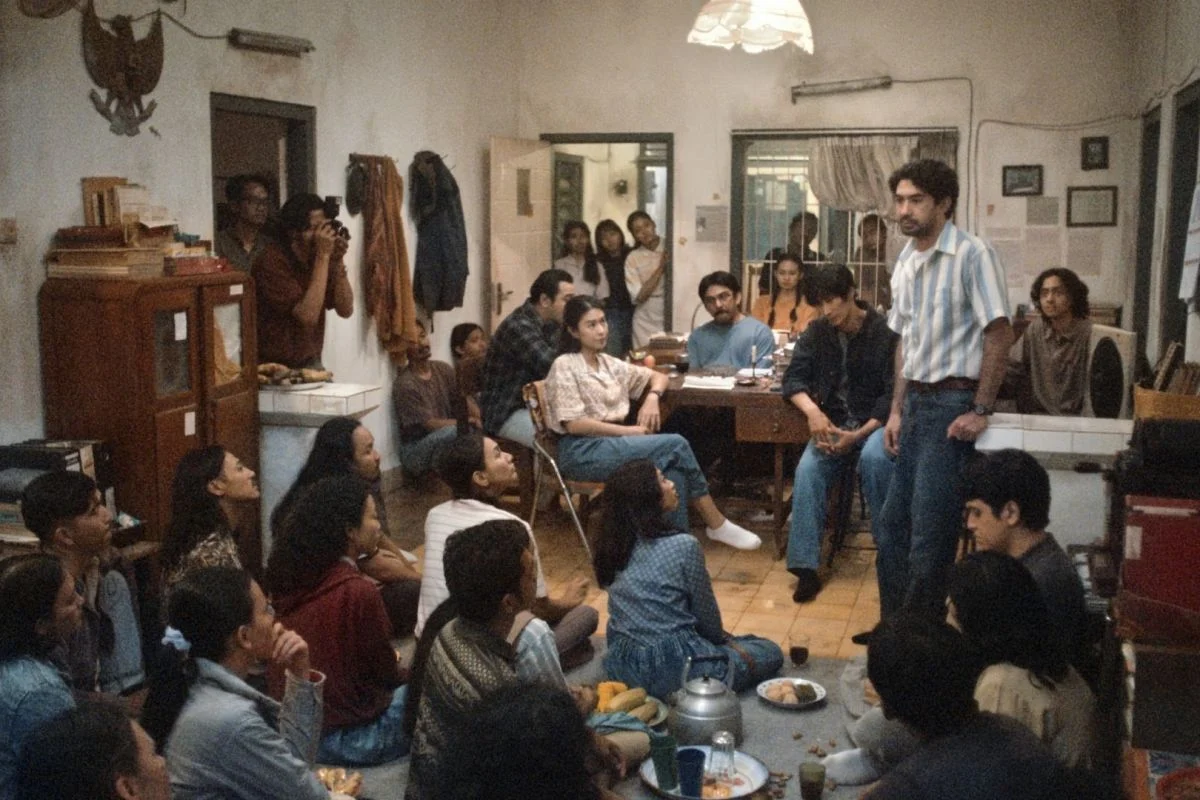
The film centers primarily on the character of Biru Laut, portrayed by award-winning actor Reza Rahadian, a university student in Yogyakarta whose deep intellectual curiosity drives him toward extensive reading, writing, and political discourse. Alongside a close-knit circle of like-minded peers—including Daniel (Kevin Julio), Alex (Ben Nugroho), and Sunu (Dewa Dayana)—Laut becomes a foundational member of a clandestine study and advocacy group known as Winatra. For these young intellectuals, the simple act of reading banned literature, hosting underground discussions, and articulating critical perspectives constitutes a vital moral obligation in the face of systemic injustice and state authoritarianism.
However, the political atmosphere deteriorates rapidly following the high-profile arrest of three student activists accused of distributing prohibited books. This crackdown injects profound peril into the daily operations of the Winatra group. Despite the escalating dangers and the constant threat of surveillance, Laut and his companions refuse to silence their convictions, maintaining their commitment to public advocacy and intellectual freedom.
The central turning point of the narrative occurs on a fateful night when Biru Laut and several of his closest colleagues mysteriously vanish without a trace. Their sudden disappearance shatters the lives of their families, plunging them into an agonizing vacuum of uncertainty. The second half of the cinematic adaptation shifts its emotional weight toward the families left behind, specifically focusing on Bapak (Arswendy Bening Swara), Ibu (Christine Hakim), and Laut’s younger sister, Asmara Jati (Yunita Siregar).
Years after the disappearance, Asmara spearheads a tireless campaign alongside former colleagues and friends of her brother to uncover the truth behind the abductions. This multi-year investigation transcends a simple missing persons search; it becomes a grueling crusade for legal closure, historical accountability, and the fundamental right to know the fate of their loved ones. Through this intergenerational lens, Laut Bercerita examines themes of enduring grief, romantic devotion, ideological betrayal, physical violence, and the psychological torment of unresolved loss.
Star-Studded Ensemble Cast and Character Portrayals
Bringing Leila S. Chudori’s deeply beloved literary figures to the screen required an exceptional ensemble of Indonesia’s most accomplished dramatic actors. Headlined by Reza Rahadian in the demanding lead role of Biru Laut, the production features a high-caliber roster that guarantees profound emotional depth and authenticity.
The supporting cast is anchored by industry veterans and versatile performers, including Christine Hakim and Arswendy Bening Swara as the grieving parents, whose portrayals capture the agonizing burden of parental loss during a dark political era. Yunita Siregar takes on the crucial role of Asmara Jati, serving as the narrative’s steadfast moral compass and driving investigative force. Furthermore, the ensemble is strengthened by the inclusion of cinematic luminaries Dian Sastrowardoyo and Eva Celia, alongside Kevin Julio, Ben Nugroho, and Dewa Dayana.
The casting process focused heavily on matching the psychological complexity of the novel’s characters. According to lead actor Reza Rahadian, the transition from page to screen maintained strict fidelity to the original characterizations, utilizing both Chudori’s source text and the adapted screenplay as exhaustive blueprints for character development.
The Creative Process of Adapting a Literary Masterpiece
Adapting a widely read and deeply revered contemporary novel into a feature film presents unique structural and artistic challenges. Published initially in 2017, Leila S. Chudori’s novel Laut Bercerita achieved massive commercial and critical success, resonating deeply with readers across generations who sought to understand the human realities of the 1998 Reformasi movement and the preceding years of political disappearances.
To translate this sprawling literary work into a structured 135-minute cinematic experience, author Leila S. Chudori collaborated directly with director Yosep Anggi Noen on the screenwriting process. In interviews discussing the adaptation, Chudori noted that the translation from text to visual medium inevitably necessitated editorial pruning. Certain narrative subplots, minor characters, and descriptive passages from the book had to be omitted or condensed due to strict runtime limitations, even though the creative team deeply valued those elements.
Director Yosep Anggi Noen, known for his distinct artistic vision and sensitive handling of socio-political themes in independent and mainstream cinema, worked meticulously to balance the poetic nature of Chudori’s prose with the kinetic demands of visual storytelling. By blending atmospheric cinematography, rigorous historical art direction, and grounded naturalistic performances, Noen sought to recreate the claustrophobic and tense environment of late-90s Indonesia without reducing the narrative to mere historical exposition.
Socio-Political Background and Historical Context
To fully appreciate the narrative gravity of Laut Bercerita, audiences must understand the historical backdrop of Indonesia during the late 1990s. This era was characterized by the final, highly volatile years of President Suharto’s New Order regime—a period marked by strict press censorship, the criminalization of dissident political thought, systematic human rights abuses, and the suppression of student movements.
Universities served as epicenters of intellectual resistance, where young students organized underground reading circles, clandestine publications, and public demonstrations demanding democratic transparency, economic reform, and freedom of speech. Activists operating within this environment faced severe risks, including arbitrary detention, interrogation, physical intimidation, and, in the most tragic cases, forced disappearances by state security apparatuses.
The novel and its cinematic adaptation draw heavily on the documented real-life accounts of activists who were abducted in the months leading up to the fall of the Suharto government in May 1998—some of whom eventually returned to tell their stories, while others remain missing to this day. By foregrounding these historical traumas, Laut Bercerita functions as a vital cultural archive, ensuring that the sacrifices made by a generation of young Indonesians are neither forgotten nor trivialized by contemporary society.
Broader Implications and Cultural Significance
The release of Laut Bercerita in October 2026 carries significant cultural and socio-political implications for the contemporary Indonesian film industry. In recent years, domestic cinema has experienced a resurgence in historical dramas and literary adaptations that engage directly with complex national traumas. However, projects that explicitly address human rights violations and state-sponsored violence of the New Order era remain relatively rare within mainstream commercial distribution.
Industry analysts suggest that the backing of Pal8 Pictures and the involvement of prominent commercial actors like Reza Rahadian and Dian Sastrowardoyo will ensure widespread commercial visibility, allowing important historical discussions to reach mainstream audiences, particularly younger demographics who may possess limited first-hand knowledge of the pre-Reformasi era.
By tying the premiere date to Youth Pledge Day, the producers have intentionally positioned the film as a catalyst for national dialogue regarding the fragility of democracy, the importance of historical memory, and the civic responsibilities of contemporary youth. As societal debates surrounding freedom of expression, state accountability, and historical transparency continue to evolve in modern Indonesia, Laut Bercerita arrives not merely as a cinematic milestone, but as a timely artistic testament to the enduring human capacity to resist oppression and demand justice against insurmountable odds.