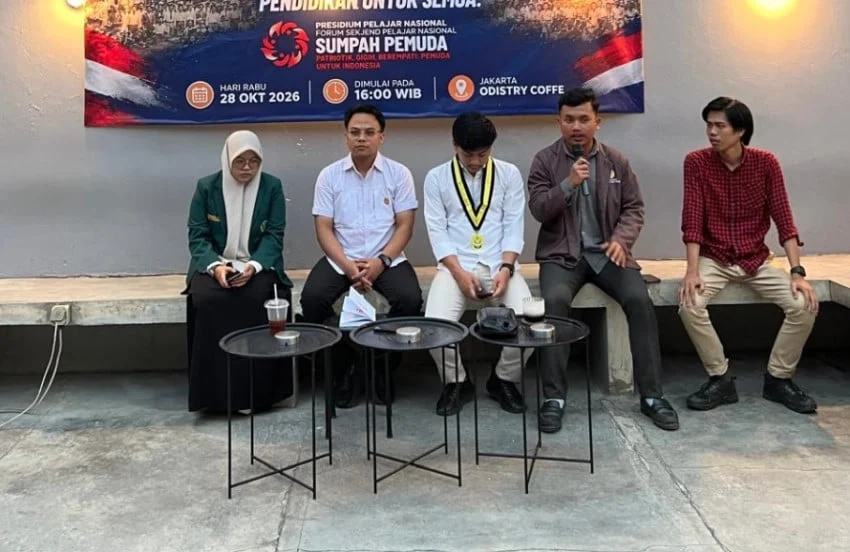
In commemoration of the 98th anniversary of the Youth Pledge, the Presidium Pelajar Nasional (PPN) has issued a nationwide call for Indonesian youth to prioritize national unity and maintain sportsmanship in the face of increasingly polarized societal discourse. As the nation reflects on the historic momentum of October 28, 1928, the PPN leadership emphasizes that the spirit of Sumpah Pemuda must evolve from a ceremonial remembrance into an active framework for solidarity and collective national progress.
The call to action comes at a critical juncture in Indonesia’s sociopolitical landscape, where digital platforms and globalized information flows have introduced new complexities to the concept of national identity. By fostering an environment of critical thinking and collaborative dialogue, the PPN seeks to position students not merely as beneficiaries of national development, but as active architects of the country’s future trajectory.
Historical Context: The 1928 Milestone
To understand the weight of the PPN’s appeal, one must look back to the Second Youth Congress held in Batavia (now Jakarta) on October 28, 1928. At that time, young representatives from various regional youth organizations—such as Jong Java, Jong Sumatranen Bond, and Jong Celebes—overcame deep-seated regional loyalties to forge a unified national identity. The resulting pledge was a bold defiance of colonial efforts to keep the archipelago fragmented along ethnic and linguistic lines.
The 1928 pledge—One Motherland, One Nation, and One Language—remains the bedrock of Indonesia’s modern statehood. It proved that diversity, often seen as a potential fault line, could be synthesized into a singular force for independence. Today, the PPN argues that the challenge is no longer colonial division, but rather the internal friction caused by ideological echo chambers and partisan politics that threaten to erode the cohesive fabric of the younger generation.
The Modern Imperative: Sportsmanship and Unity
Reza Firdaus, Coordinator of the Presidium Pelajar Nasional, emphasized during the commemoration on Wednesday, October 28, 2026, that unity does not equate to the erasure of individuality or intellectual diversity. "True unity is the willingness to place the national interest above the ego of groups, organizations, or political preferences," Firdaus stated.
The PPN’s emphasis on "sportsmanship" is particularly noteworthy. In the context of student movements and youth activism, sportsmanship refers to the capacity to engage in fierce intellectual debate while maintaining mutual respect for opponents. This approach is intended to mitigate the "us-versus-them" mentality that often characterizes contemporary discourse on social media and within academic environments. By advocating for a culture of fair play in ideas, the PPN hopes to bridge the divide between students of varying religious, ethnic, and organizational backgrounds.
Demographic Data and the Role of Youth
The urgency of the PPN’s message is underscored by demographic data. Indonesia is currently experiencing a "demographic bonus," where the working-age population significantly outnumbers the dependent population. According to projections from the Central Statistics Agency (BPS), the youth demographic (aged 16–30) constitutes nearly a quarter of the total population.
This demographic weight gives students and young professionals immense potential to influence policy, economic development, and social standards. However, this potential is contingent upon social stability. Research from the Indonesian Institute of Sciences (LIPI) has previously indicated that while youth engagement in civic life is increasing, there is a marked trend toward political apathy among students who feel that institutional politics do not serve their interests. The PPN aims to counter this by creating institutional spaces where students can participate in constructive policy advocacy, such as expanding access to education and addressing digital literacy.
Chronology of the 2026 Sumpah Pemuda Commemorations
The commemorative activities organized by the PPN followed a structured approach to bridge historical reflection with future-oriented goals:
- October 25, 2026: Pre-commemorative discussions were held across major urban centers, focusing on the historical legacy of the 1928 Youth Congress and its relevance to the current digital era.
- October 27, 2026: A series of collaborative workshops were conducted to facilitate dialogue between student organizations from different regional backgrounds, aiming to dismantle stereotypes and encourage cross-regional networking.
- October 28, 2026: The official ceremony, marked by the release of the PPN manifesto on national unity and youth sportsmanship. The day concluded with a student-led forum on educational equity.
Policy Implications and Structural Challenges
The PPN’s vision for the future of Indonesian youth is not limited to social harmony; it extends to a critique of how students are treated within the state apparatus. A recurring point of contention is the tendency for policymakers to treat students as passive recipients of national programs rather than active stakeholders.
By demanding "equal space to grow, learn, and contribute," the PPN is advocating for a shift in governance. This includes:
- Academic Freedom: Ensuring that campuses remain spaces for critical inquiry without the threat of administrative or external intimidation.
- Policy Consultation: Integrating youth perspectives into national policy-making, particularly regarding the job market, technology integration, and climate change resilience.
- Institutional Inclusion: Encouraging a more representative structure in student councils that reflects the diverse geographic and socioeconomic makeup of the country.
Analysis: Bridging the Digital Divide
The digital age presents a double-edged sword for the PPN’s mission. While the internet allows for rapid organization and the dissemination of the "Unity in Diversity" (Bhinneka Tunggal Ika) message, it also enables the spread of misinformation that can lead to rapid polarization.
Independent analysis suggests that the PPN’s focus on "sportsmanship" is a strategic response to the rise of "keyboard warriors" who prioritize viral outrage over substantive discussion. By moving the focus from digital skirmishes to in-person, structured dialogue, the PPN is attempting to rebuild the social capital that was arguably weakened by the isolation of the mid-2020s.
If the PPN succeeds in fostering a culture where diverse student organizations can collaborate on shared goals—such as the improvement of national education standards—it could set a precedent for broader civil society. The stability of a democracy often depends on the ability of its younger citizens to resolve disagreements through established institutional channels rather than through inflammatory rhetoric.
Official Responses and Future Outlook
While government reactions to the PPN’s specific statements remain pending, the Ministry of Education and Culture has historically encouraged student participation in national development. Independent education analysts note that the PPN’s proactive stance provides a necessary counter-narrative to the perception of youth as a demographic susceptible to radicalization or extreme partisan bias.
Looking forward, the PPN plans to sustain this momentum by formalizing a "National Student Compact," a document intended to outline the basic principles of cooperation between different student bodies. This document will serve as a foundational agreement, ensuring that regardless of political shifts, the core commitment to national unity remains intact.
As the nation moves toward the end of 2026, the PPN’s message serves as a reminder that the Sumpah Pemuda is a living entity. It is not merely a memory preserved in textbooks, but a dynamic contract that requires constant renewal by each generation. By emphasizing sportsmanship, critical thinking, and the prioritization of the national interest over group ego, the PPN is attempting to ensure that the promise made in 1928 continues to hold for the many decades to come.
The success of this initiative will ultimately be measured by the ability of these student leaders to turn their rhetoric into tangible policy influence. As they continue to navigate the complexities of a modern, interconnected Indonesia, their call for unity stands as a vital touchstone for the country’s democratic health. In the final analysis, the PPN’s message is clear: the strength of the nation lies in its ability to remain cohesive, not in spite of its differences, but because of its commitment to a shared, inclusive future.