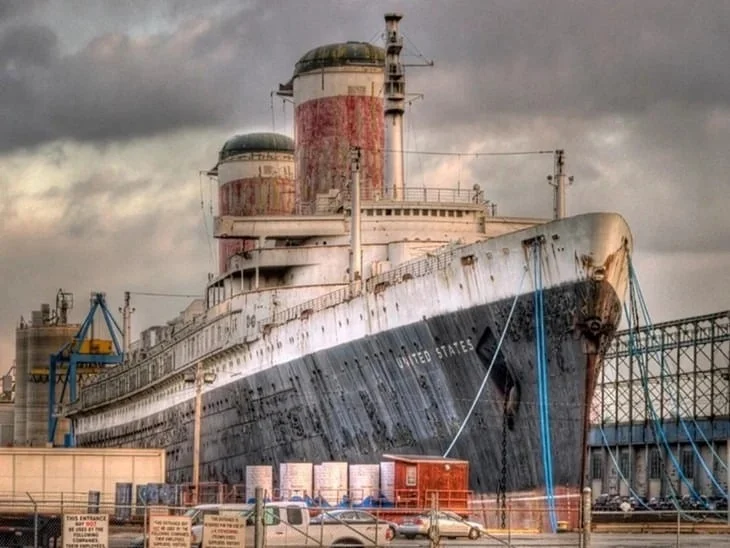
A Legacy of Speed and Diplomacy
Launched in 1952, the SS United States was more than just a luxury liner; it was a marvel of mid-century engineering. Designed by naval architect William Francis Gibbs, the ship was constructed with a dual purpose: to provide unparalleled transatlantic travel and to serve as a high-speed troop transport in the event of a national emergency. Its hull, composed of lightweight aluminum, allowed it to achieve speeds that remain unmatched by passenger liners to this day.
During its prime, the SS United States served as a preferred mode of transport for the American political elite. Presidents Harry S. Truman, Dwight D. Eisenhower, and John F. Kennedy were among those who graced its decks. The ship represented the pinnacle of American industrial power, symbolizing a post-war era where the United States dominated both the seas and the geopolitical landscape. However, as the jet age dawned in the 1960s, the economic viability of ocean liners plummeted, leading to the ship’s decommissioning in 1969. Since then, the vessel has remained a subject of intense preservation efforts, languishing at various piers while enthusiasts fought to save the "Big U" from the scrapyard.
The Logistics of a Massive Submersion
The decision to scuttle the SS United States was not reached lightly. After years of failed restoration attempts and mounting docking fees, the Okaloosa County authorities stepped in with a definitive plan. The ship is slated to be towed to a site approximately 40.7 kilometers (25.3 miles) southwest of Destin-Fort Walton Beach, Florida.
The process of turning a ship into an artificial reef is highly regulated. Before the vessel reaches the seafloor, it must undergo extensive environmental remediation. This includes the removal of all hazardous materials, such as asbestos, fuel, oils, and non-biodegradable plastics, to ensure that the sinking does not introduce toxins into the marine environment. The Environmental Protection Agency (EPA) mandates stringent standards for such projects, ensuring that the ship is "clean" before it touches the seabed.
Once the hull is prepared and towed to the designated coordinates, the scuttling process involves opening sea valves to allow controlled flooding. The goal is for the vessel to settle upright, providing a stable, vertical structure that can withstand the currents of the Gulf of Mexico.
Chronology of the SS United States
- 1952: The SS United States makes its maiden voyage, capturing the Blue Riband with a record speed of 35.59 knots.
- 1969: The vessel is officially withdrawn from service due to the rise of commercial air travel.
- 1970s–1990s: The ship passes through various owners, including the U.S. Maritime Administration, with several failed attempts to return it to service or convert it into a floating hotel.
- 2011: The SS United States Conservancy acquires the ship, beginning a decades-long struggle to secure funding for its preservation.
- 2024: Following the exhaustion of preservation options and legal disputes over docking, Okaloosa County, Florida, finalizes plans to purchase the vessel for conversion into an artificial reef.
The Science of Artificial Reefs
The transformation of the SS United States into an artificial reef is part of a broader, successful initiative in the Florida Panhandle. Okaloosa County has previously scuttled over 12 other large vessels to stimulate marine life. Scientific data regarding these projects consistently show that artificial reefs act as "oases" in the desert-like, sandy bottoms of the Gulf.
When a large metal structure is placed on the seafloor, it immediately attracts marine organisms. Within weeks, algae and barnacles begin to colonize the surface. This "bio-fouling" provides the foundation for a complex food web. Smaller fish congregate to feed on the algae and invertebrates, which in turn attract larger predatory species such as snapper, grouper, and various pelagic fish.
The SS United States, with its immense size and multi-deck structure, offers a unique opportunity for marine biologists. The ship’s internal corridors and expansive cargo holds will provide shelter for a vast array of species, effectively acting as an underwater apartment complex. The vertical relief provided by the ship’s superstructure is particularly beneficial, as it forces nutrient-rich currents upward, further encouraging the growth of soft corals and sponges.
Economic and Environmental Impact
For the community of Destin-Fort Walton Beach, the project is a significant investment in both ecology and the local economy. Artificial reefs are proven drivers of "blue tourism." Divers and recreational anglers are drawn to these sites, providing a steady stream of revenue for local businesses. The Florida Fish and Wildlife Conservation Commission (FWC) has noted that artificial reefs reduce the pressure on natural coral reefs, which are increasingly vulnerable to climate change and human interference.
However, the implications go beyond economics. By creating a protected habitat, the project contributes to the restoration of marine biomass. Studies conducted on existing reefs in the Gulf suggest that these man-made structures can increase the survival rate of juvenile fish by providing critical nursery grounds. As global fish stocks face pressure from overfishing, the creation of these "no-take" or managed zones around artificial reefs acts as a vital insurance policy for biodiversity.
Official Responses and Public Sentiment
The move has drawn mixed reactions from the maritime community. While preservationists lament the loss of a historic icon, many marine conservationists have lauded the initiative.
"The ship was reaching a state of terminal disrepair," said a spokesperson for the local environmental task force overseeing the project. "We had to choose between letting the ship slowly disintegrate at a pier, where it provided no benefit to anyone, or giving it a second life as a cornerstone of the Gulf’s marine ecosystem. We believe this is the most honorable way to retire a vessel of this stature."
The SS United States Conservancy, while disappointed that a static museum restoration was not achieved, acknowledged that the sinking ensures the ship remains a part of American history rather than being broken up for scrap metal. The ship will, in effect, become a permanent, underwater monument.
Broader Implications for Maritime Preservation
The fate of the SS United States highlights the ongoing tension between historic preservation and the realities of maintenance costs. Preserving a ship of this scale requires millions of dollars in annual upkeep, a burden that few non-profit organizations can sustain indefinitely.
As the world’s maritime heritage ages, the model being pioneered in Florida may become a blueprint for other nations. Instead of simply sending decommissioned ships to scrapyards—a process that often carries significant environmental risks in developing nations—nations can opt for "reef-ing." This provides a controlled end-of-life process that actively improves the environment.
The sinking of the SS United States will be a historic event in its own right. It will serve as a reminder of the industrial ingenuity of the 20th century while simultaneously looking toward the biological necessities of the 21st. As the ship descends to the floor of the Gulf of Mexico, it will transition from a symbol of American speed to a sanctuary of marine life, ensuring that its legacy persists for centuries to come, albeit in a form its original designers never could have imagined.
Ultimately, the transformation of the SS United States serves as a case study in circular economy principles applied to large-scale infrastructure. By repurposing the steel hull, the project prevents the carbon-intensive process of smelting and recycling, while simultaneously creating an asset that will provide ecological services for decades. The project stands as a testament to the fact that even the most static relics of the past can be reimagined to support the future of the planet’s oceans.