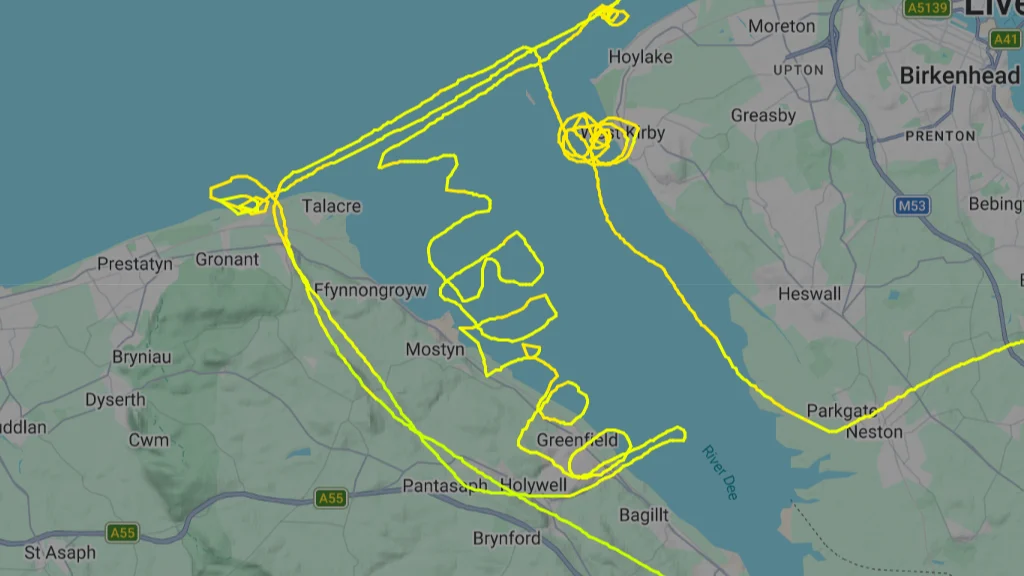
A flight instructor operating out of Liverpool has captured international attention after utilizing a routine test flight to etch a literal message of his mental state into the digital atmosphere. The pilot, an employee of the aviation company Ravenair, spent a two-hour sortie on Saturday, July 18, 2026, navigating a Piper Tomahawk across the skies of the Wirral Peninsula, Cheshire, and North Wales. While the aircraft appeared to be performing standard maneuvers to the naked eye from the ground, digital flight tracking software revealed a much more whimsical intent: the pilot had meticulously traced the words "I’m Bored" across the flight path.
The unconventional flight pattern was first flagged by aviation enthusiasts monitoring Flightradar24, a global flight tracking service that provides real-time information about thousands of aircraft around the world. The data revealed that the small, single-engine aircraft departed from Liverpool and proceeded to engage in a series of sharp, calculated turns over the Dee Estuary and surrounding regions to spell out the message in block letters. The incident has since sparked a conversation regarding the nature of pilot training, the monotony of maintenance flights, and the growing trend of "GPS art" in the aviation industry.
The Chronology of the Flight
The mission began as a standard maintenance or "test flight," a routine procedure in the aviation industry used to ensure that an aircraft is functioning correctly after repairs or periods of inactivity. The aircraft, a Piper PA-38-112 Tomahawk—a model widely used for flight training—took off from its base in Merseyside on Saturday morning.
According to flight tracking data, the journey commenced at approximately 11:30 AM local time. Initially, the aircraft followed a standard departure route, heading south toward the Wirral Peninsula. For the first portion of the flight, the pilot maintained a steady altitude and heading, consistent with a typical check of the aircraft’s primary systems. However, as the aircraft reached the airspace above the Dee Estuary—a large area of tidal sands between the Wirral and North Wales—the flight path took a creative turn.
Between 12:00 PM and 12:40 PM, the pilot engaged in the most technical portion of the flight. Operating at a consistent altitude to ensure the "writing" remained legible on a two-dimensional map, the pilot began maneuvering the Tomahawk to spell out the letters. The "I" was followed by an apostrophe and an "M," followed by a large, clear "BORED." Each letter required precise timing and specific degrees of bank to ensure the lines were straight and the curves were uniform.
By 1:00 PM, the message was complete. The pilot then transitioned back to a standard navigational path, circling briefly over parts of North Wales and Cheshire before heading back toward the Mersey. The aircraft touched down at its home base at approximately 1:30 PM, concluding a flight that lasted exactly two hours.
Technical Execution and the Piper Tomahawk
The choice of aircraft for this particular stunt was significant. The Piper Tomahawk is a two-seat, fixed tricycle gear general aviation airplane. It was designed specifically as a trainer, known for its responsiveness and, at times, its challenging stall characteristics, which earn it the nickname "Traumahawk" among some student pilots. Because of its light weight and agility, it is an ideal platform for the tight turns required to "draw" in the sky.
Executing GPS art in a light aircraft is not as simple as it might appear. It requires a high level of situational awareness and mastery of the aircraft’s navigation systems. To spell out "I’m Bored" legibly, the pilot would have needed to use a combination of GPS waypoints and manual stick-and-rudder coordination. Each letter must be scaled appropriately so that it is visible on flight tracking software like Flightradar24 or FlightAware, which aggregate ADS-B (Automatic Dependent Surveillance-Broadcast) signals transmitted by the aircraft.
Aviation experts note that while the pilot claimed to be "bored," the act of spelling out a message actually requires more concentration than a standard straight-and-level flight. The pilot must account for wind drift, which can "smear" the letters if not properly compensated for, and must ensure they do not infringe upon restricted airspace or interfere with the flight paths of commercial airliners entering and exiting major hubs like Manchester or Liverpool John Lennon Airport.
Official Response from Ravenair Management
In the aftermath of the flight, Ravenair, the flight school and aviation services company based at Liverpool John Lennon Airport, addressed the viral nature of the incident. Wayne Barrett, the operations manager at Ravenair, provided a lighthearted yet professional perspective on the instructor’s actions.
"I think the pilot was indeed a little bit bored because it was just a test flight," Barrett remarked in an interview following the event. He was quick to point out, however, that the "boredom" did not equate to a lack of professionalism or skill. "It was quite a skillful flight. He was a bit bored, but perhaps he had to concentrate quite a lot at the end to spell those words out, so maybe he wasn’t bored at all by the time he finished."
Barrett confirmed that the pilot was a qualified flight instructor and that the maneuvers performed did not violate any safety protocols. Test flights are often used to "burn time" to reach certain maintenance intervals or to ensure that engines are running smoothly under various load conditions. As long as the pilot remains within the designated practice areas and maintains communication with Air Traffic Control (ATC), the specific pattern they fly is largely at their discretion.
Ravenair management indicated that the pilot would not face disciplinary action for the stunt. "He’s a bit of a joker," Barrett added, noting that the pilot was currently on a scheduled break and the aircraft had been returned to the hangar in perfect working order.
The Rise of Sky Art in Modern Aviation
This incident is part of a growing global trend where pilots use the sky as a digital canvas. As flight tracking technology has become accessible to the general public via smartphone apps, the "audience" for a flight path has expanded from just air traffic controllers to millions of aviation enthusiasts worldwide.
In recent years, there have been several notable examples of flight path art:
- COVID-19 Tributes: During the 2020 pandemic, several pilots across Europe and North America traced "NHS" or "Stay Home" to show support for healthcare workers.
- Holiday Greetings: Pilots frequently draw Christmas trees, reindeer, or hearts on Valentine’s Day.
- Product Launches: Some commercial entities have used test flights of new aircraft, such as Boeing or Airbus, to draw the company logo or the silhouette of the aircraft itself over entire continents.
While some critics argue that such maneuvers are a waste of fuel or an unnecessary distraction, the aviation community generally views them as a display of precision and a way to break the monotony of long-duration test flights. In the case of the Ravenair instructor, the message "I’m Bored" served as a humorous meta-commentary on the nature of the task at hand.
Safety and Regulatory Implications
From a regulatory standpoint, the Civil Aviation Authority (CAA) in the United Kingdom maintains strict guidelines regarding flight safety, but there are no specific rules forbidding "drawing" in the sky, provided the pilot adheres to Standardized European Rules of the Air (SERA).
The primary concerns for any pilot attempting such a feat include:
- Airspace Infringement: The Wirral and Cheshire areas are close to the controlled airspace of Manchester and Liverpool airports. The pilot had to ensure that the "B" and the "D" in his message did not stray into zones where commercial traffic is prioritized.
- Fuel Management: "Sky art" often involves more turns and throttle changes than a standard cruise, which can increase fuel consumption. A pilot must ensure that their creative endeavors do not compromise the required fuel reserves.
- Vigilance: Focusing on a GPS screen to ensure a letter is shaped correctly can lead to "head-down" time. Pilots are required to maintain a "see and avoid" vigil for other aircraft, especially in the busy corridors of the North West of England.
In this instance, the flight was conducted in clear weather conditions (VFR – Visual Flight Rules), and the pilot was an experienced instructor, which mitigated the risks associated with the maneuvers.
Analysis: The Human Element in Aviation
The viral "I’m Bored" flight highlights an often-overlooked aspect of the aviation industry: the psychological demands of routine operations. While the public often views piloting as a high-adrenaline profession, much of a pilot’s time—especially for instructors and maintenance pilots—is spent in repetitive tasks.
Flight instructors often fly the same patterns and teach the same maneuvers daily. Maintenance test flights, while critical for safety, can be tedious as they require the pilot to stay within a specific geographic area for a set duration. The Ravenair pilot’s decision to spell out his boredom is a humanizing moment in a field often defined by rigid checklists and strict formality.
Furthermore, the incident demonstrates the power of transparency in the digital age. Twenty years ago, a pilot could have flown in circles for hours and only a handful of radar controllers would have known. Today, every turn is recorded and archived, turning a private moment of levity into a global news story. This serves as a reminder to professionals in all "monitored" industries that their work is now subject to public scrutiny in real-time.
Conclusion
The Ravenair "I’m Bored" flight will likely be remembered as a classic example of aviation humor. It successfully combined technical skill with a lighthearted message, capturing the imagination of the public while maintaining the safety standards expected of a professional flight instructor. As the aircraft sits back in its hangar in Merseyside and the pilot enjoys his time off, the digital trail of his boredom remains etched in the archives of Flightradar24, a testament to the fact that even in a highly regulated and technical world, there is always room for a bit of human personality.
The event also underscores the reliability of the Piper Tomahawk and the operational flexibility of schools like Ravenair. While the message was one of boredom, the execution proved that the pilot was anything but disengaged. As Wayne Barrett aptly noted, the level of concentration required to "write" in the sky likely cured the pilot’s boredom by the time he reached the final letter. For now, the skies over the Wirral have returned to their standard flight patterns, but the aviation community continues to watch the maps, waiting for the next pilot to turn a routine flight into a work of art.