
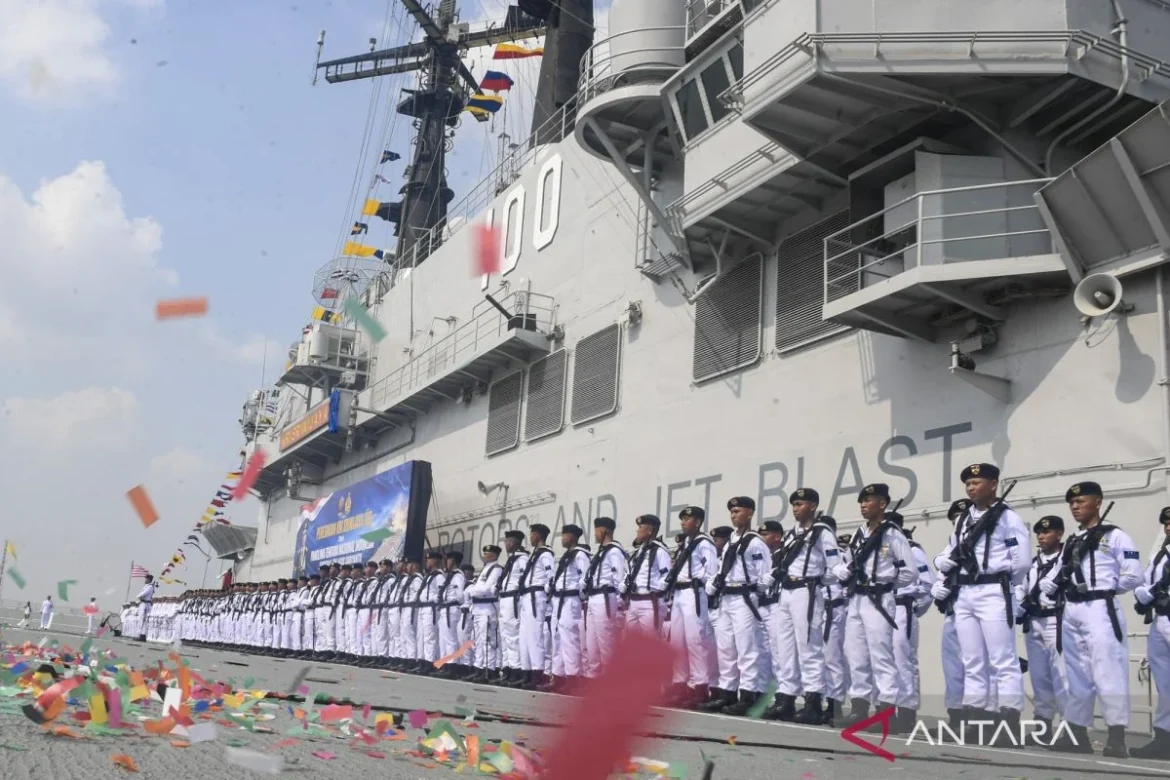
The arrival of the ITS Giuseppe Garibaldi at Pier 107 of Tanjung Priok Port, North Jakarta, on Friday, September 18, 2026, marks a transformative milestone for the Indonesian Navy (TNI AL). As the vessel docked, signaling its official integration into the national maritime defense apparatus, it brought to fruition years of strategic diplomatic maneuvering and technical procurement negotiations between Jakarta and Rome. Once commissioned as KRI Sriwijaya, this vessel will not only be the largest in the Indonesian fleet but also the first of its kind to operate under the Indonesian flag, fundamentally altering the nation’s power projection capabilities in the Indo-Pacific region.
A Strategic Acquisition: From Mediterranean to Archipelago
The handover of the ITS Giuseppe Garibaldi—previously designated with the hull number C551—represents a significant evolution in Indonesia’s naval architecture. The vessel, a seasoned veteran of the Italian Navy, underwent rigorous inspections and logistical preparations before embarking on its final voyage to Southeast Asia.
The official commissioning ceremony, where the Italian Tricolore will be lowered and the Indonesian Merah Putih hoisted, is scheduled for September 24, 2026. This transition signifies more than a change of ownership; it reflects Indonesia’s commitment to modernizing its maritime capabilities to protect the world’s largest archipelago. While the ship was originally designed for combat operations involving short-takeoff and vertical-landing (STOVL) aircraft such as the AV-8B Harrier II, the Indonesian Ministry of Defense has signaled a strategic shift in its intended utility, focusing heavily on humanitarian assistance and disaster relief (HADR) as well as maritime surveillance.
The Anatomy of an Aircraft Carrier: Beyond Mere Size
The term "aircraft carrier" often evokes images of massive nuclear-powered supercarriers, but the designation encompasses a diverse spectrum of vessels. At its core, an aircraft carrier is a mobile airbase that allows a nation to project air power across vast distances, independent of land-based infrastructure.
Unlike conventional destroyers or frigates, which prioritize kinetic weaponry—such as anti-ship missiles and torpedoes—as their primary offensive capability, the carrier’s power is defined by its flight deck. The design of the Giuseppe Garibaldi—now KRI Sriwijaya—includes specialized hangars, fuel depots for aircraft, and advanced communication systems required to manage complex air operations. These features allow the ship to serve as a floating logistics hub, enabling the rapid deployment of helicopters, drones, and, potentially, advanced combat aircraft to regions where local runways may be damaged or non-existent.
Chronology of the Procurement
The path to this acquisition was a multi-year process characterized by high-level diplomatic discourse.
- Early 2024: Preliminary discussions regarding a potential naval cooperation agreement between Italy and Indonesia were initiated.
- Mid-2025: Formal agreement reached for the transfer of the Giuseppe Garibaldi to the Indonesian Navy as part of a broader defense procurement partnership.
- January 2026: Specialized Indonesian naval crews began training in Italy to familiarize themselves with the ship’s unique propulsion and flight management systems.
- August 2026: The vessel departed Italy, transiting through the Suez Canal and the Indian Ocean.
- September 18, 2026: The ship arrived at Tanjung Priok, Jakarta, to begin final preparations for commissioning.
- September 24, 2026: Scheduled date for the official renaming to KRI Sriwijaya and the transfer of the vessel to the Indonesian Navy.
Humanitarian and Disaster Relief: The Strategic Mandate
While the global perception of aircraft carriers is inextricably linked to warfighting, the TNI AL has emphasized that the KRI Sriwijaya will be a cornerstone of Indonesia’s "Military Operations Other Than War" (OMOTW). Indonesia, located along the Pacific "Ring of Fire," is uniquely vulnerable to seismic and volcanic disasters.
Chief of Staff of the Indonesian Navy, Admiral Muhammad Ali, has consistently highlighted that the ship’s primary focus will be disaster mitigation. In a recent statement, he noted that the vessel’s ability to act as a "floating hospital" and a staging ground for humanitarian supplies is of greater immediate value to the nation than purely offensive posturing. With the capability to launch helicopters for search and rescue (SAR) and to serve as a command center for disaster relief coordination, the KRI Sriwijaya will drastically reduce response times in remote regions of the archipelago where traditional transport infrastructure is often severed during natural catastrophes.
Technical Implications and Operational Challenges
The integration of a vessel of this size into the Indonesian fleet is not without its challenges. The TNI AL will need to invest in extensive port facilities and specialized maintenance training to ensure the long-term viability of the vessel. Unlike standard frigates, an aircraft carrier requires a high level of technical support for its flight deck and avionics.
Furthermore, there is the matter of the "air wing." While the ship was designed to handle STOVL aircraft, the current operational plan leans toward the use of medium-to-heavy transport helicopters and tactical unmanned aerial vehicles (UAVs). This shift allows the Navy to monitor the vast Exclusive Economic Zone (EEZ) of Indonesia, particularly the volatile regions of the North Natuna Sea, with greater persistence. By deploying drones from the KRI Sriwijaya, the Indonesian Navy can maintain a continuous presence in sensitive waters without the need for constant refueling at distant shore bases.
Official Responses and Strategic Rationale
Government officials and military analysts have largely lauded the acquisition as a bold step in regional maritime security. The Ministry of State Secretariat has confirmed that the President will meet with Italian naval representatives to finalize the bilateral security cooperation, emphasizing the importance of international partnerships in maintaining maritime stability.
Analysts point out that by acquiring a platform like the Giuseppe Garibaldi, Indonesia has effectively leapfrogged years of indigenous research and development, gaining immediate access to a "blue-water" capability. While the ship is nearing the end of its typical operational lifespan by international standards, the vessel’s hull and systems remain robust enough to serve Indonesia for a decade or more, provided the Navy maintains a rigorous refit schedule.
Broader Impact on the Indo-Pacific
The presence of KRI Sriwijaya creates a new dynamic in regional naval politics. As tensions rise in the South China Sea, the ability of a Southeast Asian nation to operate an aircraft carrier serves as a deterrent and a statement of sovereignty. Even if the vessel is used primarily for humanitarian purposes, its mere presence at sea forces neighboring nations to recalibrate their assessments of Indonesia’s defensive reach.
Furthermore, the naming of the ship—KRI Sriwijaya—is symbolic. It references the powerful maritime empire that once dominated the Southeast Asian seas, projecting a message of historical continuity and national pride. The move to name the ship after such a legendary kingdom underlines the government’s desire to reassert Indonesia’s role as a significant maritime power in the 21st century.
Future Prospects for the Indonesian Navy
Looking ahead, the KRI Sriwijaya is expected to undergo a series of comprehensive upgrades to its sensors and communication systems to integrate with the existing fleet of Indonesian frigates and corvettes. The Navy is also exploring the acquisition of modern naval helicopters capable of anti-submarine warfare (ASW) and long-range surveillance to be based permanently on the carrier.
The successful integration of the KRI Sriwijaya will likely pave the way for future indigenous development. By operating a vessel of this size, the Indonesian Navy will gain invaluable institutional knowledge, preparing its sailors and engineers for the eventual design and construction of future domestic carriers.
As the nation prepares for the formal commissioning on September 24, the mood in Jakarta is one of anticipation. The KRI Sriwijaya is not just a piece of military hardware; it is a symbol of Indonesia’s growing stature and its determination to safeguard its vast maritime interests. Whether in the face of natural disaster or the complexities of regional geopolitics, the arrival of the KRI Sriwijaya marks the beginning of a new chapter for the Indonesian Navy, one defined by increased range, greater operational flexibility, and a stronger commitment to maintaining the integrity of the archipelago.