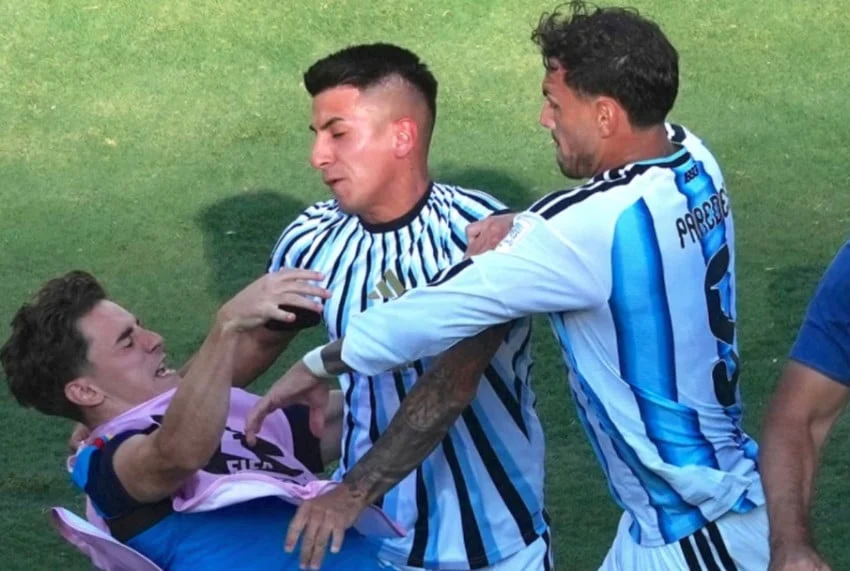
FIFA has issued a surprising clarification regarding an intense incident involving Argentine midfielder Leandro Paredes following the 2026 World Cup final against Spain. Contrary to widespread reports of him receiving a red card after the final whistle, FIFA has confirmed that Paredes was not, in fact, sent off by the referee during the match. This revelation aims to correct the narrative that emerged in the aftermath of the hotly contested final, held at the iconic Stadium New York New Jersey on Sunday, July 19th.
While Paredes escaped immediate disciplinary action on the field, his involvement in the post-match scuffle has not entirely cleared him from potential sanctions. FIFA has confirmed to BBC Sport that an investigation is currently underway into the disturbances that marred the conclusion of the tournament’s showpiece event. The investigation will scrutinize the conduct of several Argentine players, as well as the team’s overall behavior.
The Dramatic Climax of the 2026 World Cup Final
The 2026 FIFA World Cup final, which saw Spain clinch their second-ever world title with a dramatic 1-0 victory over Argentina in extra time, courtesy of a decisive goal from Ferran Torres, will unfortunately also be remembered for the unsportsmanlike conduct that erupted once the final whistle blew. Instead of celebrating La Furia Roja’s historic triumph, the footballing world was left discussing the contentious clashes that involved a number of Argentine players.
Footage from the match clearly shows a heated exchange unfolding shortly after the referee, Slavko Vincic, brought the game to a close. Leandro Paredes was seen forcefully pushing Spanish defender Eric Garcia in the neck, becoming embroiled in a melee that resulted in Spanish midfielder Gavi falling to the ground. Simultaneously, reports and video evidence suggest that Nahuel Molina may have thrown a punch towards Spanish captain Rodri. Other Argentine figures, including Thiago Almada and assistant coach Roberto Ayala, were also observed in close proximity to the center of the altercations.
This post-match fracas led many observers to believe that Paredes had received a direct red card from referee Vincic. If this had been the case, he would have been the second Argentine player to be dismissed, following Enzo Fernandez, who was shown a red card in the dying moments of injury time for accumulating two yellow cards. However, FIFA’s official statement now refutes these assumptions, emphasizing that no disciplinary action was taken against Paredes during the actual flow of the game. This means his name will not be added to the historical list of players who have been sent off in a World Cup final, a distinction held by only six previous individuals.
FIFA’s Investigative Process and Potential Ramifications
The disciplinary committee of FIFA has appointed an independent prosecutor to lead the thorough investigation into all aspects of the post-match disturbances. This inquiry is not limited to individual player misconduct but will also encompass an assessment of the Argentine team’s collective behavior following the final whistle. FIFA’s commitment to upholding the integrity of the sport necessitates a comprehensive review of such incidents, ensuring that fair play and sportsmanship remain paramount, even in the high-stakes environment of a World Cup final.
The FIFA Disciplinary Code outlines a range of potential sanctions for breaches of its regulations, which can include fines, suspensions from future matches, and even tournament bans. The severity of any penalties will depend on the findings of the independent prosecutor and the subsequent decisions made by the disciplinary committee. Factors such as the intent behind the actions, the impact on opponents, and any prior disciplinary history of the involved individuals will likely be taken into consideration.
Historical Context of World Cup Final Red Cards
To understand the significance of FIFA’s clarification regarding Paredes, it is pertinent to recall the rarity of red cards being issued in World Cup finals. Throughout the history of the tournament’s ultimate match, dismissals have been few and far between, often marking significant turning points or adding to the drama of an already momentous occasion.
The first player to be sent off in a World Cup final was Pedro Monzón of Argentina in 1990 against West Germany. This was followed by his teammate Gustavo Dezotti in the same match, making it a memorable final for all the wrong reasons for Argentina. In 1998, France’s Marcel Desailly was red-carded in their triumphant final against Brazil. The 2006 final saw Zinedine Zidane famously receive a red card for his headbutt on Marco Materazzi, a moment that became etched in footballing folklore. The 2010 final had John Heitinga of the Netherlands dismissed in extra time against Spain. Most recently, in the 2022 final, no players were sent off, though the match was filled with intense moments and controversial decisions.
The absence of a red card for Paredes means that the record of dismissals in World Cup finals remains unchanged by this particular incident. However, the ongoing investigation into the post-match conduct could still lead to disciplinary measures that have repercussions for the players involved and potentially the Argentine Football Association.
Broader Implications for Football’s Governing Body and Player Conduct
FIFA’s intervention and clarification highlight the organization’s role in maintaining order and upholding the spirit of the game, even in the highly charged atmosphere of a World Cup final. The investigation serves as a stark reminder to players and teams that their conduct, both on and off the pitch, is subject to scrutiny and potential sanction.
The incident also brings to the fore the challenges faced by match officials in managing highly emotional situations. While referees are trained to handle pressure, the aftermath of a World Cup final can often spill over into intense exchanges that test their authority and the established rules of the game. FIFA’s review of such incidents is crucial for refining protocols and ensuring that appropriate disciplinary measures are in place to deter future misconduct.
The focus on team behavior also signals a broader trend within FIFA to address collective responsibility. This means that not only individual acts of aggression but also the overall demeanor and actions of a squad can be subject to review. This approach aims to foster a culture of respect and sportsmanship throughout the footballing world.
As the investigation unfolds, the football community will be keenly observing FIFA’s decision-making process. The outcome will not only determine the fate of the players involved but will also contribute to the ongoing dialogue about player conduct, the role of governing bodies, and the enduring values that should define the beautiful game. The 2026 World Cup final, despite its controversial ending, may well serve as a catalyst for further reinforcement of these principles.