NEW JERSEY, USA – The aftermath of the 2026 FIFA World Cup Final, a fiercely contested match between Spain and Argentina held at New Jersey Stadium, has been overshadowed by a significant disciplinary investigation launched by world football’s governing body, FIFA. The organization confirmed on Monday, July 20, 2026, that its Disciplinary Committee has initiated proceedings into alleged breaches of the FIFA Disciplinary Code (FDC) stemming from unsportsmanlike conduct that erupted on the field immediately after the final whistle.
The dramatic conclusion to the tournament, which saw Spain clinch their first World Cup title in over two decades by defeating Argentina 1-0 in extra time, was marred by aggressive altercations involving several players and staff members from the defeated Argentinian squad. FIFA’s statement, released through official channels and reported by ESPN, indicated that a thorough review of match reports has led to the appointment of a Disciplinary Prosecutor. This prosecutor is tasked with investigating the reported incidents and will subsequently submit a comprehensive report to the FIFA Disciplinary Committee for their final judgment.
"Following a review of the relevant match reports concerning the FIFA World Cup Final between Spain and Argentina, and in accordance with Article 36 of the FIFA Disciplinary Code (FDC), the FIFA Disciplinary Committee has appointed a Disciplinary Prosecutor to investigate alleged breaches of the FDC in connection with post-match incidents," stated FIFA in their official release. The global football federation further added that "Further details will be announced by the FIFA Disciplinary Committee once the prosecutor’s report has been finalized."
The final itself, held in the packed New Jersey Stadium in the early hours of Monday morning, was a tense affair. Spain’s victory was secured by a solitary, decisive goal from forward Ferran Torres in the latter stages of extra time, a moment of brilliance that etched their names into football history. However, the jubilation of the Spanish team and their supporters was abruptly interrupted by scenes of discord on the pitch as players from both sides, still emotionally charged from the grueling ninety minutes plus thirty minutes of extra time, became embroiled in a series of confrontations.
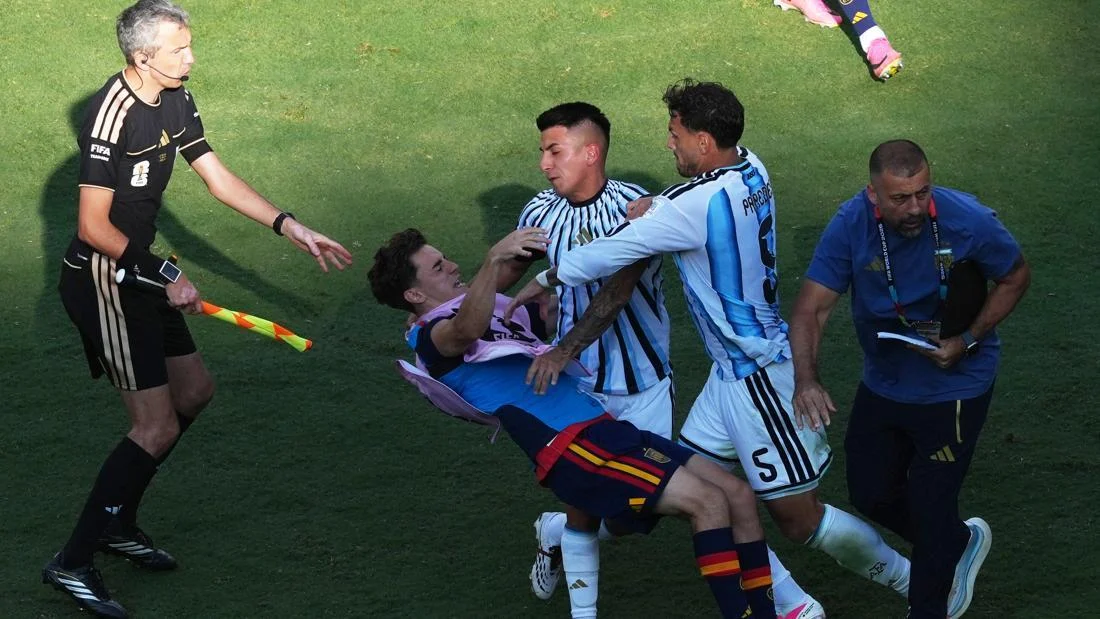
Eyewitness accounts and broadcast footage revealed that two prominent Argentinian players, Leandro Paredes and Nahuel Molina, were at the center of some of the most visible altercations. Leandro Paredes was observed engaging in aggressive physical contact, including what appeared to be a chokehold on Spanish player Eric Garcia. He was also seen shoving Gavi, another Spanish midfielder, causing him to fall to the ground. Simultaneously, Nahuel Molina was captured on camera appearing to punch Rodri, the Spanish midfielder, in the abdomen as Rodri was running past him to join his teammates in their victory celebrations.
The unsportsmanlike conduct was not confined to the playing field. Reports also indicate that Roberto Ayala, an assistant coach for the Argentinian national team, was involved in a heated exchange with Spanish player Dani Olmo. Ayala was seen striking Olmo in the aftermath of the match, further escalating the already tense atmosphere. These actions have drawn widespread criticism from various quarters of the footballing world, with many observers deeming the behavior of the Argentinian squad as a stark display of poor sportsmanship, especially towards the newly crowned champions.
Historical Context of World Cup Finals and Disciplinary Actions
The FIFA World Cup Final is the pinnacle of international football, a tournament watched by billions globally. The immense pressure, national pride, and sheer intensity of these matches can, at times, lead to heightened emotions and on-field incidents. However, FIFA has consistently emphasized the importance of maintaining the integrity and spirit of the game, with its Disciplinary Code serving as a framework to address misconduct.
Past World Cup finals have seen their share of controversial moments and disciplinary actions. The infamous headbutt by Zinedine Zidane in the 2006 final, for instance, resulted in his expulsion from the match and subsequent fines. The 1990 final also witnessed a record two red cards for Argentina. While physical confrontations of the scale alleged in the 2026 final are relatively rare at this level, the governing body’s proactive approach underscores its commitment to upholding fair play.
The 2026 World Cup, hosted across North America, was heralded as a new era for the tournament, featuring an expanded format with 48 participating nations. The final in New Jersey was anticipated to be a classic, pitting two footballing giants with rich World Cup histories against each other. Spain, having endured a period of rebuilding, finally achieved their ultimate goal, while Argentina, led by a new generation of stars, fell short of adding another star to their already illustrious jersey. The intense rivalry and the fine margins of the match undoubtedly contributed to the heightened emotions.
Chronology of Post-Match Incidents
Based on available reports and media coverage, the sequence of events that led to FIFA’s investigation can be broadly reconstructed:
- 118th Minute (Extra Time): Ferran Torres scores the winning goal for Spain, securing a 1-0 lead.
- Full-Time Whistle: The match concludes, with Spain declared champions.
- Immediate On-Field Celebrations and Discontent: Spanish players begin celebrating their victory. Simultaneously, a visible sense of disappointment and frustration appears to manifest among Argentinian players.
- First Confrontation (Paredes and Garcia/Gavi): Leandro Paredes is observed physically confronting Eric Garcia, allegedly applying a chokehold, and then shoving Gavi.
- Second Confrontation (Molina and Rodri): Nahuel Molina is seen making physical contact with Rodri as the latter runs past him during his team’s celebrations.
- Third Confrontation (Ayala and Olmo): Assistant coach Roberto Ayala reportedly engages with Dani Olmo, culminating in a physical strike.
- Continued Tensions: While referees and security personnel intervene to de-escalate the situation, a general atmosphere of lingering tension and animosity persists on the field for several minutes as players are escorted away.
- Post-Match Interviews and Initial Reactions: Early reports and social media commentary begin to highlight the unsportsmanlike conduct, with many criticizing the Argentinian players’ reactions.
- FIFA’s Official Statement: Days following the final, FIFA formally announces the initiation of a disciplinary investigation into the post-match incidents.
Supporting Data and Player Involvement
The 2026 World Cup final was characterized by a high level of physicality throughout the match, with a total of seven yellow cards issued to players from both sides. This indicates the intensity of the contest even before the post-match chaos. The players directly implicated in the post-match altercations are:
- Leandro Paredes (Argentina): A defensive midfielder known for his combative style. His alleged actions involved direct physical aggression towards two Spanish players.
- Nahuel Molina (Argentina): A right-back who was involved in a physical altercation with Spanish midfielder Rodri.
- Eric Garcia (Spain): A central defender who was reportedly the target of Paredes’s aggression.
- Gavi (Spain): A young, dynamic midfielder who was allegedly shoved by Paredes.
- Rodri (Spain): A key defensive midfielder for Spain, who was allegedly punched by Molina.
- Roberto Ayala (Argentina Assistant Coach): His alleged physical assault on Dani Olmo adds a layer of staff misconduct to the investigation.
- Dani Olmo (Spain): The Spanish winger who was reportedly struck by Ayala.
The involvement of multiple players and a coaching staff member underscores the gravity of the situation and the broad scope of FIFA’s inquiry. The FDC, under Article 36, covers a wide range of offenses including unsporting behavior, offensive gestures, and physical assault, with potential sanctions ranging from fines to suspensions.
Official Responses and Reactions
While specific individuals have not yet been formally charged or sanctioned, the statements from FIFA indicate a clear intent to address the situation.
FIFA: As detailed in their official release, FIFA has formally initiated an investigation, demonstrating their commitment to upholding the principles of fair play and the integrity of the sport. The appointment of a Disciplinary Prosecutor signifies a structured and methodical approach to assessing the evidence and determining appropriate disciplinary measures.
Spanish Football Federation (RFEF): While no official statement has been released by the RFEF specifically addressing the post-match incidents, it is widely expected that they would support FIFA’s investigation and any necessary disciplinary actions to ensure the protection of their players and the upholding of sporting conduct. Spanish media outlets have largely condemned the actions of the Argentinian players.
Argentinian Football Association (AFA): The AFA has yet to issue a formal public statement regarding the specific allegations. However, in the immediate aftermath of the final, official communications from the AFA focused on congratulating the team on their World Cup journey and acknowledging the immense effort put forth. It is anticipated that the AFA will cooperate fully with FIFA’s investigation. Individual players or their representatives may release statements in due course.
Player Reactions (Inferred): Given the emotional nature of a World Cup final, it is highly probable that players on both sides experienced a range of emotions. Spanish players, while celebrating their monumental victory, would likely feel a sense of injustice and anger over the post-match aggression. Argentinian players, facing the bitter disappointment of defeat, may have acted out of frustration, though such actions are not condoned by sporting regulations. Public statements from players involved, if any, will be closely monitored.
Broader Impact and Implications
The investigation launched by FIFA carries significant implications for the individuals involved, the Argentinian Football Association, and the broader perception of the 2026 World Cup.
Potential Sanctions: Depending on the findings of the Disciplinary Prosecutor and the subsequent decision of the Disciplinary Committee, sanctions could be imposed on the involved players and staff. These could include match bans (potentially affecting future international competitions), hefty fines, and even reputational damage. For players like Paredes and Molina, who are key figures in the Argentinian squad, a suspension could have a substantial impact on their international careers.
Reputational Damage: The scenes of chaos detract from the otherwise triumphant narrative of the 2026 World Cup. For Argentina, a nation with a proud footballing heritage, such displays of poor sportsmanship can tarnish their image on the global stage, particularly after a hard-fought and ultimately unsuccessful campaign. Conversely, Spain’s victory, while celebrated, is now inextricably linked to the controversial aftermath.
Upholding Sporting Values: FIFA’s swift initiation of an investigation signals their commitment to maintaining the integrity and spirit of football. By taking decisive action, they aim to deter similar behavior in future tournaments and reinforce the importance of respect, fair play, and sportsmanship, regardless of the outcome of a match. This investigation serves as a crucial reminder that while competition is fierce, conduct must remain within the bounds of established regulations.
Fan Perception: The incident could also influence how fans perceive the teams involved and the nature of international football rivalries. While passion is expected, violence and aggression are not, and the governing body’s response will be crucial in shaping public opinion and ensuring that the focus remains on the skill and drama of the game itself.
The coming weeks will be critical as the Disciplinary Prosecutor compiles their report. The football world will be closely watching for the findings and the eventual decisions of the FIFA Disciplinary Committee, which will undoubtedly set a precedent for how such post-match misconduct is handled in the future. The legacy of the 2026 World Cup final will, in part, be defined by how effectively FIFA addresses these serious allegations of unsportsmanlike conduct.