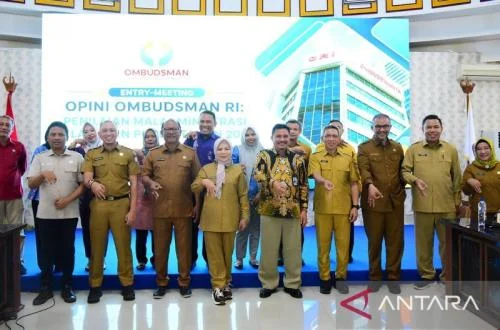
GORONTALO – In a pivotal move aimed at fortifying its commitment to professional, integrated, and maladministration-free public services, the Gorontalo Provincial Government, led by Deputy Governor Idah Syahidah Rusli Habibie, officially inaugurated the Entry Meeting for the 2026 Public Service Maladministration Assessment. Held on Tuesday at the prestigious Dulohupa Room within the Gubernatorial complex, this event marks a critical juncture in the province’s ongoing efforts to elevate the quality and trustworthiness of its administrative functions. The comprehensive assessment, spearheaded by the Indonesian Ombudsman, is not merely a procedural formality but a strategic initiative designed to systematically identify, prevent, and mitigate potential instances of maladministration across key governmental agencies, thereby ensuring that the services rendered truly reflect the needs and rights of the citizenry.
The Entry Meeting drew a distinguished assembly of key stakeholders, underscoring the collaborative spirit vital for such a comprehensive undertaking. Among the notable attendees were Partono, a Member of the Indonesian Ombudsman (Ombudsman RI); Muslimin B. Putra, Head of the Ombudsman RI Gorontalo Representative Office; Sofian Ibrahim, the Provincial Secretary of Gorontalo; alongside numerous leaders of regional apparatus organizations (OPDs) and other invited guests. This robust representation from both the provincial administration and the national oversight body signifies a strong, unified front in the relentless pursuit of good governance and transparent public service delivery. The synergy demonstrated at this meeting is crucial, as it sets the tone for an assessment process that demands full cooperation and a shared understanding of its overarching objectives.
Setting the Stage: The Imperative of Public Service Excellence
The Indonesian Ombudsman (Ombudsman RI) plays an indispensable role in upholding the principles of good governance and ensuring accountability within public service delivery across the archipelago. Established under Law No. 37 of 2008, the Ombudsman functions as an external oversight body, tasked with receiving, examining, and resolving public complaints regarding maladministration in the provision of public services by state administrators and government agencies. Its annual assessments are critical instruments, not just for identifying shortcomings but for driving continuous improvement and fostering a culture of integrity and professionalism within the bureaucracy. The 2026 assessment in Gorontalo is a continuation of this national mandate, reflecting a strategic pivot towards proactive prevention rather than reactive correction.
Maladministration, in the Indonesian context, encompasses a broad spectrum of misconduct, including but not limited to delays in service provision, discrimination, deviation from procedures, incompetence, abuse of authority, and requests for unofficial fees. Such practices erode public trust, create inefficiencies, and can stifle economic development by increasing uncertainty and transaction costs for citizens and businesses alike. Therefore, the Ombudsman’s focus on evaluating public service quality and preventing maladministration aligns perfectly with Indonesia’s broader national agenda of bureaucratic reform (Reformasi Birokrasi), which seeks to create a clean, effective, accountable, and responsive government. For a province like Gorontalo, with its unique socio-economic landscape and aspirations for regional growth, ensuring transparent and efficient public services is paramount for attracting investment, fostering local entrepreneurship, and enhancing the overall quality of life for its residents.
Deputy Governor’s Vision: Beyond Compliance to Citizen-Centricity
In her opening remarks, Deputy Governor Idah Syahidah Rusli Habibie articulated a profound appreciation for the Ombudsman RI’s unwavering consistency in evaluating public service delivery. She underscored that the Entry Meeting transcended mere administrative protocol, serving instead as a vital platform for comprehensive evaluation and a crucial forum for aligning perceptions. This shared understanding, she emphasized, is fundamental for the sustained prevention and effective control of potential maladministration. Her statements resonated with a deep understanding of the critical link between governmental efficacy and public confidence.
"Public service is the face of the government before its people," Deputy Governor Idah asserted with conviction. "The quality of service is not solely measured by speed and convenience, but equally by procedural certainty, clarity of information, fairness of service, and freedom from maladministration. Therefore, this evaluation must serve as a tangible moment for genuine reform and improvement." Her emphasis on these qualitative aspects highlights a shift from a purely output-focused view to one that prioritizes the experience and rights of the service recipient. She further elaborated that a truly professional public service fosters an environment where citizens feel heard, respected, and assured of their entitlements, thereby strengthening the social contract between the government and its constituents. This citizen-centric approach is the cornerstone of effective governance and a prerequisite for sustainable development.
The Evolving Paradigm: Focus on Prevention and Control
A significant theme highlighted by Deputy Governor Idah was the conceptual evolution of the assessment, which now places greater emphasis on the proactive aspects of prevention and control of maladministration. She implored all regional apparatus organizations (OPDs) to dedicate serious attention to this paradigm shift. Previous evaluation outcomes, she noted, must not be seen as mere historical data but as a strategic "roadmap" for strengthening existing policies and refining service implementation. The ultimate goal, she reiterated, is to ensure that the benefits of these reforms are genuinely felt and appreciated by the community. This forward-looking perspective signals a move away from simply addressing past grievances towards building robust systems that inherently deter future instances of misconduct.
The Gorontalo Provincial Government has unequivocally committed to leveraging the 2026 assessment as a catalyst for accelerating bureaucratic reform. This commitment translates into a multi-faceted action plan. Key pillars of this strategy include the rigorous strengthening of service standards, ensuring they are clear, measurable, and enforceable; a significant enhancement of apparatur capacity through targeted training and professional development programs; the strategic utilization of information technology to streamline processes, improve transparency, and reduce opportunities for discretion; and crucially, the reinforcement of internal oversight mechanisms within every regional apparatus organization. This holistic approach aims to create an ecosystem of accountability where excellence in public service is not an aspiration but a deeply embedded operational standard.
The Assessment Process: A Phased Approach to Accountability
The journey towards improved public service quality through the Ombudsman’s assessment is a meticulously structured, multi-phased process. The Entry Meeting, held in Gorontalo, serves as the official launch, signaling the commencement of data collection and evaluation for the 2026 assessment cycle.
-
Phase 1: Preparation and Socialization (Pre-Entry Meeting): This initial stage involves the Ombudsman RI designing the assessment methodology, developing survey instruments, and identifying target agencies based on various factors, including public complaints data, previous assessment results, and strategic importance. For Gorontalo, this would have included preliminary data gathering and coordination with the provincial government. The Entry Meeting then acts as the official socialization of these parameters to the provincial stakeholders.
-
Phase 2: Data Collection and Field Verification (Post-Entry Meeting): Following the Entry Meeting, the Ombudsman team will embark on extensive data collection. This typically involves:
- Document Review: Examining official documents, standard operating procedures (SOPs), service charters, complaint handling mechanisms, and internal regulations of the targeted OPDs.
- Direct Observation: Field visits to service units to observe actual service delivery, physical infrastructure, and information accessibility.
- Interviews: Conducting interviews with service providers, management, and frontline staff to understand operational challenges and perspectives.
- Mystery Shopping: Deploying undercover agents or "mystery shoppers" to experience public services firsthand and objectively assess compliance with standards and potential for maladministration.
- Public Surveys and Focus Group Discussions: Gathering feedback directly from service users to gauge their satisfaction levels and identify pain points.
-
Phase 3: Analysis and Reporting: Once data collection is complete, the Ombudsman team meticulously analyzes the findings, identifying strengths, weaknesses, areas of non-compliance, and instances of potential maladministration. This culminates in a comprehensive assessment report that includes specific recommendations for improvement for each evaluated agency.
-
Phase 4: Follow-up and Monitoring: The Ombudsman doesn’t merely issue reports; it actively monitors the implementation of its recommendations. This often involves periodic reviews and checks to ensure that the provincial government and its OPDs are making tangible progress in addressing the identified issues. Persistent non-compliance can lead to further public exposure or stronger recommendations.
This rigorous process ensures that the assessment is not a superficial exercise but a deep dive into the operational realities of public service delivery, fostering genuine, evidence-based improvements.
Critical Examination: Locales of Evaluation and Expected Outcomes
Deputy Governor Idah gave particular attention to the regional apparatus organizations slated for evaluation in the current year’s assessment cycle. The identified focal points for this intensive scrutiny include the Dinas Pendidikan dan Kebudayaan (Department of Education and Culture), the Dinas Sosial (Social Affairs Department), the Dinas Kependudukan dan Pencatatan Sipil (Department of Population and Civil Registration), and the UPTD Rumah Sakit Umum Daerah Hasri Ainun Habibie (Hasri Ainun Habibie Regional General Hospital Unit). These selections are strategically important, as they represent sectors that directly impact the daily lives and fundamental rights of a vast majority of Gorontalo’s population. Education, social welfare, civil documentation, and healthcare are foundational pillars of a functioning society, and any maladministration in these areas can have profound and lasting negative consequences for citizens.
The Deputy Governor emphatically stressed that all recommendations issued by the Ombudsman RI from previous assessments must be regarded as absolute benchmarks for implementing corrective measures. She articulated a clear expectation: there should be no recurrence of negative findings from preceding years. This firm stance reflects a commitment to progressive improvement and an intolerance for stagnation in service quality.
"I urge all regional apparatus organizations that are the locus of this evaluation to treat the Ombudsman’s recommendations as an absolute guide for improvement," she declared. "Do not repeat the negative notes from previous years, but instead demonstrate tangible, measurable improvements in the quality of service provided to the community." This directive underscores the accountability expected from each department head and their teams, placing the onus on them to translate recommendations into actionable reforms that yield visible results for the public. The expectation is not merely compliance, but demonstrable progress in fostering a more responsive and efficient bureaucracy.
Ombudsman’s Perspective: A Partner in Good Governance
Ombudsman RI Member Partono, present at the Entry Meeting, provided crucial insights into the Ombudsman’s overarching philosophy. He reiterated that the Ombudsman’s role extends beyond that of a mere watchdog; it is fundamentally a partner in fostering good governance. The assessment process is designed to be constructive, aiming to collaborate with provincial governments to identify systemic issues and co-create sustainable solutions. He emphasized that the Ombudsman’s findings are not punitive but diagnostic, offering a mirror for self-reflection and a roadmap for enhancement. The ultimate goal, he articulated, is to cultivate a public service culture that is inherently transparent, accountable, and responsive to citizens’ needs.
Muslimin B. Putra, Head of the Ombudsman RI Gorontalo Representative Office, further localized this perspective. He highlighted the unique challenges and opportunities within Gorontalo Province. While acknowledging the provincial government’s existing efforts, he stressed the importance of consistent, sustained political will from leadership to ensure that reforms penetrate every layer of the bureaucracy. He pointed out that local specificities, such as geographical distribution of communities or particular socio-economic conditions, often influence the dynamics of public service delivery and maladministration risks. Therefore, tailored approaches and a deep understanding of the local context are essential for effective implementation of the Ombudsman’s recommendations. Both Ombudsman representatives reiterated that genuine improvement necessitates a whole-of-government approach, where every civil servant understands their role in upholding public service integrity.
The Ripple Effect: Broader Implications for Gorontalo’s Future
The successful implementation of the Ombudsman’s recommendations and the subsequent improvement in public service quality will have far-reaching positive implications for Gorontalo Province.
- Enhanced Citizen Trust and Participation: When citizens experience efficient, fair, and transparent services, their trust in government institutions grows. This can lead to increased civic participation, stronger social cohesion, and a more engaged populace, which is vital for democratic health.
- Reduced Corruption and Inefficiency: By identifying and rectifying procedural ambiguities, discretionary powers, and lack of oversight, the assessment directly contributes to reducing opportunities for corruption and streamlining bureaucratic processes. This translates into cost savings for both the government and the public.
- Improved Investment Climate: A government renowned for its efficient and predictable public services is more attractive to investors. Businesses, both local and foreign, seek environments where permits are clear, regulations are stable, and bureaucratic hurdles are minimal. This can stimulate economic growth, create jobs, and diversify the provincial economy.
- Sustainable Development Goals (SDGs): Good governance and accessible public services are integral to achieving several Sustainable Development Goals, including SDG 16 (Peace, Justice, and Strong Institutions). Gorontalo’s efforts align directly with these global objectives, contributing to a more equitable and just society.
- Professionalization of Bureaucracy: The emphasis on capacity building, clear standards, and accountability fosters a more professional and meritocratic civil service. This not only improves service delivery but also enhances the morale and effectiveness of government employees.
Conclusion: Sustaining the Momentum for Transformative Change
In her concluding remarks, Deputy Governor Idah Syahidah Rusli Habibie extended an invitation to all stakeholders to view the evaluation process as a collective endeavor. This shared responsibility, she articulated, is fundamental to constructing public services that are increasingly qualitative, accountable, and genuinely oriented towards the interests of the community. The Entry Meeting for the 2026 Public Service Maladministration Assessment in Gorontalo is more than just an annual review; it is a reaffirmation of the provincial government’s unwavering dedication to excellence and integrity in public service. By embracing the Ombudsman’s guidance and proactively addressing areas for improvement, Gorontalo is poised to not only meet but exceed national standards, ultimately building a more responsive, transparent, and trusted government for all its citizens. The momentum generated from this collaborative initiative must be sustained, ensuring that the promise of efficient and ethical public service becomes an enduring reality for the people of Gorontalo.