
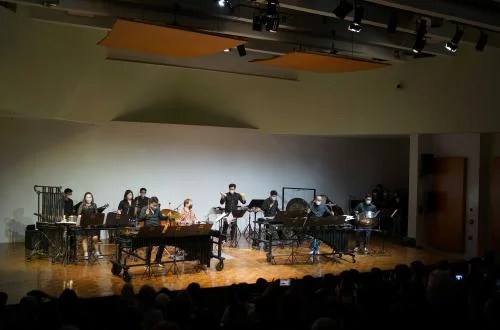
Indonesia, a nation endowed with a profound and vibrant percussion tradition, possesses the potential to emerge as a beacon for the advancement of percussion music, not only within Asia but on a global scale. Despite this immense artistic wealth, the full scope of this potential remains largely untapped. Recognizing this significant opportunity, the Yayasan Musik Amadeus Indonesia (YMAI), or Amadeus Music Foundation of Indonesia, has launched a series of ambitious initiatives, culminating in the groundbreaking "Kenopsia" percussion concert, aiming to galvanize the nation’s percussion scene.
A Landmark Concert and Comprehensive Initiatives
The "Kenopsia" concert, held at the GoetheHaus in Jakarta over the recent weekend, marks a historic moment for the YMAI, representing its first-ever full percussion concert in its 30-year history. This significant event showcased the Amadeus Percussion Ensemble (Ampere) and featured the esteemed Austrian percussionist Adi Schober. Beyond the concert itself, YMAI’s commitment to fostering percussion excellence is further evidenced by its preceding organization of the Indonesia Percussion Composition Competition (IPECC) and the Indonesia Percussion Meeting (IPM). The "Kenopsia" concert served as the grand finale, premiering the winning compositions from the IPECC, thereby providing a crucial platform for emerging Indonesian percussion composers.
The program for "Kenopsia" was meticulously curated to highlight both established and new works. It opened with "Novena" by James Swearingen, artfully arranged by I Nyoman Trieswra Minartha. This was followed by the unveiling of the IPECC winning pieces: "Dialektika, Dualitas, Kontradiksi" by Arya Pugala Kitti and Lucy Freia, "Restrained" by Andre, "March 16th" by Jeremia Saputra, and the titular "Kenopsia" by Regina Budiyanto Sutisno. The second half of the concert delved into a diverse repertoire, including "Blue Samba" by Murray Houllif, Adi Schober’s solo piece, "The Music of James Bond" arranged by James Bocook and I Nyoman Trieswara Minartha, "Mambo Africano" by Alice Gomez and Marily Rife, and concluded with David Mancini’s "Suite for Solo Drumset and Percussion Ensemble," featuring Adi Schober as the soloist.
The Amadeus Legacy: Nurturing Musical Talent for Three Decades
The Yayasan Musik Amadeus Indonesia, founded by Grace Soedargo in 1992, has been a steadfast pillar in cultivating musical education in Indonesia through its Sekolah Musik Amadeus (SMA), or Amadeus Music School. Since its inception, SMA has provided comprehensive musical training to thousands of students of all ages, beginning as young as two years old. Currently, the school boasts over 200 students actively engaged in learning a wide array of instruments, including piano, strings, wind instruments, and crucially, percussion.
With a dedicated faculty of 25 educators, SMA remains committed to advancing classical music education in Indonesia. This commitment extends beyond classroom instruction to active participation in various student orchestras and ensembles, fostering collaborative musical experiences. Notably, SMA holds a unique distinction within Southeast Asia as the only music school affiliated with the prestigious Johann Sebastian Bach Musikschule (JSBM) in Vienna, Austria. This international connection underscores SMA’s dedication to upholding global standards in music education.
Addressing the Percussion Potential: Vision and Objectives
Grace Soedargo articulated the YMAI’s overarching vision for the percussion community: "By organizing the IPECC, IPM, and the ‘Kenopsia’ concert, Amadeus aims to create a significant impact in the field of percussion music in Indonesia." Her aspiration is for Indonesian percussionists to be profoundly inspired and driven to elevate their skills to international benchmarks. This sentiment is echoed by the enthusiastic reception of the initiatives, suggesting a growing appetite for structured development and global exposure within the Indonesian percussion landscape.
The establishment of the Amadeus Percussion Ensemble (Ampere) in August 2017, coinciding with the silver anniversary of the YMAI and SMA, was a direct response to the growing interest and talent within the school’s percussion department, which itself was established that same year under the leadership of Ryan Saputro. The primary objective of Ampere is to cultivate percussionists capable of achieving international acclaim. The "Kenopsia" concert serves as a testament to the ensemble’s progress and a showcase of the talent nurtured by the foundation.
A Global Perspective: The Expertise of Adi Schober
The inclusion of Austrian percussionist Adi Schober in the "Kenopsia" concert brought an invaluable international dimension to the event. Schober, born in 1967 in Holabrunn, Austria, embarked on his percussion journey at the tender age of five, concurrently pursuing studies in piano, organ, and trumpet. His formal percussion education took him to the Hochschule für Musik und darstellende Kunst Wien under the tutelage of Prof. Horst Berger. Further honing his skills, he studied drum set and percussion with Prof. Fritz Ozmec and jazz percussion at the Konservatorium der Stadt Wien with Prof. Walter Grassmann. His pedagogical expertise in percussion was cultivated under Prof. Kurt Prihoda.
Schober’s extensive career includes teaching across numerous Austrian cities, founding the "Adi Schober Quintett," performing in orchestras and big bands, and serving as music director for various festivals in Austria. Since 2009, he has been actively involved in developing rhythm-based therapy for individuals with mental health challenges, collaborating with Dr. Kurt Sindermann and Dr. Barbara Schaffer. His personal recording studio has become a hub for his improvisational works and is also utilized by "Internationale Ignaz J Pleyel Gesellschaft," "Gramola," and "Apollon." Schober’s participation provided Indonesian musicians with direct exposure to world-class percussion artistry and pedagogical approaches.
The Indonesian Percussion Landscape: A Historical Context and Future Trajectory
Indonesia’s relationship with percussion is deeply interwoven with its cultural fabric, evident in the rich traditions of gamelan, angklung, and various indigenous rhythmic instruments found across the archipelago. These traditional forms, while distinct, share a common thread of intricate rhythmic patterns, communal performance, and profound spiritual or ceremonial significance. The YMAI’s initiatives represent a modern evolution, seeking to bridge these traditional roots with contemporary and Western classical percussion practices.
The Indonesia Percussion Composition Competition (IPECC) has played a crucial role in this bridging process. By encouraging the creation of new works, IPECC has provided a platform for Indonesian composers to explore innovative ideas and express contemporary musical narratives through the percussion medium. The "world premiere" of these winning compositions at "Kenopsia" not only validated the composers’ talent but also enriched the repertoire available to Indonesian percussionists. This process of creation and performance is vital for the sustained growth and evolution of any musical genre.
The Indonesia Percussion Meeting (IPM), another cornerstone of YMAI’s efforts, serves as a crucial forum for dialogue, knowledge exchange, and networking among percussionists, educators, composers, and enthusiasts. Such meetings are instrumental in fostering a sense of community, sharing best practices, and collectively strategizing for the future development of percussion in the country. While specific attendance figures for IPM were not detailed in the provided article, its consistent organization alongside IPECC and the concert signifies a sustained commitment to building a robust ecosystem for percussion.
Supporting Data and Broader Implications
The global percussion market is a dynamic and growing sector, with increasing demand for both classical and contemporary percussionists across various fields, including orchestras, chamber ensembles, film scoring, and contemporary music performance. The professional percussionist job market is competitive, with many seeking opportunities in diverse ensembles and educational institutions. Initiatives like those spearheaded by YMAI are crucial for preparing Indonesian musicians to compete on this international stage.
The affiliation of Sekolah Musik Amadeus with the Johann Sebastian Bach Musikschule in Vienna is a significant data point, indicating a commitment to adhering to rigorous European musical pedagogical standards. This affiliation can lead to enhanced curriculum development, teacher training, and student exchange programs, further elevating the quality of music education in Indonesia.
The broader implications of YMAI’s "Kenopsia" project are far-reaching. Firstly, it elevates the profile of percussion as a distinct and vital discipline within the Indonesian music scene. Secondly, by premiering new works, it contributes to the expansion of the Indonesian percussion repertoire, providing valuable material for future generations. Thirdly, the involvement of an international artist like Adi Schober fosters cross-cultural artistic exchange, enriching the local music community with global perspectives and techniques.
Furthermore, the focus on developing percussionists to "world standards" has the potential to create new career pathways for young Indonesians. As Indonesia’s economy continues to grow and its cultural influence expands, there will be an increasing demand for high-caliber artists in various international forums. By investing in percussion education and performance opportunities, YMAI is directly contributing to this national artistic development.
The success of "Kenopsia" and its accompanying initiatives could serve as a model for other musical disciplines within Indonesia. The structured approach—combining education, composition, performance, and international collaboration—offers a blueprint for nurturing artistic talent and promoting cultural heritage on a global scale. The foundation’s foresight in recognizing and actively cultivating the country’s rich percussion heritage positions Indonesia to become a significant player in the global percussion community. The echoes of "Kenopsia" are expected to resonate, inspiring a new wave of percussionists and composers to push the boundaries of this dynamic musical art form.