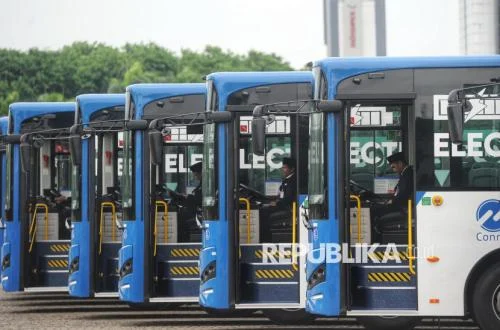
JAKARTA – A single electric bus operating within the TransJakarta public transportation network has the potential to generate significant savings for the Indonesian government, slashing fuel subsidies by an estimated Rp302 million annually. When a comprehensive analysis incorporating various operational aspects is conducted, the cumulative cost savings over a 5.5-year operational lifespan for one electric bus could reach approximately Rp3.9 billion, a figure equivalent to the current purchase price of a new 12-meter electric bus itself. This remarkable financial efficiency underscores the strategic advantage of transitioning Jakarta’s extensive bus rapid transit system towards electric mobility, offering a compelling case for accelerated adoption.
The calculation of these substantial savings stems from a detailed comparison of the subsidized diesel fuel price against commercial fuel rates, coupled with the superior operational efficiency inherent in electric buses compared to their internal combustion engine (ICE) counterparts. This financial modeling provides a robust economic rationale for the ambitious electrification plans being pursued by TransJakarta, the operator of the world’s longest bus rapid transit system.
The Economic Imperative: Unpacking the Savings
Gatot Indra Koswara, Principal Specialist for Transformation and Change Management at TransJakarta, elucidated these findings during a recent Focus Group Discussion (FGD) held in Jakarta on Wednesday (April 15, 2026), involving the Strategic Transportation Initiative (Instran) and PT Kalista Nusa Armada. He emphasized that while the initial capital expenditure for an electric bus might be roughly twice that of an ICE bus, this higher upfront cost is effectively neutralized and eventually surpassed by the dramatic reductions in energy and maintenance expenses. "Indeed, the price of an electric bus can be more than double that of an ICE bus, but we compensate for this price increase with energy costs that are four times cheaper than ICE, and maintenance costs that are also twice as low," Gatot stated.
The economic model presented by Gatot is built upon a set of specific assumptions regarding fuel prices. It uses a subsidized diesel price of Rp6,800 per liter, contrasting it with the commercial non-subsidized Dexlite fuel price, which is pegged at approximately Rp14,500 per liter. This substantial differential of around Rp7,700 per liter forms the cornerstone of the government subsidy savings.
A typical TransJakarta ICE bus travels an average of 78,475 kilometers per year. With an assumed fuel efficiency of 2 kilometers per liter, such a bus consumes approximately 39,238 liters of diesel annually. Based on the Rp7,700 per liter subsidy differential, the potential reduction in government fuel subsidy expenditure for a single ICE bus converting to electric power amounts to roughly Rp302 million per year. "If we convert the difference between the subsidized cost and the non-subsidized Dexlite solar cost, it’s approximately Rp302 million per year per unit of government subsidy that must be disbursed to subsidize solar for public or goods transportation," Gatot elaborated, highlighting the direct fiscal relief for the central government.
Beyond the central government’s subsidy burden, TransJakarta’s analysis also identified significant operational cost efficiencies at the provincial government level, which directly impacts the operational budget allocated to the public transport operator. From an energy perspective, the operational cost for an ICE bus is estimated at Rp3,400 per kilometer. In stark contrast, an electric bus incurs only about Rp800 per kilometer. This calculation factors in an electricity price of Rp731 per kWh and the respective energy efficiencies of both vehicle types. The resulting energy cost differential translates into an annual saving of approximately Rp204 million per electric bus unit.
Furthermore, maintenance expenses represent another critical area of substantial savings. An ICE bus typically requires about Rp5,400 per kilometer for maintenance, whereas an electric bus, with its simpler powertrain and fewer moving parts, costs around Rp2,600 per kilometer to maintain. This difference alone yields an additional annual saving of approximately Rp219.7 million per unit. The reduced complexity of electric drivetrains means fewer components subject to wear and tear, less frequent fluid changes, and overall lower labor costs for servicing.
When these three major components of savings—fuel subsidy, energy costs, and maintenance expenses—are aggregated, TransJakarta projects a total efficiency that becomes profoundly significant over the medium term. Over a period of approximately 5.5 years, the accumulated savings are projected to reach around Rp3.99 billion per unit. As Gatot pointed out, this sum is nearly equivalent to the current market price of a new 12-meter electric bus, effectively demonstrating that the operational savings can fully offset the initial investment within a relatively short timeframe. "If we talk about maintenance savings, and energy savings, actually if we collect it all into one, if we multiply by 5.5 years, it will yield (savings) of approximately Rp3.9 billion, or currently almost the price of one 12-meter electric bus," he explained.
Gatot’s assertions firmly reinforce the notion that despite the initial higher investment cost for electric buses, the substantial operational and energy subsidy savings provide a compelling financial justification for the transition. This robust economic argument forms a cornerstone of Jakarta’s broader strategy for sustainable urban development.
A Strategic Shift for Urban Mobility: Background and Context
Jakarta, a megacity grappling with persistent traffic congestion and severe air pollution, has long sought innovative solutions to enhance its public transportation system. TransJakarta, established in 2004, has grown to become a cornerstone of the city’s mobility infrastructure, serving millions of commuters daily across an expansive network. The transition to electric buses is not merely an operational upgrade; it is a strategic imperative aligned with national and global sustainability goals.
Indonesia, as a signatory to the Paris Agreement, is committed to reducing its greenhouse gas emissions by 29% independently and up to 41% with international assistance by 2030. Decarbonizing the transportation sector, which is a major contributor to urban air pollution and carbon emissions, is critical to achieving these targets. President Joko Widodo’s administration has been a vocal proponent of electric vehicle (EV) adoption, positioning Indonesia as a potential hub for EV battery production due to its abundant nickel reserves, a key component in lithium-ion batteries. Government policies, including tax incentives and infrastructure development plans, are aimed at accelerating EV uptake across both private and public sectors.
For Jakarta, the impetus for electrification is particularly urgent. The city frequently ranks among the world’s most polluted cities, with vehicle emissions being a primary culprit. The health implications of poor air quality are severe, ranging from respiratory illnesses to cardiovascular diseases. Adopting electric buses directly addresses this challenge by eliminating tailpipe emissions, thereby improving urban air quality and public health. Furthermore, electric buses operate much more quietly than diesel buses, contributing to a reduction in urban noise pollution, which is another significant quality-of-life improvement for residents.
Chronology of TransJakarta’s Electric Journey
TransJakarta’s journey towards electrification began with initial pilot projects and feasibility studies to assess the viability of electric buses in Jakarta’s demanding operational environment. Early trials, often in partnership with various manufacturers and technology providers, aimed to evaluate performance, range, charging infrastructure requirements, and overall operational costs.
- 2019-2020: TransJakarta commenced initial trials of electric buses from various manufacturers, including BYD and Mobil Anak Bangsa (MAB), to understand their performance under Jakarta’s specific conditions, including traffic, climate, and charging needs.
- 2021: Following successful trials, TransJakarta announced ambitious plans to electrify its entire fleet, setting a target to transition all 10,000 buses to electric by 2030. This commitment signaled a strong policy direction.
- 2022: The first batch of commercially operated electric buses began service, marking a significant milestone. TransJakarta partnered with operators and manufacturers to gradually integrate these vehicles into its routes. This initial deployment focused on proving the concept and refining operational procedures.
- 2023: Expansion continued, with more electric buses being added to the fleet, supported by the development of necessary charging infrastructure at depots and along strategic routes. The focus shifted to scaling up operations and ensuring reliable service.
- 2024-Present: TransJakarta continues to actively procure electric buses and expand charging facilities, aiming for a steady increase in its electric fleet size. The discussions and analyses, such as the FGD mentioned, are part of ongoing efforts to refine strategies and accelerate the transition, building on real-world operational data and financial modeling. The 2026 date mentioned in the original article (April 15, 2026) likely refers to the projected date of the FGD itself, indicating a forward-looking analysis and commitment to ongoing evaluation of these initiatives.
Beyond Financial Gains: Environmental and Social Impact
The shift to electric buses offers benefits far beyond the substantial financial savings. Environmentally, the elimination of tailpipe emissions from thousands of buses will significantly reduce local air pollutants such as particulate matter (PM2.5), nitrogen oxides (NOx), and sulfur oxides (SOx), which are major contributors to smog and respiratory illnesses. This directly translates to improved public health outcomes for Jakarta’s residents. Furthermore, replacing diesel consumption with electricity, especially if sourced increasingly from renewable energy, will drastically lower the carbon footprint of the city’s public transportation system, contributing directly to Indonesia’s climate change mitigation efforts. Each electric bus, by displacing diesel consumption, contributes to reducing greenhouse gas emissions.
Socially, the adoption of electric buses can enhance the commuting experience. Electric buses are notably quieter and produce fewer vibrations, offering a smoother and more comfortable ride for passengers. This improvement in public transport quality can encourage more residents to opt for buses over private vehicles, further alleviating traffic congestion and reducing overall emissions. The image of a cleaner, more modern public transport system also elevates Jakarta’s status as a forward-thinking, sustainable global city.
Official Responses and Broader Implications
The findings presented by TransJakarta align well with the broader policy directives from various government ministries. The Ministry of Transportation has consistently advocated for sustainable transport solutions and has issued regulations to support EV adoption in public transport. The potential for reducing fuel subsidies is particularly attractive to the Ministry of Finance, which has historically borne the immense burden of energy subsidies, often diverting significant funds from other critical development areas. Any measure that can sustainably reduce this expenditure is met with strong governmental support.
Experts from environmental non-governmental organizations (NGOs) have lauded TransJakarta’s initiative. They view the electrification of public transport as a critical step in addressing Jakarta’s air quality crisis. These organizations often advocate for stronger policy incentives, faster deployment of charging infrastructure, and public awareness campaigns to maximize the benefits of EV adoption. They also highlight the importance of ensuring that the electricity used to charge these buses increasingly comes from renewable sources to achieve true "zero-emission" transportation.
From an industrial perspective, the large-scale adoption of electric buses by TransJakarta creates significant opportunities for local manufacturing and technology development. It incentivizes domestic bus manufacturers to develop electric models, fosters the growth of battery assembly plants, and drives innovation in charging infrastructure solutions. This localized supply chain development can create jobs, enhance technological capabilities, and reduce reliance on imported components, aligning with Indonesia’s broader industrialization goals. The scale of TransJakarta’s needs (potentially thousands of buses) provides a substantial market signal for investment in this sector.
Challenges and the Path Forward
Despite the compelling advantages, the transition to a fully electric TransJakarta fleet is not without its challenges. The initial capital investment, while offset by long-term operational savings, still represents a significant upfront cost that requires careful financial planning and potentially innovative financing mechanisms. Securing adequate and reliable charging infrastructure across all depots and potentially along routes is another critical hurdle. This involves not only installing charging stations but also ensuring that the electricity grid can support the increased demand, particularly during peak charging times. Battery technology, while rapidly advancing, still presents considerations regarding range anxiety, battery degradation over time, and ultimately, responsible recycling and disposal of spent batteries.
Moreover, the training of technical personnel for maintenance and operation of electric buses is essential. The skill sets required for electric vehicles differ significantly from those for ICE vehicles, necessitating comprehensive training programs for mechanics, drivers, and operational staff.
However, the detailed financial analysis provided by TransJakarta, demonstrating that operational savings can fully cover the initial investment within a relatively short period, provides a powerful argument for overcoming these challenges. It positions electric buses not just as an environmental choice, but as a fiscally responsible and strategically sound investment for the future of urban mobility in Jakarta and potentially a blueprint for other Indonesian cities. The ongoing commitment from TransJakarta and the supportive policy environment from the Indonesian government suggest a clear and determined path towards a cleaner, more efficient, and sustainable public transportation system for the nation’s capital.