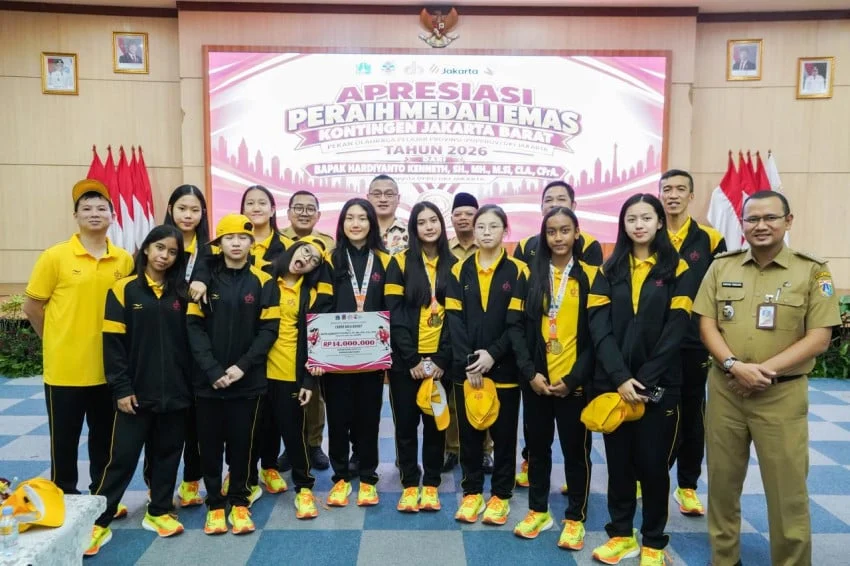
The sporting landscape of the Indonesian capital underwent a significant shift on September 5, 2026, as the West Jakarta contingent officially claimed the title of overall champion at the Pekan Olahraga Pelajar Provinsi (Popprov) DKI Jakarta 2026. This victory marks a watershed moment in the region’s athletic history, representing the first time since the inception of the Popprov tournament in 2017 that West Jakarta has ascended to the top of the medal standings. To celebrate this unprecedented achievement, Hardiyanto Kenneth, a member of the Jakarta Regional House of Representatives (DPRD) from the Indonesian Democratic Party of Struggle (PDI-P), spearheaded a ceremonial appreciation event, providing financial bonuses to the gold medalists during a formal gathering at the West Jakarta Mayor’s Office on Tuesday, September 15, 2026.
A New Era for West Jakarta Athletics
The Popprov DKI Jakarta is a premier multi-sport event designed to identify and cultivate young athletic talent across the five administrative cities and the Thousand Islands regency. Since the tournament’s inaugural edition in 2017, the competition has been dominated by traditional powerhouses, particularly South Jakarta and East Jakarta, which have historically benefited from more robust infrastructure and centralized training programs.
The 2026 edition, hosted at the Hall A Gelanggang Mahasiswa Soemantri Brodjonegoro in South Jakarta from August 31 to September 5, 2026, served as a rigorous testing ground for student-athletes. West Jakarta’s path to the overall title was characterized by high-intensity performances across team sports, which proved to be the decisive factor in their overall medal tally. By securing 7 gold medals, 2 silver medals, and 7 bronze medals, the West Jakarta delegation managed to outperform East Jakarta and South Jakarta, both of which finished with 5 gold medals apiece, while North Jakarta secured 3 gold medals.
Chronology of the 2026 Popprov Campaign
The tournament began with high expectations, as participating contingents arrived at the Soemantri Brodjonegoro sports complex with updated rosters following a series of regional qualifiers. The first three days of the competition were dominated by individual preliminary rounds in badminton and tactical group matches in football and basketball.
By the fourth day, the leaderboard began to tighten. While other regions focused on individual athletics, West Jakarta’s strategy prioritized team cohesion. The momentum shifted significantly when the West Jakarta squads advanced to the finals in multiple disciplines simultaneously. The culmination of the event on September 5 saw a frantic push for podium spots, where West Jakarta successfully defended its leads in the final matches of sepak takraw and team basketball, effectively cementing their status as the overall champions before the closing ceremony.
Strategic Disciplines and Medal Distribution
The success of the West Jakarta contingent was not a result of individual brilliance alone but rather a testament to the depth of their team-based sports programs. The seven gold medals were distributed across four major categories:
- Women’s U-15 Basketball: A tactical victory that showcased the strength of the grassroots youth basketball system in West Jakarta.
- Men’s U-15 and U-18 Badminton: Continued dominance in the regional badminton circuit, highlighting the effectiveness of club-school partnerships.
- Men’s U-15 and U-18 Football: The most significant point contributors, requiring high stamina and endurance over the week-long tournament.
- Men’s and Women’s U-18 Sepak Takraw: An impressive display of agility and technique that proved vital in the final medal count.
The financial recognition provided by Hardiyanto Kenneth reflected the scale of these efforts. The bonus structure was tiered based on the size and logistical complexity of the teams:
- Football Teams: Received a total of Rp18 million per gold-winning squad.
- Basketball Teams: Received Rp14 million per squad.
- Sepak Takraw Teams: Received Rp6 million per squad.
- Badminton Teams: Received Rp5 million per squad.
Official Responses and Community Impact
The ceremony at the West Jakarta Mayor’s Office was attended by local officials and the athletes themselves. Mayor Iin Mutmainnah expressed pride in the students, noting that the victory was a result of long-term investment in regional training centers. "This is not just a trophy; it is a signal that our youth development programs are working," she stated during the event.
Hardiyanto Kenneth, who has been a vocal proponent of sports development in the legislature, emphasized that the bonuses were intended to serve as a catalyst for future performance rather than merely a reward for past efforts. "We recognize the immense dedication required to balance academic responsibilities with elite-level sports training," Kenneth remarked. "By providing these incentives, we aim to ensure that our athletes feel supported by their government and are motivated to pursue higher levels of competition at the national and international stages."
Broader Implications for DKI Jakarta Sports
The victory of West Jakarta raises critical questions regarding the future of sports development in the province. Historically, the disparity in sports facilities between administrative regions has led to uneven success rates. West Jakarta’s breakthrough suggests that decentralizing training resources and increasing the frequency of inter-regional competitions can yield tangible results in a relatively short period.
Analysts suggest that the success of the 2026 Popprov will likely prompt other administrative regions to re-evaluate their youth athletic policies. If West Jakarta can maintain this momentum, it could challenge the hegemony of South and East Jakarta in future iterations of the event. Furthermore, the inclusion of team sports like sepak takraw and basketball as the primary drivers of this victory highlights a shifting focus toward collective discipline, which is essential for grooming athletes for the professional leagues.
Challenges Ahead: Sustainability and Talent Retention
While the celebration in West Jakarta is currently at its peak, sports administrators warn of the "retention challenge." Many student-athletes often face a performance plateau once they transition from junior to senior levels. The challenge for the West Jakarta government will be to integrate these medalists into a sustainable pathway that provides continuous coaching and advanced training, potentially through scholarships or regional sports academies.
The bonus program initiated by Hardiyanto Kenneth is a positive step toward professionalizing the student sports experience. However, the long-term impact will depend on the continuity of such support. The success of the 2026 Popprov serves as a benchmark. It proves that with the right combination of athletic infrastructure, coaching talent, and legislative support, regional delegations can overcome historical disadvantages to reach the pinnacle of the provincial stage.
As the dust settles on the Soemantri Brodjonegoro sports complex, the narrative for the coming year is clear: West Jakarta is no longer an underdog in the Jakarta sports scene. They have set a new standard for excellence, and the pressure will now be on the other regions to match this intensity in the upcoming cycle of student sports competitions. For the students of West Jakarta, this victory serves as a reminder that consistency and teamwork are the cornerstones of athletic achievement, qualities that will undoubtedly serve them well as they progress in their sporting careers.