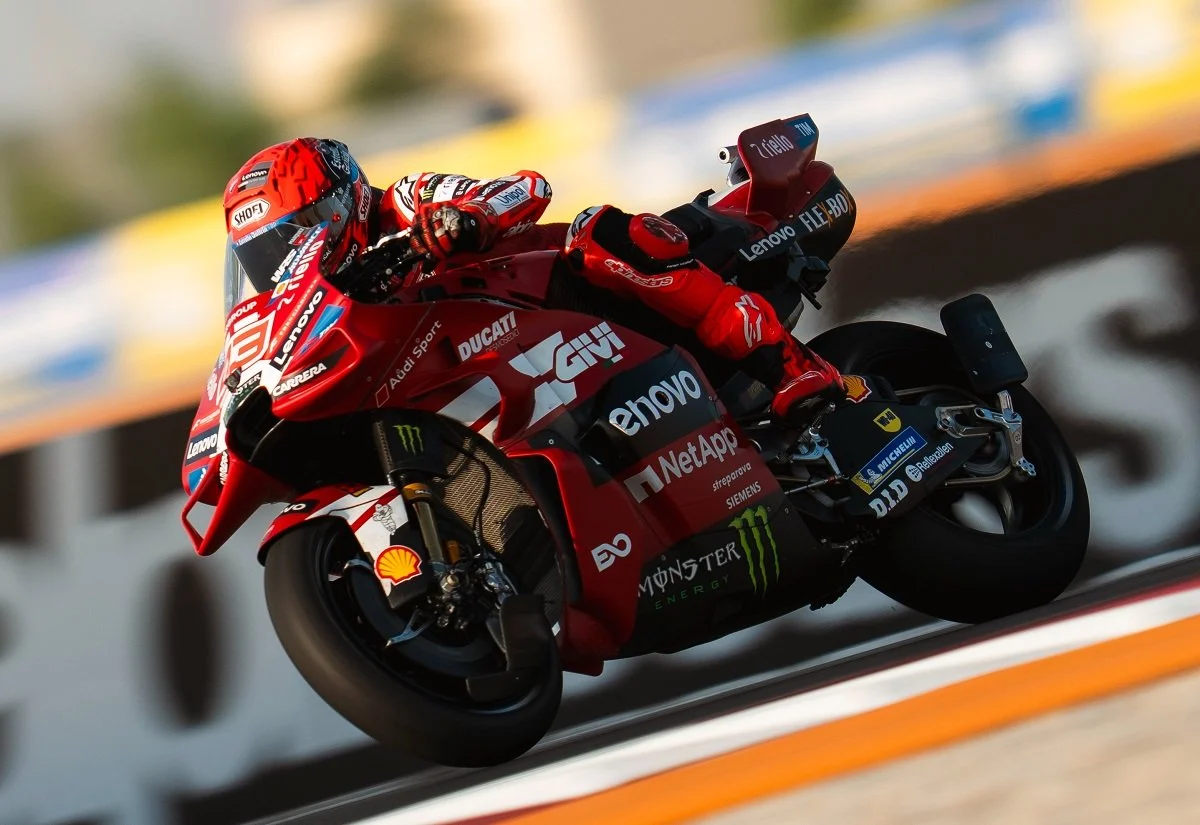
The 2026 MotoGP World Championship season has delivered its fair share of high-octane drama, but few moments match the visceral, physiological intensity experienced by Ducati Lenovo Team’s Marc Marquez during the closing stages of the Grand Prix of Qatar at the Lusail International Circuit. Racing under the dazzling floodlights of Doha on Sunday, November 8, 2026, the Spanish veteran was pushed to absolute physical and biological limits. In what he later described as one of the most taxing races of his illustrious career, Marquez revealed that his heart rate soared to a staggering 190 beats per minute (BPM) during the frantic final two laps of the race—a physiological threshold he had not touched in over a decade of elite Grand Prix competition.
The disclosure, first shared by the multi-time world champion via his verified social media channels before being elaborated upon in post-race media debriefs, highlights the immense athletic demands of modern MotoGP. While the physical toll of riding a 300-horsepower prototype motorcycle is well documented, Marquez’s candid admission offers a rare, data-driven window into the acute stress experienced by elite riders when championship stakes collide with grueling on-track combat. Despite the severe physical depletion, the aggressive maneuvering on track allowed Marquez to extend his championship lead over his closest rival, Jorge Martin, to a commanding 60 points with the season rapidly drawing to a close.
The Anatomy of a Heart-Stopping Finale
The climax of the Qatar Grand Prix was defined by a relentless battle for positioning that forced Marquez to dig deeper into his physical reserves than he had planned. As the race entered its twilight laps, the Ducati rider found himself locked in a fierce tactical pursuit, ultimately hunting down and overtaking Trackhouse Racing’s Raul Fernandez to secure a vital second-place finish.
The exertion required to execute those precise overtaking maneuvers while managing tire degradation and machine stability sent Marquez’s cardiovascular metrics into overdrive. Sharing a telemetry screenshot of his biometric data with his global fanbase on the Tuesday following the race, Marquez noted the historical significance of the reading.
"It has been more than 10 years since the last time my heart rate reached this number," Marquez wrote, capturing the anxiety of the moment. "My heart felt like it was going to pop out in the last two laps!"
For a professional athlete whose resting heart rate is exceptionally low due to rigorous cardiovascular conditioning, reaching 190 BPM indicates that the body was operating at its absolute maximum anaerobic and aerobic capacity. The data underscored that Marquez was not merely managing a points gap; he was engaged in an all-out physiological survival test against both his competitors and his own physical limitations.
A Weekend Defined by Conservation and Fatigue
To fully understand the gravity of Marquez’s physical state during the Grand Prix, one must examine the grueling schedule and the toll it took on his body leading up to the Sunday evening race. The 2026 MotoGP calendar, characterized by its unrelenting triple-header flyaway sequence, had already stretched the paddock’s physical endurance to the breaking point. For Marquez, who has navigated a heavily documented history of major injuries and surgeries throughout his career, managing physical stamina has become an essential component of his race-weekend strategy.
Speaking to international media outlets, including Crash, Marquez detailed the extent of his exhaustion heading into the Doha weekend. "Physically, I am completely exhausted: three races in a row, and this weekend I was completely overwhelmed," Marquez admitted.

The weekend’s progression illustrated a calculated exercise in energy preservation. Marquez revealed that his team had to drastically alter their usual practice and preparation routines just to ensure the rider had enough stamina to complete the Grand Prix distance.
"If you look at Friday afternoon, I could only do two laps and then stop, then two laps again; even this morning, during the warm-up session, I went out onto the track late—all to save energy for the race," he explained.
This austere approach to practice sessions meant that Marquez and his crew had to rely heavily on simulator data, overnight engineering analysis, and past setup knowledge rather than extensive track time. Yet, despite the lack of optimal preparation and the lingering fatigue from a punishing triple-header schedule, Marquez emphasized that his mental sharpness remained a key asset. While his body was sending distress signals, his tactical focus and cognitive processing under pressure allowed him to maximize his points haul when it mattered most.
The Tactical Pursuit of Raul Fernandez
The catalyst for the dramatic spike in Marquez’s heart rate was the fierce on-track duel that unfolded in the closing stages of the 22-lap race at Lusail. As the front-runners managed their Michelin rubber across the abrasive Qatari asphalt, the battle for the podium positions intensified significantly in the final third of the event.
Raul Fernandez, riding with impressive pace and defensive resilience, proved to be a formidable obstacle. Marquez, cognizant of the broader championship implications and the necessity of capturing every available point against Jorge Martin, realized that settling for third place was suboptimal. Initiating a late-race charge, Marquez pushed his Ducati Desmosedici GP to the limit, threading the needle through high-speed sweeping corners where aerodynamic turbulence and rear-wheel sliding demand absolute precision.
The maneuver to overtake Fernandez required a high-risk, high-reward braking calculation. Executing the pass in the tightening radius of the Lusail circuit’s complex required a sudden, explosive burst of physical strength to alter the bike’s trajectory while managing the aggressive power delivery of the V4 engine. It was during this intense sequence of acceleration, hard braking, and defensive positioning that Marquez’s biometric telemetry registered the unprecedented 190 BPM spike. The resulting pass not only secured second place on the podium but also inflicted a crucial psychological and points-based blow to his championship rivals.
Championship Implications and the Road Ahead
While the race did not mathematically seal the 2026 MotoGP World Championship, the sporting and psychological implications of Marquez’s performance in Qatar are profound. By stretching his advantage over Jorge Martin to 60 points, Marquez solidified his status as the driver of the championship narrative, showcasing a blend of raw speed, tactical maturity, and sheer grit.
In modern motorcycle racing, where marginal gains dictate success, physiological monitoring has evolved into an essential tool for teams and riders. Data streams tracking heart rate, core body temperature, and hydration levels help athletes understand their limits under extreme stress. Marquez’s open disclosure of his 190 BPM reading serves as a reminder of the human element embedded within technological motorsport. Behind the carbon-fiber helmet and the millions of dollars of advanced engineering lies an athlete metabolizing acute stress in real time.
As the 2026 season hurtles toward its thrilling conclusion, the resilience demonstrated by the Ducati Lenovo rider in Doha reinforces his enduring competitive hunger. Whether Marquez can close out the championship campaign without pushing his cardiovascular system to such dangerous extremes again remains to be seen. However, the Qatar Grand Prix has etched another unforgettable chapter into his career lore—proving that even after a decade at the absolute pinnacle of motorcycle racing, Marc Marquez still possesses the capacity to leave his heart on the track.