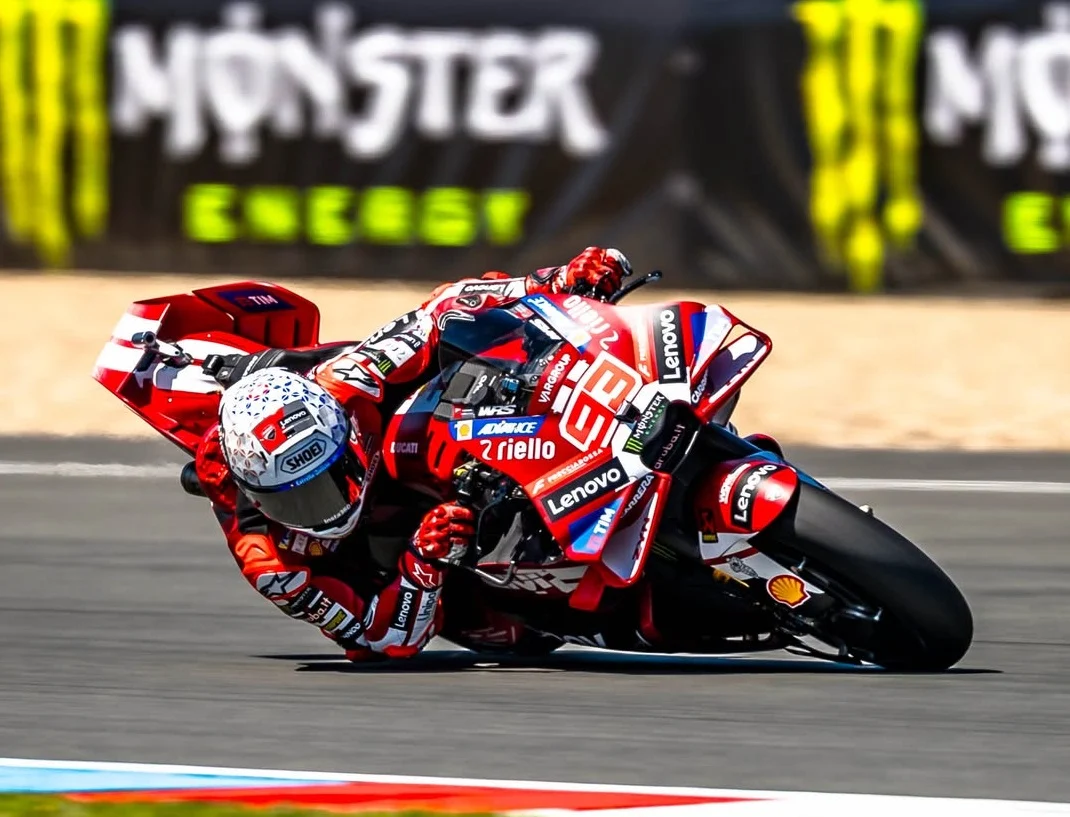
JAKARTA – Five-time MotoGP World Champion Jorge Lorenzo has identified three distinct "ace cards" that he believes will grant Ducati Lenovo rider Marc Marquez a significant competitive edge in the latter half of the 2026 MotoGP season, potentially propelling him towards a championship title. Lorenzo, who shared the Repsol Honda garage with Marquez in 2019, articulated his insights on his podcast, "Duralavita," revealing a strategic advantage rooted in specific circuit characteristics.
The Counter-Clockwise Circuit Advantage
Lorenzo’s analysis centers on Marquez’s exceptional prowess at circuits that feature a predominantly counter-clockwise layout. He posits that Marquez possesses a unique ability to dominate these tracks, an advantage not shared by his rivals. "He has three trump cards that others do not possess, namely three circuits with counter-clockwise layouts," Lorenzo stated, as reported by Motosan on Monday, July 19, 2026.
These strategically important venues, according to Lorenzo, are Aragon, followed by Phillip Island towards the end of the season, and finally, the season-closer at Valencia. Lorenzo emphasized the critical role these tracks could play if the championship battle remains close. "If he arrives there with a very tight classification, he could have a significant competitive advantage," he explained.
The former champion further elaborated on the physics and rider dynamics at play. "I think when you arrive at a circuit with left-hand corners, like these three circuits, you have an 80-90 percent chance of winning," Lorenzo remarked. This assertion stems from the physical demands placed on a rider and their machinery. In counter-clockwise circuits, riders lean into left turns more frequently, which can lead to greater tire wear on the right side and increased strain on the rider’s left arm and shoulder. Marquez, with his adaptive riding style and exceptional physical conditioning, has historically excelled in these scenarios, mitigating the usual challenges.
Conversely, Lorenzo noted the parity on tracks with a more even distribution of right-hand turns. "However, on circuits with right-hand corners, things are much more balanced. The championship becomes very interesting," he added. This highlights the fact that while Marquez is a formidable competitor on any track, his dominance is amplified on circuits that play to his specific strengths, reducing the opportunities for other riders to exploit potential weaknesses.
Sachsenring: A Testament to Marquez’s Counter-Clockwise Mastery
The recent triumph of Marc Marquez at the Sachsenring circuit in Germany serves as a powerful empirical validation of Lorenzo’s theory. The Sachsenring, renowned for its demanding layout, features an overwhelming majority of left-hand turns – specifically, ten left turns compared to only three right turns. This configuration creates a unique challenge, with a significant portion of the lap characterized by sustained leaning into left-hand corners, particularly in the second and third sectors of the track.
Marquez’s victory at the German Grand Prix on the weekend of July 10-12, 2026, marked his tenth premier class Grand Prix win and his thirteenth across all categories at the Sachsenring. This remarkable achievement drew a historical parallel, equaling the record for the most wins at a single circuit held by the legendary Giacomo Agostini at Imatra. This repetition of success at a track that heavily favors left-hand turns underscores Lorenzo’s point about Marquez’s distinct advantage.
The Sachsenring performance was not merely a win; it was a display of mastery. Marquez navigated the challenging sequence of left turns with his signature precision and aggression, demonstrating a level of comfort and speed that his competitors struggled to match. This performance, occurring mid-season, serves as a potent indicator of his potential to leverage similar advantages at the identified counter-clockwise circuits later in the year.

The Strategic Significance of Aragon, Phillip Island, and Valencia
The three circuits identified by Lorenzo—Aragon, Phillip Island, and Valencia—each possess distinct characteristics that contribute to their strategic importance in the context of Marquez’s potential championship charge.
Aragon (MotorLand Aragón): Located in the Aragon region of Spain, this circuit is known for its sweeping, fast corners and a long straight. While it does feature a mix of left and right turns, the layout has historically favored riders with strong cornering speed and stability, areas where Marquez has consistently excelled. The track’s counter-clockwise orientation (though less pronounced than Sachsenring) and its demanding nature can indeed play into Marquez’s strengths, particularly his ability to carry speed through corners. The Spanish fans’ passionate support at Aragon also provides an emotional boost for the Catalan rider.
Phillip Island (Phillip Island Grand Prix Circuit): The iconic Australian circuit is a true test of a rider’s skill and bravery. It is characterized by incredibly fast, flowing left-hand corners and a significant amount of time spent leaned over. The wind is also a major factor, often making it one of the most unpredictable and challenging tracks on the calendar. Marquez’s innate talent for managing grip in high-speed corners and his ability to adapt to changing conditions make Phillip Island a prime venue for him to assert dominance. The sheer number of fast left-handers aligns perfectly with Lorenzo’s thesis.
Valencia (Circuit Ricardo Tormo): The season finale at Valencia is a tight, twisty circuit with a surprising number of left-hand turns, despite its relatively short lap length. It is often described as a "stadium" circuit due to the spectator accessibility around the track. While it might not appear as overtly "counter-clockwise" as Sachsenring, the nature of its turns, particularly the sequence leading onto the main straight, demands excellent corner-exit drive and precision. For Marquez, if the championship is on the line, this circuit offers an opportunity to capitalize on any lingering advantage in cornering performance, especially against rivals who might be struggling with tire degradation or confidence in the tight sections.
Broader Implications for the 2026 MotoGP Season
Lorenzo’s assessment carries significant weight, given his intimate knowledge of MotoGP’s competitive landscape and his firsthand experience with Marquez’s formidable abilities. His analysis suggests that the 2026 MotoGP championship could be decided not just by raw pace and consistency across all tracks, but by the strategic exploitation of specific circuit layouts.
If Marquez can indeed translate this theoretical advantage into tangible results at Aragon, Phillip Island, and Valencia, it would significantly complicate the championship aspirations of his rivals. Riders who might be stronger on clockwise tracks or more adaptable across the board could find themselves at a distinct disadvantage in the crucial closing stages of the season.
The Ducati Lenovo team, known for its strong technical package, would also benefit immensely from such a scenario. A rider like Marquez, capable of maximizing performance on these specific circuits, could elevate the team’s championship prospects. The team’s engineers would likely focus on fine-tuning the bike setup to further enhance Marquez’s strengths on these counter-clockwise layouts, potentially creating an even wider performance gap.
The Psychological Edge
Beyond the physical and technical aspects, Lorenzo’s observation also touches upon the psychological dimension of racing. Knowing that a particular track layout plays to one’s strengths can provide a significant mental boost. For Marquez, the prospect of entering these key races with a known competitive advantage could foster a sense of confidence and control, putting immense pressure on his competitors. This psychological edge, combined with his on-track prowess, could prove to be the decisive factor in a closely contested championship.
The 2026 MotoGP season, therefore, appears poised for a dramatic conclusion, with Jorge Lorenzo’s astute analysis highlighting the intricate interplay of rider skill, machine performance, and circuit characteristics that will ultimately determine the world champion. The three counter-clockwise circuits identified by Lorenzo will undoubtedly be watched with keen interest as they could very well become the battlegrounds where the 2026 MotoGP crown is decided.