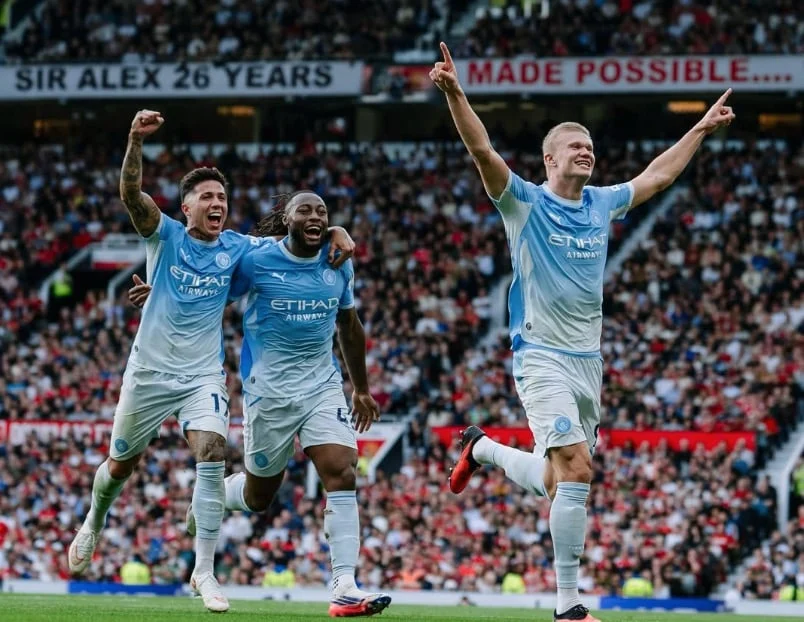
The Manchester Derby remains one of the most storied fixtures in global football, and the latest iteration at Old Trafford on September 14, 2026, lived up to its reputation for drama and tactical intensity. In a match defined by narrow margins, tactical resilience, and a contentious VAR intervention, Manchester City emerged victorious with a 1-0 win over their cross-town rivals, Manchester United. The decisive moment arrived in the 60th minute when Erling Haaland, the prolific Norwegian striker, found the back of the net to maintain City’s perfect start to the domestic campaign.
A Game of Two Halves and High Stakes
The atmosphere at Old Trafford was electric, with both sides entering the fray with distinct objectives. For Manchester United, the match represented a critical opportunity to stabilize their season after a shaky start. For Pep Guardiola’s Manchester City, it was a test of their ability to maintain dominance despite early adversity.
The first half was characterized by a high-tempo chess match, which took a significant turn when Manchester City’s Phil Foden was dismissed with a straight red card. The dismissal, which occurred during a heated midfield challenge, forced the visitors to reorganize defensively for the remainder of the contest. Despite the numerical disadvantage, City’s tactical discipline allowed them to frustrate United’s offensive buildup, successfully neutralizing the threats posed by the hosts’ creative core.
Chronology of the Conflict
The second half began with a renewed sense of urgency from the home side. Sensing the numerical advantage, Manchester United pressed high, looking to exploit the gaps in City’s defensive line. The most significant moment of the early second half occurred in the 51st minute, when Kobbie Mainoo unleashed a stinging drive from outside the penalty area. The ball struck the left post, ricocheted into the frame of Gianluigi Donnarumma, and somehow stayed out of the net, much to the frustration of the Old Trafford faithful.
The tide turned decisively in the 60th minute. Josko Gvardiol, overlapping on the left flank, delivered a cross that took a deflection off a United defender. The ball fell kindly to Erling Haaland, who was initially flagged for offside. After a lengthy review by the Video Assistant Referee (VAR), the officials determined that the ball had come off a defender, rendering the offside call void. Haaland, showing composure under pressure, fired a precise volley past Senne Lammens from a tight angle to break the deadlock.
Following the goal, the match opened up significantly. In the 68th minute, Enzo Fernandez nearly doubled City’s lead, curling a long-range effort that rattled the frame of the goal. United responded with desperation, as Bruno Fernandes tested Donnarumma from distance in the 70th minute, only to be denied by a sharp save. Harry Maguire, pushed forward into an auxiliary striker role in the final minutes, came close with a header that sailed narrowly wide of the target. Despite late pressure from United, City’s backline remained resolute, securing a clean sheet and all three points.
Statistical Breakdown and Tactical Analysis
The statistical narrative of the match underscores the defensive shift necessitated by the red card. While Manchester United enjoyed a greater share of possession in the second half, City’s efficiency in the final third proved the difference.
- Possession: Manchester United 58% – 42% Manchester City
- Shots on Target: Manchester United 4 – 3 Manchester City
- Corners: Manchester United 7 – 2 Manchester City
- Fouls: Manchester United 11 – 14 Manchester City
The tactical setup employed by Guardiola post-red card demonstrated the versatility of his squad. By dropping the midfield deeper and relying on the hold-up play of Haaland, City were able to disrupt United’s rhythm. For United, the inability to capitalize on the extra man is a point of concern for the coaching staff. The reliance on long-range efforts from Fernandes and aerial threats from Maguire suggests a lack of penetration in the central channels against a low-block defense.

Reactions and Official Perspectives
While post-match statements from the managers remained guarded, the mood in both camps was starkly different. Sources close to the Manchester City dressing room indicated that Guardiola praised the "extraordinary defensive resilience" of his players, noting that winning at Old Trafford with ten men is a testament to the squad’s mental fortitude.
Conversely, the atmosphere within the Manchester United camp reflected deep frustration. The coaching staff emphasized the missed opportunities early in the second half, particularly the Mainoo strike that hit the woodwork. Analysts suggest that the failure to convert high-percentage chances has been a recurring theme in United’s early-season performance, putting increased pressure on the attacking transition.
Broader Implications for the Premier League Table
This result has significant ramifications for the 2026/2027 Premier League title race. Manchester City now moves to 12 points from four matches, sitting in second place. They trail current leaders Arsenal only on goal difference, setting the stage for an early-season battle of attrition between the two title favorites.
For Manchester United, the outlook is more precarious. This defeat marks their second loss in four matches, leaving them in the middle of the pack and struggling to find consistency. With the domestic schedule set to intensify in the coming weeks, the pressure on the club to refine their tactical approach and improve their conversion rate will mount significantly.
Historical Context and The Rivalry
The Manchester Derby has evolved significantly over the past decade. Once dominated by local talent and traditional rivalries, the fixture is now a global showcase of tactical innovation and financial investment. The integration of modern players such as Donnarumma, Lammens, and Fernandez into these squads highlights the global nature of the recruitment strategies employed by both clubs.
As the season progresses, this match will likely be viewed as a turning point. For City, it reinforces their status as the team to beat, demonstrating that even when hampered by disciplinary setbacks, they possess the quality to win. For United, it serves as a reality check, highlighting the gap between them and the league’s elite that must be bridged if they are to mount a serious challenge for the top four.
Concluding Thoughts
The 1-0 victory for Manchester City was a masterclass in game management. In a sport that increasingly prioritizes high-octane attacking football, the ability to control a game without the ball, and to execute a single, clinical opportunity under immense pressure, remains the hallmark of a champion. As the dust settles at Old Trafford, the focus shifts to the next round of fixtures, but the psychological advantage gained by City in this encounter cannot be understated.
The Premier League season remains in its infancy, yet the patterns of dominance are already beginning to emerge. Whether Manchester United can respond to this setback with a string of positive results, or whether Manchester City continues their relentless pursuit of the summit, will be the defining narrative of the next few months of English football. The rivalry between these two giants continues to provide the drama that makes the Premier League the most-watched sporting league in the world, and this latest chapter serves as a potent reminder of why the Manchester Derby remains the pinnacle of domestic competition.