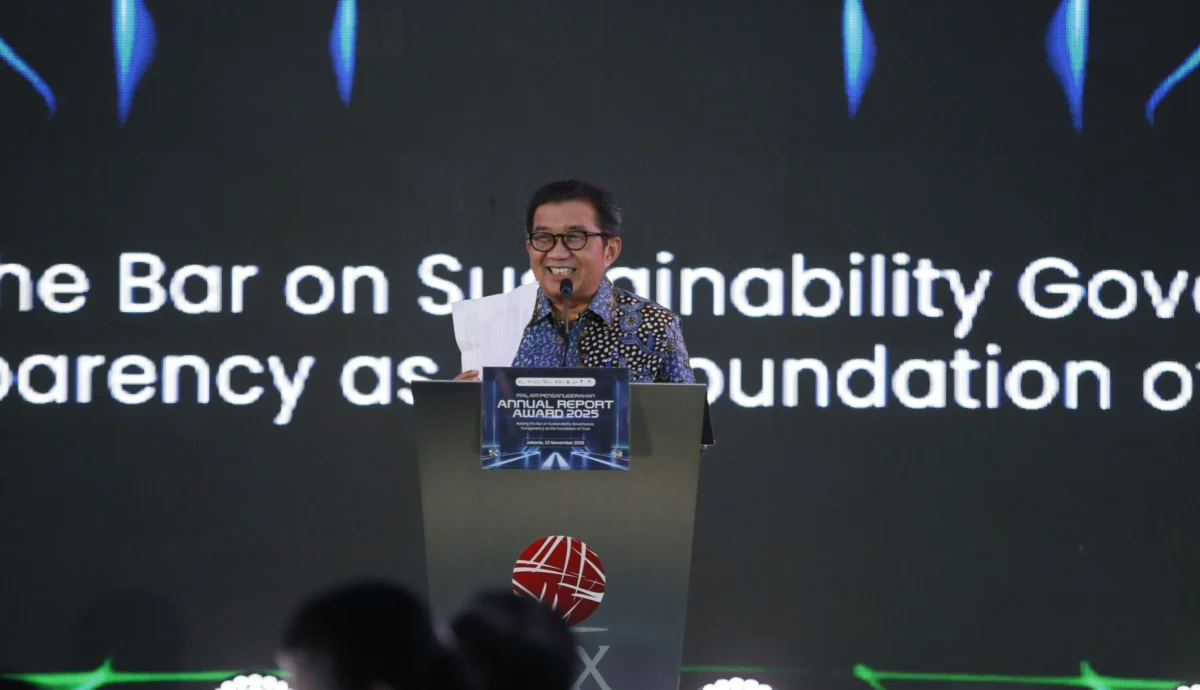
JAKARTA – The integrity of the Indonesian capital market faces a critical juncture as regulatory bodies tighten their oversight on corporate governance standards. During the prestigious Annual Report Award (ARA) 2025 ceremony held at the Main Hall of the Indonesia Stock Exchange (IDX) on Monday, November 23, 2026, the Deputy Chairman of the Supervisory Board, Muliaman D. Hadad, delivered a sobering message to the nation’s publicly listed companies. He underscored that in an interconnected financial ecosystem, the actions of a single entity can trigger systemic repercussions that threaten investor confidence across the entire market.
The event, which serves as a benchmark for transparency and quality in corporate reporting, became the backdrop for a stern reminder regarding the fragility of market trust. Muliaman emphasized that while individual corporate integrity is the responsibility of each board of directors, its cumulative effect forms the bedrock of the national economy’s capital formation engine.
The Anatomy of Market Trust and Systemic Risk
Muliaman D. Hadad’s address highlighted a fundamental truth in financial markets: trust is the primary currency. He categorized integrity into two distinct yet symbiotic spheres: corporate integrity and market integrity. Corporate integrity is defined by the accuracy of financial reporting, the transparency of management practices, and the accountability of the board. Market integrity, conversely, is the aggregate confidence that participants have in the fairness and efficiency of the trading system.
"Each time an issuer chooses to obscure financial realities, misrepresent earnings, or hide material conflicts of interest, they are essentially laying bricks for a fragile market foundation," Muliaman stated. His remarks were directed at the hundreds of executives present, urging them to view their annual reports not merely as compliance documents, but as vital instruments of stakeholder communication.
The risk, as identified by the Supervisory Board, is the "contagion effect." In capital markets, an investor’s reaction to a scandal is rarely localized. When a major firm is found to have manipulated its books, the resulting skepticism often leads to a broad divestment strategy. Investors, fearing that systemic rot might exist elsewhere, may opt to exit the market entirely rather than conduct the exhaustive due diligence required to distinguish "clean" companies from those hiding underlying issues.
Chronology of Governance Oversight in Indonesia
The emphasis on corporate governance in Indonesia has evolved significantly over the last decade. Following several high-profile corporate scandals in the early 2020s, regulatory bodies—including the Financial Services Authority (OJK) and the IDX—have incrementally increased the stringency of listing requirements.
- 2023: Regulatory updates were introduced to mandate stricter disclosure of environmental, social, and governance (ESG) metrics.
- 2024: The implementation of enhanced digital monitoring systems for real-time financial reporting began, allowing regulators to flag anomalies in quarterly filings more efficiently.
- 2025: The current year saw the integration of artificial intelligence in audit oversight, aimed at detecting non-disclosure of related-party transactions, which Muliaman specifically cited as a major danger point.
- Late 2026: The current focus has shifted from mere quantitative reporting to the qualitative aspect of "truth in presentation," culminating in the warnings issued at this year’s Annual Report Award.
This timeline reflects a transition from "rule-based" compliance to "principle-based" governance. Regulators are moving away from accepting boxes being checked and toward evaluating the spirit in which corporations engage with their shareholders.
The Economic Impact of Governance Failures
The implications of a governance breach extend far beyond the share price of the individual company involved. When market integrity is questioned, the cost of capital for all domestic firms tends to rise. Risk premiums increase, and international institutional investors may reclassify the market as "high-risk," leading to capital flight.
Data from the Indonesia Stock Exchange indicates that while the number of listed companies has grown steadily, the volatility associated with individual company scandals remains a deterrent to retail investor participation. Historically, when a mid-to-large-cap company faces an audit restatement or a corruption scandal, the broader market index often experiences a period of prolonged stagnation as investors shift to safer asset classes, such as government bonds or foreign equities.

Muliaman’s warning is particularly timely given the current macroeconomic environment, where inflationary pressures and global interest rate fluctuations already place strain on corporate balance sheets. In such an environment, transparent communication regarding debt sustainability and cash flow management is paramount.
Perspectives from the Industry and Regulators
Following Muliaman’s address, several market analysts and industry representatives echoed the sentiment that corporate governance is no longer a "nice-to-have" feature but a competitive necessity.
"The market is becoming increasingly unforgiving," said an independent financial analyst present at the event. "Investors now have access to a wealth of data through fintech platforms. If a company attempts to hide a conflict of interest, the discrepancy is usually found by the market within days, if not hours. The cost of being caught is now much higher than the cost of being transparent."
The Annual Report Award itself acts as a mechanism to encourage high standards. By recognizing companies that provide clear, honest, and comprehensive reporting, the authorities hope to create a "virtuous cycle" where transparency is rewarded with higher valuations and lower borrowing costs, thereby incentivizing others to follow suit.
Analyzing the "Conflict of Interest" Trap
One of the specific areas highlighted by the Deputy Chairman was the failure to disclose conflicts of interest. In emerging markets, family-owned conglomerates and complex corporate structures often create scenarios where the interests of the majority shareholders may diverge from the interests of minority shareholders.
When these conflicts are not disclosed, it creates an "asymmetric information" problem. The market is not operating on a level playing field, and the subsequent discovery of such conflicts invariably leads to a loss of investor confidence. Muliaman’s message serves as a clear directive: the regulator will no longer tolerate the "gray areas" that companies have historically used to mask such relationships.
Future Outlook and Regulatory Enforcement
Looking ahead, the Supervisory Board is expected to ramp up enforcement actions in 2027. This includes more frequent "on-site" inspections of audit committees and a more aggressive posture toward firms that fail to address findings from external auditors.
The message from the 2025 Annual Report Award is clear: the era of "creative accounting" and opaque management is closing. Companies that prioritize short-term stock price manipulation over long-term structural integrity will find themselves increasingly isolated. As Muliaman noted, the companies that are currently performing well and operating with integrity are the ones who stand to lose the most if the overall market reputation is tarnished by the reckless actions of a few.
Ultimately, the sustainability of the Indonesian capital market depends on the collective commitment of its participants. By linking individual corporate ethics to the stability of the entire market, the regulatory authorities are attempting to foster a culture of shared responsibility. For the thousands of investors—both local and international—who rely on the Jakarta market for their financial future, the message is one of necessary, if stern, vigilance. The path forward requires a uncompromising adherence to the principles of transparency, accountability, and ethical management, ensuring that the Indonesian capital market remains a robust and attractive destination for global capital.