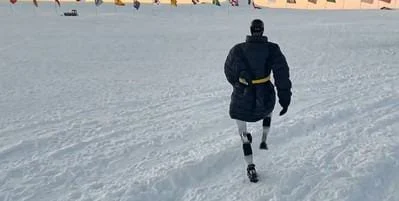
Antarctica, widely regarded as the most hostile environment on Earth, recently served as the testing ground for a pioneering venture in robotics. On November 8, a humanoid robot attempted to navigate the grueling terrain of the White Continent as part of a marathon held at Camp Ultima. This event, which saw the robot join a field of 25 human athletes, marked the first time a humanoid machine has been deployed in a formal endurance race within the Antarctic Circle. Despite being outfitted with specialized thermal protection, the robot’s foray into extreme-environment athletics was cut short, highlighting the significant chasm that remains between laboratory success and real-world utility in sub-zero conditions.
The expedition, which saw temperatures plummet to minus 24 degrees Celsius (minus 11.2 degrees Fahrenheit), was designed to test the limits of battery technology, joint mobility, and thermal regulation in automated systems. While the human participants prepared to tackle distances reaching up to 160 kilometers (99 miles), the robot managed to cover only three kilometers before its internal power systems failed, forcing a premature end to its mission.
The Chronology of the Antarctica Trial
The deployment of the humanoid robot to Camp Ultima was the culmination of months of logistical preparation. Shipping sensitive robotics equipment to Antarctica requires adherence to strict environmental protocols and rigorous climate-proofing measures. Upon arrival, the technical team spent several days calibrating the robot’s actuators, which are notoriously susceptible to "brittleness" and lubrication freezing in extreme cold.
On the morning of November 8, the robot stood at the starting line alongside international athletes. The race began under clear but biting conditions. For the first few hundred meters, the robot maintained a steady gait, adjusting its center of gravity to compensate for the shifting, icy surface of the Antarctic terrain. However, the extreme thermal load required to keep the onboard electronics within operational parameters began to draw power at an exponential rate. By the three-kilometer mark, the onboard diagnostic systems reported critical voltage drops, and the robot’s central processor initiated a shutdown sequence to prevent permanent hardware damage. The support team retrieved the unit, marking the conclusion of its maiden Antarctic run.
Contextualizing Performance: From Beijing to the South Pole
The attempt at Camp Ultima stands in stark contrast to the robot’s performance in more controlled, temperate environments. Earlier this year, in Beijing, China, a humanoid unit of similar design participated in a half-marathon, where it demonstrated agility and speed that shocked the robotics community. In that event, the robot traversed the 21-kilometer course in just 50 minutes and 26 seconds.
To put this achievement into perspective, the current human world record for a half-marathon is held by Ugandan athlete Jacob Kiplimo, who clocked a time of 57 minutes and 31 seconds in Lisbon in 2021. The robot’s ability to outperform a world-class human athlete in Beijing was attributed to constant-speed maintenance and the lack of cardiovascular fatigue. However, the disparity between the Beijing result and the Antarctic failure underscores a fundamental challenge in robotics: energy density. While a robot can be optimized for a flat, urban track, the chaotic, high-resistance, and thermally taxing environment of the Antarctic presents variables that current battery and thermal insulation technologies cannot yet resolve.
Technical Challenges of Polar Robotics
The failure of the robot in Antarctica provides researchers with invaluable data regarding "cold-soak" effects. In extreme cold, chemical batteries experience a sharp decline in discharge capacity. Even with thermal jackets and internal heating elements, the energy required to prevent a battery from freezing often consumes the very power needed for locomotion.
Engineers involved in polar exploration technologies note that the mechanical design of humanoid robots poses unique challenges compared to wheeled or tracked vehicles. A humanoid relies on complex multi-joint movements to maintain balance. Each joint requires an actuator, and each actuator requires energy. When the lubricating grease in these joints thickens due to the cold, the actuators must work harder, creating a feedback loop of increased power consumption and decreased operational life. Furthermore, the sensitivity of sensors and cameras to sudden temperature shifts can lead to condensation or internal short-circuiting, further complicating the deployment of such units in polar regions.
Industry and Academic Perspectives
While the mission did not reach its goal of completing a long-distance segment, robotics experts are viewing the event as a necessary "stress test." Dr. Aris Thorne, a robotics analyst, noted in a post-event analysis that the goal of such missions is rarely to win a race, but to identify the "breaking point" of the machine.
"We often see humanoid robots performing beautifully in pristine lab conditions," Dr. Thorne remarked. "The move to the Antarctic is the ultimate litmus test. The fact that it moved at all in minus 24-degree weather is a technical achievement in itself. The failure at three kilometers is not a defeat; it is a data point that informs the next generation of battery management systems and material science."
From the perspective of the race organizers at Camp Ultima, the inclusion of a robot was intended to spark a dialogue about the future of exploration. As climate change continues to alter the Antarctic landscape, the potential for autonomous systems to conduct research, monitor ice shelf stability, and perform search-and-rescue operations is growing. The robot’s participation served as a public-facing demonstration of the current technological plateau, signaling to the scientific community that while robotics is advancing rapidly, the "last mile" of rugged, autonomous operation remains a significant hurdle.
Broader Implications and Future Trajectory
The implications of this experiment extend far beyond the realm of competitive sports. The development of robots capable of operating in extreme temperatures has critical applications in space exploration—specifically for missions to icy moons like Europa or Enceladus—as well as in high-latitude infrastructure maintenance and climate research.
- Energy Management: The industry will likely pivot toward developing solid-state batteries or alternative power sources, such as micro-nuclear batteries or high-efficiency thermal harvesting, to overcome the cold-induced power drain observed in Antarctica.
- Material Science: Research into cold-resistant polymers and synthetic lubricants will be accelerated to ensure that humanoid joints maintain elasticity at extreme temperatures.
- Autonomous Navigation: The challenge of traversing uneven, unpredictable terrain in low-visibility, high-glare polar conditions remains a priority for artificial intelligence developers.
Looking ahead, the team behind the humanoid project has confirmed they are already analyzing the telemetry data from the November 8 event. Adjustments to the gait cycle, thermal insulation layering, and power distribution algorithms are expected to be implemented before the next series of field tests.
While the Antarctica marathon did not result in a new record for artificial intelligence, it served as a sobering reminder of the complexity of the natural world. As technology continues to evolve, the ambition to integrate humanoids into the most unforgiving corners of our planet remains a key driver of innovation. The "three-kilometer run" in Antarctica is effectively the first step in a long, iterative journey toward creating machines that can work alongside humans, regardless of the climate, in the service of exploration and scientific discovery. The path to fully functional polar robotics is steep, but the precedent set at Camp Ultima ensures that the next attempt will be backed by a more profound understanding of the environmental barriers that define the limits of machine endurance.