
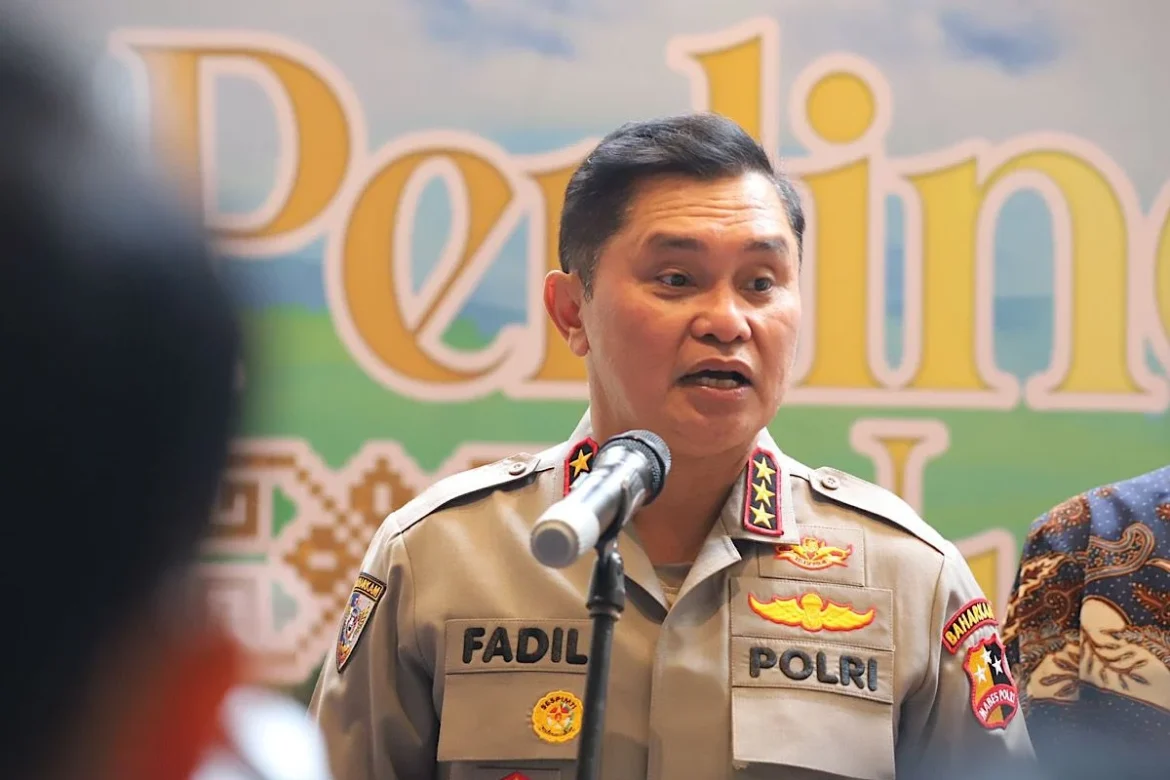
The Indonesian National Police (Polri) has officially marked the conclusion of service for two high-ranking officers who share a significant historical bond with the current Chief of National Police, General Listyo Sigit Prabowo. As of September 10, 2026, Commissioner General (Komjen) Mohammad Fadil Imran and Inspector General (Irjen) Andi Rian Ryacudu Djajadie have entered their retirement phase, formally stepping down from their respective duties within the Bhayangkara Corps. This transition, formalized under the official Surat Telegram (ST) Number ST 1877/VIII/KEP/2026, signifies a generational shift within the upper echelons of the police force, as these officers were part of the celebrated Akpol (Police Academy) Class of 1991—the same cohort that produced General Listyo Sigit Prabowo.
The Significance of the Class of 1991
The retirement of Fadil Imran and Andi Rian is not merely a routine administrative turnover; it represents the phasing out of a cohort that has been instrumental in shaping the modern face of the Indonesian National Police. The 1991 Akpol graduating class has been colloquially known in security circles as a "powerhouse" batch, producing a disproportionate number of high-ranking officials who have navigated the institution through turbulent socio-political transitions, the challenges of the COVID-19 pandemic, and the modernization of investigative and operational standards.
General Listyo Sigit Prabowo’s leadership, supported by peers from his own graduating class, has focused on the implementation of the "Presisi" (Predictive, Responsibility, Transparency, and Fairness) model. With the departure of key figures like Fadil and Andi, the institution faces a pivot point where younger, next-generation officers are expected to rise into strategic positions, carrying the legacy of the "Presisi" doctrine while adapting to the evolving threats of digital crime, radicalization, and the complexities of the 2029 national election cycle.
Profile of the Retiring Officers
Commissioner General (Purn) Mohammad Fadil Imran concludes his illustrious career as the Assistant to the Chief of Police for Operations (Astamaops). His career has been marked by high-profile assignments, most notably his tenure as the Chief of the Jakarta Metropolitan Police (Kapolda Metro Jaya) during a period of intense social mobilization and public health crises. Known for his tactical approach to urban security, Fadil was a central figure in coordinating the police’s response to major events in the capital. His role as Astamaops was critical in managing nationwide security operations, large-scale event security, and the logistical coordination of the force’s operational theater.
Inspector General (Purn) Andi Rian Ryacudu Djajadie, meanwhile, served as the Deputy Head of the Education and Training Institute (Wakalemdiklat) of the Polri. Throughout his career, Andi Rian was recognized as a seasoned investigator, particularly in the Criminal Investigation Agency (Bareskrim). His leadership in handling high-profile criminal cases solidified his reputation as a "tough-on-crime" officer. His transition into the educational sector was seen as a move to instill his extensive investigative expertise into the training curricula for the next generation of police officers.
The Administrative Transition: Surat Telegram 1877/VIII/KEP/2026
The release of Surat Telegram ST 1877/VIII/KEP/2026 confirms the systemic rotation of leadership. Beyond the retirement of these two generals, the document outlines a broader shuffling of personnel, a standard practice in the Polri to ensure institutional dynamism and to prevent the stagnation of command structures.
The most notable shift resulting from this rotation is the promotion of Inspector General Roycke Harry Langie, who will transition from his current role as the Chief of Police in North Sulawesi (Kapolda Sulawesi Utara) to assume the position of Astamaops Kapolri. This appointment is significant, as the position of Astamaops is a strategic three-star role. Consequently, the appointment necessitates the promotion of Roycke Harry Langie to the rank of Commissioner General, effectively ushering in a new, younger officer into the highest tier of the police hierarchy.

Public Sentiment and Internal Reflections
In an emotional farewell message shared via his personal social media platforms, Komjen (Purn) Fadil Imran expressed profound gratitude for his three decades of service. "Syukur (Gratitude). This word is simple but deep in its meaning. I am grateful because God gave me the opportunity to serve for more than three decades in an institution that I love," Fadil stated during his final farewell ceremony. His reflections underscore the ethos of the 1991 cohort, which often emphasized the concept of "Pengabdian" (Service) as a cornerstone of their professional identity.
Internal observers note that the departure of these senior figures is met with a mix of respect and expectation. Within the police barracks, there is a clear understanding that retirement is the natural conclusion to a lifelong commitment to state service. However, the loss of institutional memory held by officers like Fadil and Andi Rian requires an accelerated transfer of knowledge to the successors who will now lead the force into the latter half of the 2020s.
Strategic Implications for the National Police
The retirement of two peers of the current Kapolri also highlights the changing demographic of the police force. As the 1991 class begins to exit, the "Sigit Era" of the Polri is transitioning from its foundational phase to its consolidation phase. Analysts suggest that the incoming cohort, represented by the likes of the newly promoted Commissioner General Roycke Harry Langie, will be tasked with three primary challenges:
- Digital Transformation: The National Police has been aggressive in its pursuit of cyber-intelligence capabilities. The new leadership will need to maintain the pace of technological adoption to combat transnational cybercrime and the proliferation of disinformation.
- Maintaining Public Trust: Following various institutional controversies over the past few years, the police force has been working to rebuild its image. The appointment of officers with strong operational backgrounds, like Roycke Harry Langie, suggests a continued focus on professional conduct and the reduction of police-related misconduct.
- Stability During Political Transitions: With the 2029 electoral cycle approaching, the police must maintain strict political neutrality. The transition of leadership at the level of the Astamaops is vital to ensuring that the command chain remains solid and resistant to external political pressures.
Institutional Continuity
The transition process within the Polri is designed to be seamless. By utilizing the Surat Telegram system, the organization ensures that no operational vacuum is created. The appointment of a replacement before the official departure date allows for a handover period where institutional priorities, ongoing investigations, and operational strategies are communicated.
The role of the Astamaops is particularly sensitive. It manages the police’s heartbeat—the operational readiness of the force across the archipelago. The promotion of Roycke Harry Langie from a regional command (Kapolda) to a national-level strategic command is consistent with the police’s meritocratic approach to talent development. It allows for officers with proven experience in diverse regional landscapes—ranging from the high-tension urban environment of Jakarta to the diverse socio-cultural landscape of North Sulawesi—to influence national policy.
Conclusion: A Legacy of Service
The retirement of Mohammad Fadil Imran and Andi Rian Ryacudu Djajadie is a milestone in the history of the Indonesian National Police. Their careers reflect the broader trajectory of the institution: from a period of fundamental reorganization to one of stabilization and modernization. As these two generals lay down their badges, they leave behind a force that is arguably more professional, better equipped, and more deeply integrated into the digital age than the one they joined three decades ago.
As the force moves forward, the focus will now shift to how the new guard—those inheriting the mantle from the Class of 1991—will balance the demands of modern governance with the core, traditional duty of maintaining public order and security. The departure of these figures serves as a reminder that the Bhayangkara Corps is an evolving entity, one that remains defined by the dedication of those who serve, even as the names and faces in the top command structures change with the passing of time. For the incoming generation, the challenge remains clear: to uphold the "Presisi" mandate and ensure the institution remains a trusted pillar of the Indonesian state.
