
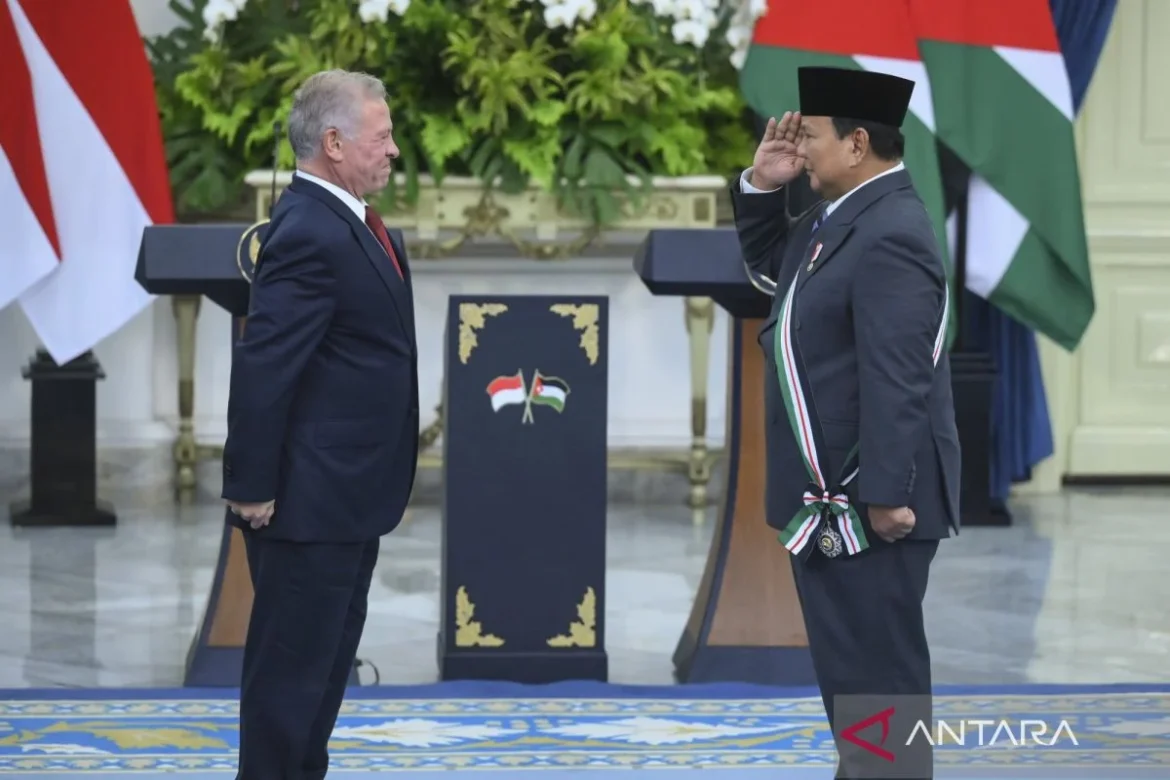
Jakarta is poised to host a significant diplomatic event this Friday afternoon as His Majesty King Abdullah II bin Al-Hussein of the Hashemite Kingdom of Jordan arrives for a state visit, marking a crucial moment for strengthening bilateral relations between the two nations. The visit, part of a broader Asian tour, underscores the growing importance of Indonesia on the global stage and Jordan’s strategic efforts to diversify and deepen its international partnerships. King Abdullah II is scheduled to engage in high-level discussions with Indonesian President Prabowo Subianto, followed by a meeting with representatives from Danantara Indonesia, a key player in the nation’s strategic industries. A highlight of the visit will be the witnessing of the signing of a bilateral Memorandum of Understanding (MoU), anticipated to solidify cooperation across various sectors and pave the way for future collaborative endeavors.
A Deepening Diplomatic Engagement and Personal Rapport
The forthcoming state visit builds upon a foundation of established diplomatic ties and a unique personal connection between the two leaders. President Prabowo Subianto had previously undertaken a visit to Jordan on April 14, 2025, where he held a private meeting with King Abdullah II at the majestic Al Husseiniya Palace in Amman. That engagement, which occurred on the second day of President Prabowo’s tour to the Hashemite Kingdom, served as a precursor to the current high-level interaction, signaling a shared commitment to fostering closer relations. Beyond official protocols, King Abdullah II and President Prabowo Subianto share a long-standing personal friendship, forged during their younger years, largely attributable to their common military backgrounds and their shared alma mater, the esteemed United States Army training institution at Fort Benning. This shared history and mutual respect are expected to imbue the official proceedings with a distinct warmth and understanding, potentially facilitating more candid and productive discussions on matters of mutual interest.
The visit comes at a time when both Indonesia, as the world’s largest Muslim-majority nation and a burgeoning G20 economy, and Jordan, a pivotal player in the Middle East, are actively seeking to enhance their roles in regional and global affairs. For Indonesia, hosting King Abdullah II provides an opportunity to reinforce its image as a bridge-builder and a significant voice for moderation and stability, particularly within the Islamic world. For Jordan, the visit to Indonesia, a prominent member of ASEAN and the Organization of Islamic Cooperation (OIC), is a strategic move to cultivate stronger ties with key Asian economies, fostering economic growth and political support amidst a complex geopolitical landscape.
King Abdullah II’s Strategic Asian Tour
King Abdullah II’s visit to Indonesia is an integral part of a wider diplomatic tour across Asia, demonstrating Jordan’s concerted effort to broaden its horizons and strengthen partnerships beyond its traditional allies. Prior to his arrival in Jakarta, the Jordanian monarch has engaged with leaders in other vital Asian economies, including Japan, Vietnam, Singapore, and Pakistan. This carefully curated itinerary reflects Jordan’s foreign policy objectives: to diversify its economic partnerships, attract foreign investment, and secure political support for its regional and international agenda.
In each of these nations, the King’s agenda likely focused on economic cooperation, trade enhancement, and discussions on regional and global security challenges. The choice of these Asian nations highlights their collective economic dynamism and strategic importance. Japan, a technological and economic powerhouse; Vietnam and Singapore, rapidly growing ASEAN economies and significant trade hubs; and Pakistan, a fellow Muslim-majority nation with substantial geopolitical weight, all offer unique opportunities for Jordan. This expansive tour underscores Jordan’s proactive approach to diplomacy, seeking to leverage its stable and moderate profile to forge new alliances and deepen existing ones, thereby bolstering its resilience and influence on the international stage. The stop in Indonesia, given its demographic size, economic potential, and diplomatic weight, is arguably one of the most significant engagements of this tour.
President Prabowo’s Prior Visit to Amman and the Foundations of Cooperation
President Prabowo Subianto’s visit to Amman on April 14, 2025, provided a crucial prelude to the current state visit. During his time in Jordan, President Prabowo engaged in extensive discussions with King Abdullah II, covering a wide array of topics, from bilateral trade and investment to regional security issues and interfaith dialogue. The meeting at Al Husseiniya Palace was reported to be highly productive, with both leaders expressing a strong desire to elevate the relationship between their countries.
During that visit, President Prabowo likely articulated Indonesia’s foreign policy priorities, including its commitment to peace, stability, and economic development, particularly within the Global South. Discussions may have also touched upon the ongoing humanitarian crises in the Middle East, with Indonesia reiterating its consistent stance on supporting Palestinian self-determination and humanitarian assistance. For Jordan, a nation at the forefront of regional challenges, Indonesia’s support and diplomatic engagement are invaluable. The prior meeting allowed the leaders to establish a shared understanding of mutual interests and potential areas for concrete cooperation, laying the groundwork for the bilateral agreements expected to be signed during King Abdullah II’s current visit to Jakarta. The personal connection, cultivated over decades, undoubtedly played a role in the candor and effectiveness of these high-level talks, fostering an environment of trust essential for robust diplomatic engagement.
Economic and Strategic Pillars: The Danantara Meeting and Phosphate Cooperation
A particularly salient aspect of King Abdullah II’s itinerary in Jakarta is his meeting with representatives from Danantara Indonesia. This meeting is highly significant, especially in light of the information from the Indonesian Foreign Minister, which explicitly stated that the King’s visit to Danantara would focus on cooperation concerning phosphate. Phosphate is a critical raw material, primarily used in the production of fertilizers, essential for global food security and agricultural productivity. Jordan possesses substantial reserves of high-quality phosphate rock, making it one of the world’s leading exporters of this vital commodity. Indonesia, with its vast agricultural sector and growing population, has a continuous demand for fertilizers to support its food production efforts.
This focus on phosphate cooperation presents a clear economic synergy. A bilateral agreement could secure a stable and affordable supply of phosphate for Indonesia, reducing its reliance on potentially volatile international markets. For Jordan, it represents an opportunity to strengthen its position as a reliable supplier to a major developing economy, diversifying its export markets. Beyond direct trade, cooperation could extend to joint ventures in phosphate processing, technology transfer in fertilizer production, or even agricultural research aimed at optimizing fertilizer use. This strategic partnership in a vital sector like agriculture not only strengthens economic ties but also contributes to the food security goals of both nations, aligning with broader global sustainable development objectives. Such an agreement could significantly boost the volume of bilateral trade, which, while steady, has considerable room for growth. In recent years, trade between Indonesia and Jordan has hovered around several hundred million US dollars annually, with key Indonesian exports including palm oil, textiles, and rubber, while Jordan’s primary exports to Indonesia have included phosphates and potash. This new focus on phosphate is poised to be a game-changer for the trade balance and overall economic partnership.
Analysis: Bolstering South-South Cooperation and Regional Stability
The state visit by King Abdullah II to Indonesia carries significant implications for both nations and the broader geopolitical landscape. Economically, the anticipated bilateral MoU, particularly the focus on phosphate, is a tangible step towards strengthening trade and investment ties. This move aligns with Indonesia’s broader strategy of diversifying its economic partners and securing critical resources, while for Jordan, it means solidifying its position in the global commodity market and forging deeper economic connections with dynamic Asian economies.
Diplomatically, the visit reinforces the concept of South-South cooperation, demonstrating how developing nations can forge strong, mutually beneficial partnerships. It also highlights the growing importance of personal diplomacy, with the long-standing friendship between King Abdullah II and President Prabowo adding a unique dimension to the state visit. Such personal rapport can often facilitate smoother negotiations and deeper trust, transcending purely transactional relationships.
From a geopolitical perspective, the visit sends a clear message about the continued relevance of moderate Islamic nations like Indonesia and Jordan in promoting peace and stability. Both countries have consistently advocated for peaceful resolutions to conflicts and promoted interfaith dialogue. Strengthening their alliance can enhance their collective voice on international platforms, particularly within the OIC and the United Nations, allowing them to exert greater influence on critical global issues, including the Middle East peace process and humanitarian efforts. The King’s positive assessment of President Prabowo’s leadership, as noted in previous reports ("Raja Abdullah II nilai Prabowo bawa Indonesia ke arah yang sangat baik" – King Abdullah II assesses Prabowo brings Indonesia in a very good direction), further underscores the mutual respect and shared vision for progress and stability. This visit is not merely a ceremonial exchange but a strategic engagement designed to yield concrete benefits and elevate the bilateral relationship to a new level of partnership.
Profile: His Majesty King Abdullah II bin Al-Hussein
Born in Amman, Jordan, on January 30, 1962, His Majesty King Abdullah II bin Al-Hussein is the eldest son of the late King Hussein bin Talal and Princess Muna Al Hussein. He holds a unique lineage, being the 41st direct descendant of Prophet Muhammad SAW, a heritage that imbues his rule with profound spiritual and historical significance within the Islamic world.
King Abdullah II’s early education began at the Islamic Educational College in Amman. He subsequently pursued his studies abroad, attending St. Edmund’s School in Surrey, England, before completing his secondary education at Deerfield Academy in the United States. His academic journey continued with a strong focus on military and international affairs. He entered the Royal Military Academy Sandhurst in England in 1980, a prestigious institution known for training future leaders. Following his commission, he furthered his academic pursuits at Pembroke College, University of Oxford, England, in 1982, and later at Georgetown University in the United States from 1987 to 1989, where he focused on international relations.
His military career is extensive and distinguished. King Abdullah II served with dedication in the Royal Jordanian Army from 1981 to 1993, gaining practical experience and rising through the ranks. His expertise in specialized military operations led him to serve as the Deputy Commander of the Jordanian Special Forces from 1993 to 1994. He then assumed the pivotal role of Commander of the Jordanian Special Forces, a position he held from 1994 until 1999. It was in 1999 that destiny called, and following the passing of his revered father, King Hussein, Abdullah II ascended to the Hashemite throne, becoming the King of Jordan.
As monarch, King Abdullah II has been a steadfast advocate for modernization, economic reform, and political development within Jordan. On the international stage, he is recognized for his tireless efforts to promote peace and stability in the Middle East, actively engaging in interfaith dialogue and championing the cause of moderation. He is married to Her Majesty Queen Rania Al Abdullah, whom he wed on June 10, 1993. Together, they have four children: two sons, Crown Prince Hussein and Prince Hashem, and two daughters, Princess Iman and Princess Salma.
Beyond his royal duties and diplomatic engagements, King Abdullah II is known for his diverse interests and hobbies. He is a qualified pilot and a skilled paratrooper, reflecting his continued connection to his military roots. His leisure pursuits also include car racing, diving, and collecting antique weapons, showcasing a multifaceted personality that blends tradition with a dynamic modern outlook. His background, both personal and professional, provides a unique lens through which he approaches statecraft, emphasizing pragmatism, a deep understanding of regional complexities, and a commitment to international cooperation.
Looking Ahead: A Future of Enhanced Partnership
The state visit by King Abdullah II to Indonesia is more than just a ceremonial occasion; it is a testament to the enduring friendship between the two leaders and a strategic move to solidify bilateral ties for the future. The discussions, particularly on economic cooperation and strategic resources like phosphate, hold the promise of tangible benefits for both nations. As Indonesia continues to assert its role as a major global player under President Prabowo’s leadership, and Jordan navigates the intricate dynamics of the Middle East, a strong and multifaceted partnership between Jakarta and Amman will be increasingly vital. This visit is poised to inaugurate a new chapter of enhanced cooperation, mutual growth, and shared commitment to regional and global stability.
