
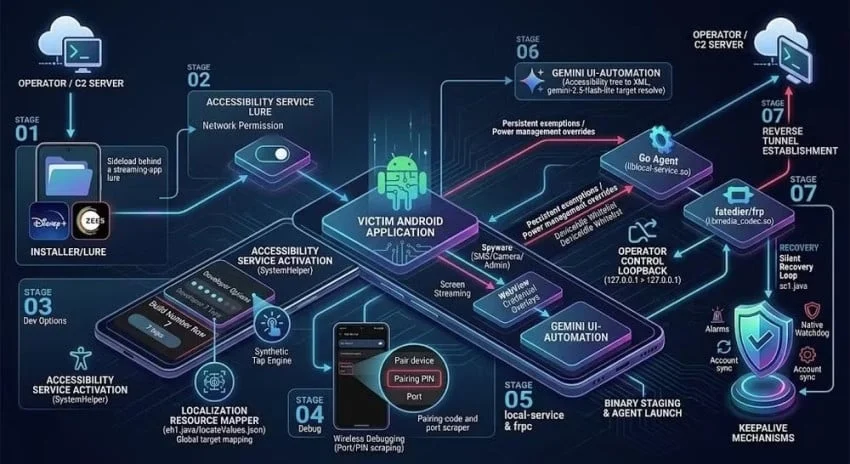
The emergence of RatHat, a sophisticated new breed of malware targeting the Android ecosystem, has sent shockwaves through the cybersecurity community, marking a significant evolution in how malicious actors utilize artificial intelligence to bypass mobile security protocols. Identified by researchers at Zimperium, a global leader in mobile security, this malware represents a departure from traditional automated scripts by integrating AI-driven agents to execute complex commands, pilfer login credentials, intercept authentication codes, and siphon sensitive financial data directly from compromised handsets. The discovery, which came to light following a report by CNET on September 20, highlights a growing trend where malware developers are weaponizing accessibility features to gain granular control over the world’s most widely used mobile operating system.
Anatomy of an AI-Driven Threat
Unlike conventional spyware that relies on pre-programmed sequences, RatHat operates with a level of autonomy that makes it particularly dangerous. Upon infiltrating a device, the malware masks itself as legitimate software—frequently impersonating essential utilities like Google Chrome. The distribution mechanism typically involves social engineering, where users are redirected to meticulously crafted landing pages designed to mirror the interface of the official Google Play Store. By mimicking the visual language of a trusted platform, the attackers effectively lower the victim’s guard, prompting them to initiate a download of the malicious package.
Once the application is installed, the malware’s primary objective is to secure the "Accessibility Service" permissions. While these services are a foundational component of Android’s design, intended to assist users with disabilities by allowing applications to interact with the UI on the user’s behalf, they are a double-edged sword. In the context of RatHat, these permissions provide the malware with a "god-mode" capability, enabling it to read screen content, perform gestures, and interact with other applications without the user’s active participation.
The Technical Execution: From Installation to Full Control
The lifecycle of a RatHat infection follows a precise, multi-stage trajectory. After obtaining the necessary accessibility permissions, the malware initiates a series of behind-the-scenes operations to escalate its privileges. According to the analysis provided by Zimperium researchers, the malware systematically navigates the device’s settings to enable "Wireless Debugging." This is a feature intended for developers to test applications over a network, but in the hands of RatHat, it serves as a gateway for the malware to grant itself elevated access to the Android Debug Bridge (ADB) shell.
The ADB shell acts as a powerful command-line interface that provides deep access to the Android operating system’s core. By establishing this level of access, RatHat effectively strips away the protective barriers typically imposed by the Android OS. Once the shell is active, the malware deploys an AI-powered agent. This agent is capable of interpreting the device’s state in real-time, executing system-level commands, and adapting to the specific environment of the phone. Whether it is bypassing two-factor authentication (2FA) prompts by reading SMS codes or harvesting credentials from banking applications, the AI-driven agent performs these tasks with a speed and efficiency that far outpaces manual or traditional automated attacks.
Chronology and Identification of the Campaign
While the public disclosure occurred in late September, cybersecurity analysts believe that the infrastructure supporting RatHat has been under development for several months. The discovery is part of a broader, ongoing investigation into the modernization of mobile threats.
- Mid-2024: Initial indicators of suspicious traffic patterns involving unauthorized ADB access on consumer devices began appearing in threat intelligence feeds.
- August 2024: Zimperium’s mobile threat defense team detected a spike in "impersonation applications" that bypassed standard Play Protect checks through sophisticated obfuscation techniques.
- September 20, 2024: Comprehensive analysis of the RatHat payload confirmed the integration of AI-based automation, leading to the public alert regarding its capability to steal financial data and authentication tokens.
The speed at which these campaigns evolve suggests that threat actors are rapidly iterating their software, moving away from "one-size-fits-all" malware toward highly specialized, adaptive tools that can target specific banking apps or cryptocurrency wallets depending on the geographic location of the victim.
The Broader Implications for Mobile Security
The rise of RatHat underscores a critical systemic vulnerability: the inherent trust model of the Android Accessibility Service. While Google has implemented stricter policies regarding the use of these services in recent versions of Android, malicious actors have found ways to trick users into granting these permissions through deceptive UI overlays and urgent security warnings.
Data from the 2024 Mobile Threat Report indicates that mobile malware incidents have increased by approximately 22% year-over-year. The shift toward AI-assisted malware is particularly concerning for financial institutions. With the increasing reliance on mobile devices for banking, digital wallets, and authentication, the threat posed by RatHat goes beyond simple data theft. It represents a threat to the integrity of the digital identity of the user. If an attacker can control a device via an ADB shell, they can effectively mirror the user’s identity, making it nearly impossible for traditional fraud detection systems to distinguish between a legitimate transaction and a malicious one.
Official Responses and Mitigation Strategies
While Google has not released a specific statement regarding the RatHat campaign, the company has consistently updated its Google Play Protect ecosystem to detect apps that attempt to exploit accessibility features. However, the nature of RatHat—often distributed outside of the official Play Store—means that users who engage in "sideloading" (installing apps from third-party sources) remain the most vulnerable.
Security experts, including those from Zimperium, emphasize that the primary defense remains user education and technical hygiene. Recommendations for protecting against AI-driven threats include:
- Vigilance with Accessibility Services: Users should be extremely cautious about granting accessibility permissions to any app, especially those that do not clearly require such capabilities for their stated function.
- Avoid Sideloading: Only download applications from official, verified sources like the Google Play Store. Even then, users should check developer credentials and review user feedback for inconsistencies.
- Monitor Developer Settings: Regularly audit the "Developer Options" in Android settings. If Wireless Debugging is enabled without the user’s knowledge, it is a definitive sign of a compromise.
- Use Mobile Endpoint Security: For enterprise environments, the deployment of mobile threat defense (MTD) solutions that can detect anomalous system-level behavior is essential.
Analysis: The AI Arms Race in Cybersecurity
The integration of AI into malware like RatHat represents a paradigm shift in the cybersecurity landscape. Historically, malware was static; once a signature was identified, antivirus software could effectively block it. However, an AI-powered agent can modify its own behavior based on the security measures it encounters. It can detect if it is being run in a virtualized sandbox (a common technique for researchers to analyze malware) and choose to remain dormant or execute benign tasks instead of its malicious payload.
This "adaptive" capability forces security vendors to move away from signature-based detection and toward behavioral analysis. The implication is clear: the future of mobile security will be defined by an AI arms race. Security vendors must employ their own machine-learning models to detect the subtle, non-human patterns of behavior that occur when an AI-driven malware agent takes control of a device’s interface.
As we move toward the end of 2024, the RatHat incident serves as a stark reminder that the complexity of mobile devices is matched only by the sophistication of those seeking to exploit them. For the average user, the takeaway is that mobile security is no longer a passive experience. It requires active vigilance, a healthy skepticism of prompts, and an understanding that the convenience of modern technology comes with the necessity of robust digital self-defense. The era of AI-enhanced threats has arrived, and the global security infrastructure must evolve with equal speed to meet the challenge.
