
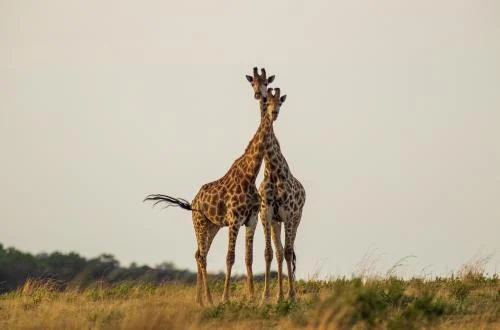
Many species across the animal kingdom engage in elaborate courtship displays, often relying on vocalizations, vibrant plumage, or complex dances to attract a mate. The familiar chorus of frog calls during breeding season or the intricate aerial ballets of birds are testament to this universal drive. However, the giraffe, the world’s tallest mammal, presents a striking exception to this rule. Unlike many of its counterparts, the giraffe does not possess a distinct mating season and, perhaps more surprisingly, does not employ vocalizations, or "mating calls," to signal its reproductive intentions. This absence of a clear auditory signal raises a fundamental question: how do these towering creatures find and select their partners in the vast savannahs of Africa?
Recent scientific research has unveiled a remarkably unconventional and, to some observers, potentially off-putting method that giraffes employ in their quest for a mate. This fascinating ritual, detailed in a recent study, centers not on auditory signals but on a sophisticated olfactory investigation involving urine, culminating in a distinctive physiological response known as the "flehmen response." This discovery sheds new light on the intricate and often subtle ways in which animals navigate the complexities of reproduction.
The elaborate courtship process for giraffes begins with a deliberate approach by the male. He will nudge or prod a nearby female, a gentle yet persistent invitation to engage. This initial contact serves as a precursor to a more intimate examination. The male then proceeds to delicately sniff the female’s genital area. This olfactory assessment is crucial, allowing him to gather vital chemical cues.
Following this initial scent detection, the female giraffe typically responds by urinating directly towards the male’s head. This act is not a sign of distress or rejection but a calculated part of the mating ritual. The urine, containing a wealth of pheromonal information, is then collected by the male. For a period of approximately five seconds, the female will allow her urine to flow into the male’s mouth.
This collected urine is then the subject of the male giraffe’s next, and perhaps most striking, action: the flehmen response. During this peculiar display, the male giraffe curls his upper lip upwards, exposing his teeth and gums. He then closes his nostrils and inhales deeply for several seconds. This exaggerated facial contortion is not unique to giraffes; it is a behavior observed in a variety of other mammals, including horses, cats, and goats, all of whom utilize it to enhance their sense of smell.
The Science Behind the Flehmen Response
The flehmen response is directly linked to a specialized sensory organ called the vomeronasal organ, often referred to as Jacobson’s organ. This organ, located in the roof of the mouth, is specifically designed to detect and analyze chemical signals, particularly pheromones. When a giraffe (or another animal exhibiting the flehmen response) curls its lip, it effectively traps airborne scents within the nasal cavity. The subsequent inhalation then draws these scents towards the vomeronasal organ, where specialized receptors can process the chemical information.
For male giraffes, the flehmen response is a critical diagnostic tool. By analyzing the chemical compounds present in the female’s urine, the male can glean invaluable insights into her reproductive status. Specifically, he is assessing her fertility and readiness to mate. The presence or absence of certain hormones and other chemical markers within the urine provides a clear indication of whether the female is ovulating and receptive to copulation.
If the scent analysis, conducted through this sophisticated olfactory examination, does not reveal the necessary signals of reproductive readiness, the male giraffe will typically disengage and move on to seek out another potential mate. This selective process ensures that mating efforts are not expended on infertile or unreceptive females, thus optimizing the chances of successful reproduction. This meticulous and somewhat unusual screening process highlights the sophisticated biological mechanisms at play in animal courtship.
A Demanding and Time-Consuming Endeavor
The process of finding a compatible mate for giraffes is far from instantaneous; it can be a considerably time-consuming and energetically demanding endeavor. Researchers have observed that a single male giraffe might approach a female multiple times, potentially as many as 150 attempts, before a successful mating occurs. This high rate of attempted courtship followed by selective rejection underscores the importance of precise reproductive timing and the male’s discerning assessment of the female’s readiness.
When a male giraffe does successfully identify a receptive female, the act of copulation itself is, in common with most mammal species, a relatively brief affair, often lasting only a few seconds. This swift culmination of a lengthy courtship highlights the efficiency of the biological imperatives driving reproduction.
The Extended Gestation and Unique Birth Process
Should the mating prove successful and the female giraffe become pregnant, she embarks on an exceptionally long gestation period, lasting approximately 400 days. This extended period of development is characteristic of large mammals and contributes to the maturity and resilience of the offspring.
A particularly remarkable aspect of giraffe reproduction occurs at the moment of birth. Giraffe mothers give birth while standing. This unique birthing position, while seemingly precarious, ensures that the newborn calf, which can be up to six feet tall at birth, can stand and walk shortly after its arrival. This immediate mobility is crucial for survival in the predator-rich environment of the African savannah, allowing the young calf to keep pace with the herd and evade danger from an early age.
The Researchers and the Research Setting
The detailed understanding of these unique giraffe courtship behaviors is largely attributable to a recent study led by Professor Lynette Hart from the University of California, Davis, School of Veterinary Medicine. Professor Hart, working alongside her husband, Benjamin Hart, an emeritus professor at the same institution, conducted this groundbreaking research.
The Harts had the invaluable opportunity to observe a wide array of giraffe behaviors during their visits to Etosha National Park in Namibia, Southern Africa. This renowned national park is a prime location for wildlife observation, offering vast open plains and abundant animal populations. The specific conditions within Etosha National Park provided the Harts with an exceptional vantage point, allowing them to monitor the activities of numerous giraffes from remarkably close proximity.
Professor Hart herself described the experience as "very unique, to be that close." This close-up observation was instrumental in capturing the subtle nuances of the giraffes’ courtship rituals, which might otherwise have gone unnoticed. The accessibility and visibility of the giraffes in Etosha National Park provided a natural laboratory for this important scientific inquiry.
Broader Implications for Wildlife Behavior Studies
The findings regarding giraffe courtship have significant implications for our understanding of animal behavior and reproductive strategies. They challenge preconceived notions about how animals seek mates, demonstrating that a lack of vocalizations does not equate to a lack of complex courtship rituals. Instead, it highlights the diverse evolutionary pathways that species have taken to ensure successful reproduction.
The reliance on olfactory cues and sophisticated chemical analysis, particularly through the flehmen response, suggests a highly developed sense of smell and a nuanced communication system that operates on a level imperceptible to human senses. This research underscores the importance of considering all sensory modalities when studying animal communication and behavior.
Furthermore, the study’s focus on a species that does not conform to typical mating patterns can inform broader conservation efforts. Understanding the specific reproductive needs and behaviors of endangered or vulnerable species is paramount to developing effective strategies for their protection and propagation. The detailed knowledge of giraffe mating rituals can contribute to habitat management and the identification of suitable breeding grounds, ensuring the long-term survival of this iconic species.
The research also serves as a reminder of the vastness of the natural world and the continuous discoveries yet to be made. Even in seemingly well-understood species, there remain intricate behaviors and biological mechanisms waiting to be unveiled. The work of Professor Hart and her husband exemplifies the dedication and curiosity required to push the boundaries of scientific knowledge, offering us a deeper appreciation for the remarkable adaptations that allow life to thrive in diverse environments. The giraffe’s unique approach to finding love, while perhaps unconventional to human sensibilities, is a testament to the ingenious solutions that evolution has crafted for the perpetuation of life.
