
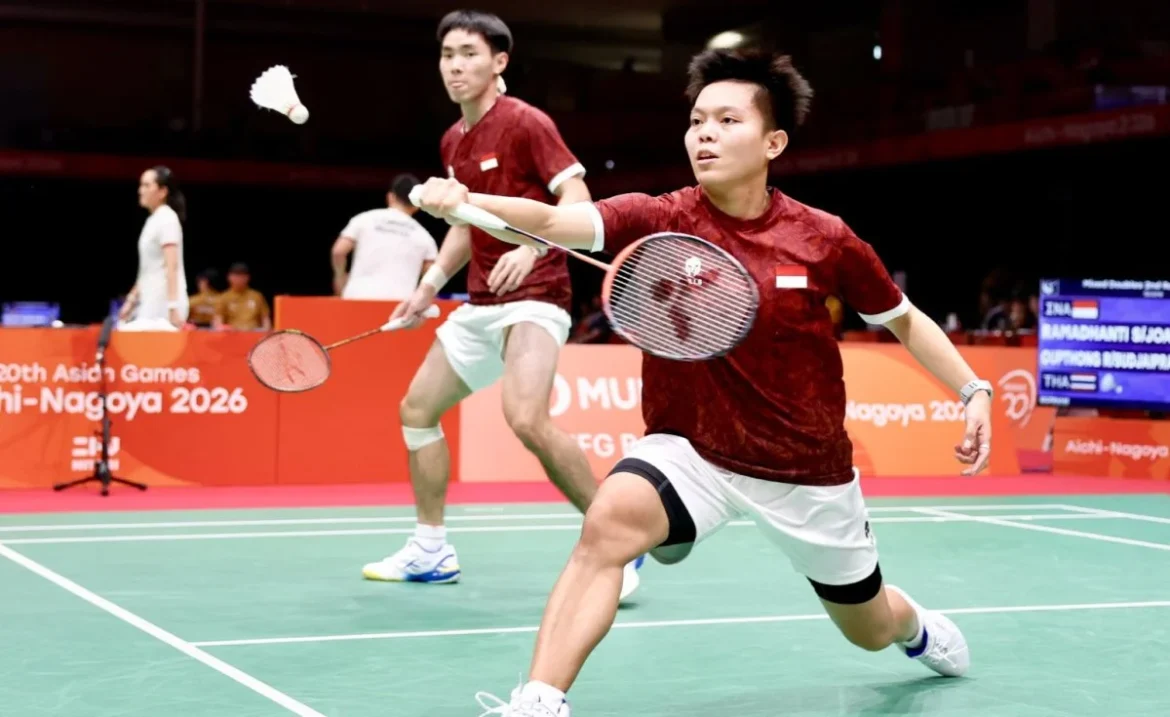
The individual badminton events at the 2026 Asian Games in Ichinomiya, Japan, delivered a roller-coaster of emotions for the Indonesian contingent. Competing at the Ichinomiya City Municipal Gymnasium on Friday, September 25, 2026, the nation’s representatives experienced contrasting fortunes in the round of 16. While the resilient mixed doubles pair of Amri Syahnawi and Nita Violina Marwah engineered a spectacular comeback victory to secure their spot in the quarterfinals, the newly formed partnership of Nikolaus Joaquin and Siti Fadia Silva Ramadhanti saw their campaign brought to a heartbreaking halt by a formidable Thai duo.
These contrasting outcomes highlight the fierce competitive landscape of continental badminton, where the margin for error is razor-thin, and international experience often dictates the flow of pressure-cooker matches. As the tournament progresses toward its medal rounds, the Indonesian coaching staff must recalibrate their strategies, celebrating the tenacity of Amri and Nita while addressing the tactical vulnerabilities exposed in Nikolaus and Fadia’s hard-fought exit.
A Hard-Fought Triumph: Amri and Nita’s Resilient Comeback
The afternoon session began with high anticipation as Amri Syahnawi and Nita Violina Marwah stepped onto the court to face the fiercely supported Japanese pair, Yuta Watanabe and Maya Taguchi. Playing on home soil, the Japanese duo immediately imposed their tempo, exploiting any hesitation from the Indonesian side.
The opening game proved to be a sobering experience for Amri and Nita. Watanabe and Taguchi dismantled the Indonesian defense with precise placement, rapid net exchanges, and relentless pressure. Amri and Nita struggled to find their rhythm, managing a meager 9 points as the Japanese pair comfortably closed out the first game 21-9. The lopsided scoreline threatened to derail the Indonesian pair’s morale, leaving fans watching from afar deeply concerned about their prospects of recovery.
However, elite-level sports often turn on subtle shifts in tactical execution and mental fortitude. Entering the second game, Amri and Nita executed a profound tactical reset. They reduced unforced errors, adopted a more aggressive stance at the net, and successfully neutralized the attacking threats of their opponents. By cutting down the unforced errors that plagued their opening performance, they gradually seized control of the rallies.
The shift paid immediate dividends. Amri and Nita fought tooth and nail to edge out the second game 21-18, forcing a decisive rubber set that silenced the partisan crowd in Ichinomiya. Momentum had officially shifted across the net.

In the third and final game, the Indonesian pair displayed remarkable physical conditioning and tactical discipline. They exploited gaps in the Japanese defense, maintaining a steady lead through sustained pressure and superior court coverage. Refusing to yield, Amri and Nita closed out the deciding set 21-15, completing a stunning turnaround after 67 minutes of intense gameplay. This hard-fought victory not only propels them into the quarterfinals of the 2026 Asian Games but also serves as a testament to their psychological resilience under pressure.
Heartbreak in the Round of 16: Nikolaus and Fadia’s Valiant Exit
While the mixed doubles landscape brought celebration, the subsequent match involving Nikolaus Joaquin and Siti Fadia Silva Ramadhanti ended in profound disappointment. The Indonesian pair faced off against Thailand’s experienced and cohesive duo, Ruttanapak Oupthong and Jhenicha Sudjaipraparat, in a battle that showcased the brutal nature of knockout badminton.
From the opening rally, the match unfolded as a tactical heavyweight bout. Neither pair was willing to concede an inch, resulting in long, grueling exchanges that tested both physical endurance and mental stamina. Nikolaus and Fadia matched their Thai opponents shot for shot, displaying moments of brilliance in defensive recovery and explosive counter-attacks.
The first game evolved into a marathon of nerves, stretching deep into extended points. Despite saving multiple game points, Nikolaus and Fadia ultimately succumbed to the composure of Oupthong and Sudjaipraparat, losing a heart-wrenching opening set 26-24. The emotional toll of dropping such a closely contested game proved difficult to overcome in the second frame, where the Thai pair capitalized on the momentary lapse in concentration to secure the match and eliminate the Indonesian hopefuls from the individual tournament.
Despite the loss, the performance of Nikolaus and Fadia offered valuable insights for the national selection committee. As a relatively fresh combination, their ability to push seasoned competitors to the absolute limit in a major multi-sport event indicates strong foundational potential, provided they can sharpen their composure during critical closing sequences.
Background and Context of the 2026 Asian Games Badminton Competition
The badminton tournament at the 2026 Asian Games, hosted across venues in Aichi and Nagoya, Japan, represents one of the most prestigious battlegrounds in the sport. Often regarded as a tournament boasting a competitive depth comparable to, or even exceeding, the World Championships due to the sheer concentration of Asian powerhouses, the event places immense physical and mental demands on every athlete.
For the Indonesian badminton team, the Asian Games carry a heavy historical burden of expectation. Indonesia remains one of the traditional powerhouses of the sport, alongside China, Japan, South Korea, and Chinese Taipei. In every multi-sport quadrennial event, the badminton squad is invariably marked as a primary gold-medal contributor by the Indonesian Olympic Committee (KOI) and the Ministry of Youth and Sports.

The inclusion of Ichinomiya as a key sub-host city for specific disciplines has brought elite badminton to regional crowds, creating an electric atmosphere that tests visiting athletes’ ability to perform under high-decibel conditions. For pairs like Amri and Nita, navigating hostile away environments is a vital rite of passage on the road to global elite status.
Chronological Breakdown of the Day’s Events
To fully understand the progression of the Indonesian campaign on Friday, September 25, 2026, a review of the afternoon timeline reveals the swift transitions athletes must endure:
- 15:00 স্থানীয় সময় (JST) / 13:00 WIB: The round of 16 matches for the individual badminton events commence at the Ichinomiya City Municipal Gymnasium.
- 15:30 WIB: Amri Syahnawi and Nita Violina Marwah take to the court for their high-stakes encounter against Japan’s Yuta Watanabe and Maya Taguchi.
- 16:15 WIB: After a difficult start, Amri and Nita drop the first game 9-21, facing an uphill battle against the home favorites.
- 17:00 WIB: The Indonesian pair mounts a successful tactical recovery, taking the second game 21-18 to force a decider.
- 17:35 WIB: Amri and Nita seal the rubber game 21-15, securing their ticket to the quarterfinals and capping off a dramatic comeback.
- 18:00 WIB: Nikolaus Joaquin and Siti Fadia Silva Ramadhanti begin their round of 16 match against Thailand’s Ruttanapak Oupthong and Jhenicha Sudjaipraparat.
- 18:50 WIB: Following an epic 26-24 battle in the opening game, the Indonesian pair falls short, ultimately concluding their individual Asian Games journey.
Strategic Implications and Post-Match Analysis
The mixed doubles results from Ichinomiya offer a clear snapshot of where Indonesian badminton currently stands on the international stage. The survival of Amri Syahnawi and Nita Violina Marwah keeps Indonesia’s medal hopes alive in the discipline, ensuring that the Red and White flag remains represented in the business end of the tournament.
From an analytical standpoint, Amri and Nita’s victory underscores the importance of tactical adaptability. Their ability to shed the psychological weight of a 9-21 defeat in the first game and reinvent their approach in the subsequent sets highlights a growing maturity within the pair. Coaches will likely analyze this resilience as a blueprint for handling similar adversity in the upcoming quarterfinal fixtures.
Conversely, the exit of Nikolaus and Fadia emphasizes the fine margins that separate victory from defeat in contemporary mixed doubles. At the elite level, physical parity is often a given; the deciding factor invariably shifts to tactical execution under extreme pressure—specifically during the crucial closing points of a tight game. Conceding the first set 26-24 stripped the Indonesian pair of the momentum required to mount a counter-offensive in the second, a lesson that will undoubtedly feature in future training evaluations back at the Cipayung national training center.
Looking Ahead to the Quarterfinals
With Amri and Nita advancing to the next round, the immediate focus shifts toward recovery, scouting, and strategic preparation for their upcoming quarterfinal opponents. The physical toll of a grueling 67-minute three-set encounter means that sports science and medical recovery protocols will play a pivotal role in ensuring the Indonesian duo is operating at peak physical capacity for the next phase.
As the 2026 Asian Games badminton competition intensifies, fans across Indonesia will continue to follow every smash, drop shot, and net tangle with bated breath. The journey in Ichinomiya is far from over, and the remaining representatives carry not only their own personal ambitions but the collective hopes of a nation steeped in badminton glory.
