
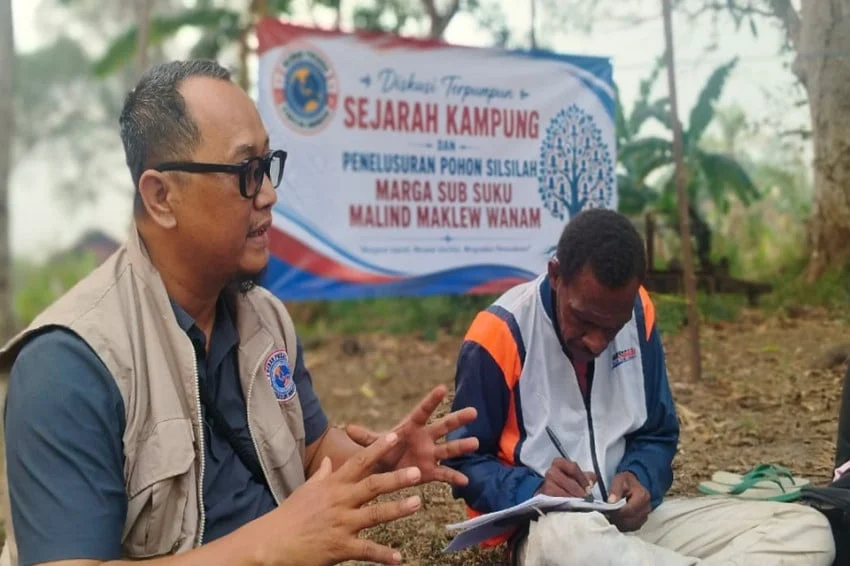
Merah Pusaka Stratejik Indonesia (MPSI), in collaboration with the Village Government and the indigenous communities of Wanam, has officially initiated a comprehensive documentation project to reconstruct the history, oral traditions, and intricate genealogical lineages of the clans belonging to the Malind Maklew sub-tribe. The endeavor commenced with a focused and deeply engaging Focus Group Discussion (FGD) held in Wanam Village, located within the vast administrative bounds of Merauke Regency, South Papua Province.
This vital cultural preservation initiative addresses a pressing contemporary concern: the gradual erosion of indigenous oral histories in the face of rapid regional development, demographic shifts, and modernization. By systematically gathering, verifying, and recording generational narratives, the initiative seeks to safeguard the collective memory of approximately 12 distinct clans that form the foundational social fabric of the Malind Maklew community.
Preserving Oral Traditions in an Era of Modernization
For generations, the history of the Malind Maklew sub-tribe has been preserved through the rich tradition of oral storytelling. Passed down from elders to the youth around hearths and during communal gatherings, these narratives detail ancestral origins, ancient migration routes across the southern wetlands of Papua, the establishment of early settlements, and complex inter-clan kinship networks. However, modern pressures, including shifts in local lifestyles and the encroachment of digital media, have threatened the continuity of these oral archives.
Recognizing the urgency of safeguarding this intangible cultural heritage, MPSI partnered with local stakeholders to design a community-led documentation framework. The FGD served as an open forum where community members, traditional elders, and clan leaders could collectively voice, cross-reference, and record historical accounts that had previously existed only in spoken form.
The scope of the documentation encompasses several critical dimensions of indigenous life:
- Ancestral Origins: Tracing the geographical and mythological beginnings of the Malind Maklew people.
- Kinship Networks: Mapping the marital, economic, and ceremonial alliances between the roughly 12 indigenous clans of Wanam.
- Settlement Evolution: Documenting historical village sites, seasonal camps, and resource-gathering areas utilized by forebears.
- Migration Chronology: Charting the historical movements of family branches across generations in response to environmental, social, and political shifts.
A Phased and Community-Centric Approach
During the intensive discussions in Wanam Village, participants emphasized that documenting the history of roughly 12 distinct clans cannot be rushed. Each clan possesses a unique historical trajectory, distinct ancestral titles, and specialized sub-branch lineages that require meticulous investigation. Consequently, the steering committee agreed that the research and verification process must be conducted in structured, phased increments.
The methodology relies heavily on the active participation of traditional authorities—namely, tribal elders (tua-tua adat), lineage heads, and knowledgeable clan historians. This participatory model ensures that historical claims are subjected to rigorous community consensus before being formally committed to written archives.
Noor Azhari, Executive Director of MPSI, underscored the importance of keeping the indigenous community at the absolute center of the project. He stressed that outside organizations must act solely as facilitators rather than arbiters of indigenous identity.

"MPSI is here to assist the documentation process, not to dictate or determine the community’s genealogical structure," Azhari stated during the forum. "History is living and is fundamentally owned by the community itself. Therefore, every single piece of information must be thoroughly confirmed and verified together with the respective clans to ensure absolute accuracy and authenticity."
Background Context: Development and Cultural Preservation in South Papua
The cultural mapping initiative in Wanam takes place against a backdrop of rapid socioeconomic transformation in South Papua. As part of national strategic initiatives—including infrastructure development and agricultural expansion projects—Merauke Regency and surrounding areas have experienced increased infrastructural connectivity and demographic influx.
While these developments bring economic opportunities and improve regional integration, indigenous communities have frequently expressed apprehension regarding the potential marginalization of local heritage, customary land rights, and traditional social structures. Local stakeholders have consistently voiced the necessity of balancing physical development with robust cultural preservation. For the residents of Wanam, establishing a clear, documented record of clan lineages and historical territorial claims is not merely an academic exercise; it is a vital mechanism for asserting cultural identity and safeguarding customary heritage amidst a changing landscape.
Furthermore, clear documentation of indigenous genealogy provides legal and social clarity that can support communities in resource management, traditional land stewardship, and cultural tourism development. By anchoring future generations in a well-documented historical reality, the Malind Maklew sub-tribe strengthens its resilience against cultural displacement.
Chronology of the Initiative
The launch of the Wanam historical reconstruction project follows a series of community consultations and preliminary assessments conducted throughout the region:
- Early 2026: Initial informal dialogues between MPSI representatives, village authorities, and local community leaders regarding the preservation of local oral histories.
- Mid-2026: Design of a participatory documentation framework focusing on the Malind Maklew sub-tribe and its constituent clans.
- September 8, 2026: Official convening of the Focus Group Discussion (FGD) in Wanam Village, marking the commencement of systematic data collection.
- Future Outlook (Late 2026 and Beyond): Implementation of phased, clan-by-clan interviews, archival compilation, and the eventual publication of verified historical records for educational and community use.
Broader Implications and Future Outlook
The collaborative effort between MPSI and the Wanam community serves as a replicable model for indigenous heritage preservation across the Papuan region. As modernization continues to reshape remote territories, bridging the gap between oral tradition and written documentation ensures that the voices of ancestral figures are not lost to time.
Experts note that documenting indigenous genealogies fosters intergenerational dialogue. When youth actively engage with elders to record family histories, a renewed sense of pride and cultural continuity is fostered within the community. Moreover, structured genealogical records provide invaluable reference points for local governance, customary dispute resolution, and cultural education programs in schools across Merauke Regency.
As the phased documentation of the 12 Malind Maklew clans moves forward, the stakeholders involved remain committed to transparency, mutual respect, and rigorous verification. Through these concerted efforts, the ancestral legacy of Wanam is positioned to endure, serving as an enduring testament to the rich history and resilience of the indigenous peoples of South Papua.
