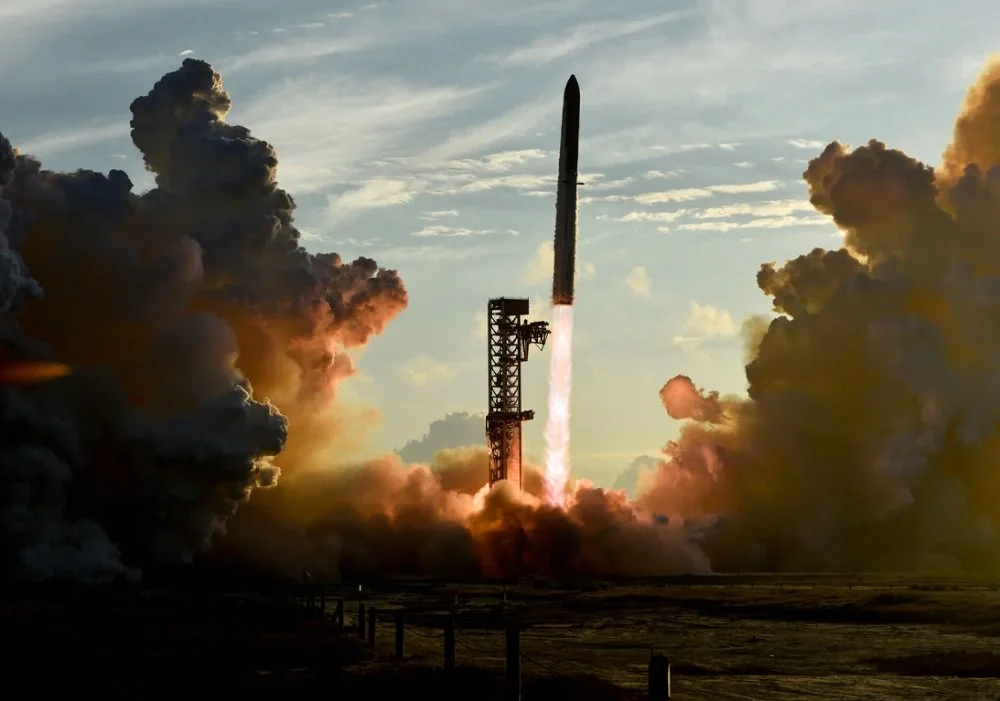
In a landmark achievement for commercial space exploration, SpaceX’s Starship—the largest and most powerful rocket ever constructed—successfully reached Earth’s orbit on September 28, 2026. This milestone marks a significant leap forward for the company’s ambitious roadmap, which aims to revolutionize space travel, facilitate lunar exploration, and eventually enable the colonization of Mars. The mission, which originated from the SpaceX Starbase facility in Boca Chica, Texas, saw the massive 120-meter tall spacecraft complete a series of critical maneuvers before executing a controlled, albeit final, descent into the Pacific Ocean.
Chronology of a Historic Flight
The launch sequence commenced early Monday morning as the integrated launch system, comprising the Super Heavy booster and the upper-stage Starship, cleared the pad under clear skies. The sheer scale of the vehicle, which dwarfs the legendary Saturn V rocket of the Apollo era, generated an immense plume of exhaust as it propelled itself toward the upper atmosphere.
The first major hurdle, the "Max Q" stage where the vehicle experiences maximum aerodynamic pressure, was cleared without incident. Shortly thereafter, the Super Heavy booster successfully performed a boost-back burn and executed a precise vertical landing back near the launch site—a testament to the reusable technology that has become the hallmark of Elon Musk’s aerospace empire.
However, the mission was not without its moments of tension. As the upper-stage Starship transitioned into orbit, telemetry data indicated an anomaly with one of the primary engines. For several minutes, mission control at Starbase navigated a period of uncertainty, with flight controllers monitoring the spacecraft’s stability. The tension was palpable until the confirmation came through the live feed: "Starship is in orbit." This announcement triggered celebratory cheers among the SpaceX engineering teams, marking the first time the company had achieved orbital velocity with the Starship vehicle.
Strategic Deployment of Starlink
Once stable in low-Earth orbit, the mission objectives shifted to the deployment of 26 next-generation Starlink satellites. These satellites represent the backbone of SpaceX’s business model, providing high-speed, low-latency internet connectivity to underserved regions globally. The successful deployment of this batch of satellites demonstrates the operational utility of Starship; unlike previous iterations, this flight was not merely a test of flight dynamics but a functional demonstration of the rocket’s capacity to serve as a high-volume orbital freighter.
The integration of Starlink launches into the Starship flight profile is a calculated move to ensure the financial sustainability of the project. As SpaceX continues to expand its presence on the stock exchange, the ability to launch significantly larger batches of satellites at a lower cost-per-kilogram than competitors remains a cornerstone of its market dominance.

The Final Descent and Re-entry Analysis
After approximately three hours in orbit, flight controllers initiated the de-orbit sequence. The Starship re-entered the Earth’s atmosphere, with live feeds capturing the intense thermal energy glowing around the hull. The spacecraft maintained a vertical orientation, showcasing the advanced thermal protection system (TPS) designed to withstand the heat of atmospheric friction.
In the final phase of the mission, the vehicle attempted a controlled descent toward the Pacific Ocean. While the craft managed to slow its velocity significantly through a series of engine burns, it tipped upon contact with the water’s surface, ultimately succumbing to a structural breach that resulted in a large explosion. Despite the loss of the vehicle, engineers consider the mission a massive success, as the primary goals—reaching orbit, deploying the payload, and testing re-entry heat shields—were effectively achieved.
Contextualizing the Starship Program
The development of Starship has been a multi-year effort characterized by a "fail-fast, learn-faster" iterative design philosophy. Unlike traditional aerospace programs that rely on years of theoretical simulations before a prototype is built, SpaceX has prioritized physical flight tests. This approach has led to multiple explosive test flights in previous years, each providing invaluable data on propellant management, engine performance, and structural integrity.
The 2026 milestone represents a transition from the experimental phase to the operational phase. For stakeholders and global space agencies, this flight provides concrete evidence that the Starship architecture is viable. The vehicle’s design is not just for satellite deployment; it is specifically engineered to carry heavy payloads to the Moon and beyond. With NASA’s Artemis program looking toward Starship as a potential Human Landing System (HLS), this successful orbit is a critical prerequisite for future crewed lunar missions.
Implications for the Future of Space Exploration
The success of this mission carries profound implications for the global space sector. Firstly, it disrupts the current economics of space launch. By utilizing a fully and rapidly reusable system, SpaceX intends to drive the cost of reaching orbit down to a fraction of current industry standards. This accessibility is expected to foster a new generation of orbital research, manufacturing, and tourism.
Secondly, the technical success regarding the Super Heavy booster’s recovery validates the infrastructure Musk envisions for future flights. The eventual goal is to have the launch tower "catch" the descending booster using mechanical arms, eliminating the need for heavy landing legs and further increasing the efficiency of the launch-to-turnaround cycle.
Finally, the mission serves as a geopolitical signal. As nations like China and India accelerate their own space programs, the United States, bolstered by the private-sector innovation of SpaceX, continues to hold a technological lead in heavy-lift launch capabilities. The ability to place 100+ tons of cargo into orbit routinely changes the strategic calculus for both national security interests and scientific exploration.

Industry and Expert Reactions
Industry analysts have lauded the mission as a "watershed moment" in modern engineering. While some critics point to the loss of the vehicle upon landing as a setback, proponents argue that the data gathered from the successful atmospheric penetration is worth far more than the hardware itself.
"The transition from the Falcon 9 era to the Starship era is now officially underway," noted an aerospace analyst familiar with the program. "We are seeing the birth of an era where space access is no longer a bottleneck but a utility. The challenges that occurred during the engine burn and the final landing are exactly what these test flights are for—they are learning opportunities that will be corrected in the next iteration."
SpaceX has already begun preparations for the next flight, incorporating the telemetry data from the recent anomaly. The company’s focus remains on refining the engine startup sequences and improving the structural integrity of the landing struts to ensure that future missions can conclude with a soft, intact landing on land or an orbital platform.
Looking Ahead
As the dust settles on the Texas coast, the path forward for Starship appears clearer than ever. The integration of high-capacity satellite launches with the development of deep-space capabilities puts SpaceX in a unique position. The company is not merely competing with other launch providers; it is essentially creating a new category of space logistics.
Future missions are expected to include more complex orbital maneuvers, potential in-orbit refueling tests—a critical requirement for reaching Mars—and expanded payload testing for both commercial and government clients. For the scientific community, the prospect of having a massive, reliable vehicle capable of launching space telescopes, planetary rovers, and, eventually, humans to the Moon, opens doors that have remained closed for decades.
The achievement on September 28, 2026, will likely be recorded in history as the day that heavy-lift space flight was finally democratized. While the road to full, rapid, and routine reusability remains under construction, the Starship program has proven that the fundamental physics of its design are sound. As SpaceX prepares for its next series of launches, the global community watches with anticipation, knowing that the horizon of human exploration has just been pushed significantly further into the cosmos.