
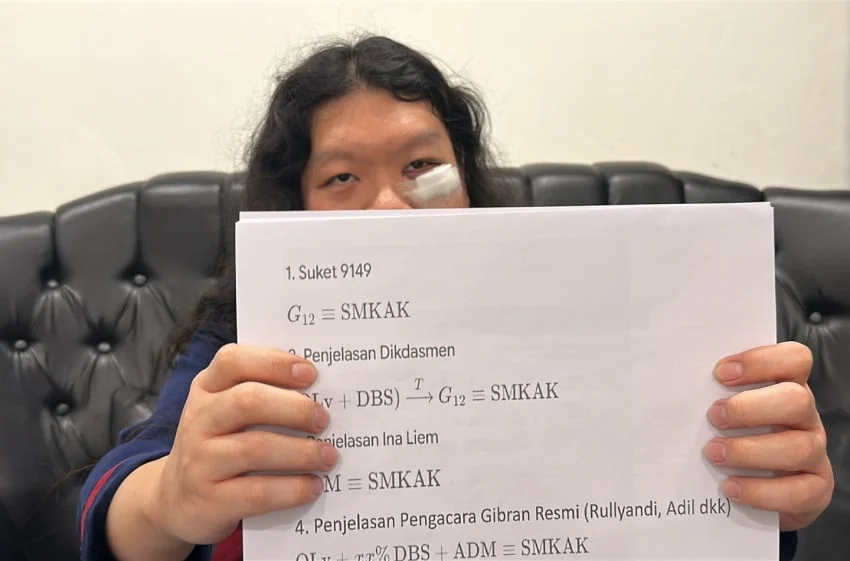
JAKARTA — The ongoing public discourse surrounding the educational credentials of high-ranking Indonesian officials has taken a sharp turn toward institutional accountability and bureaucratic transparency. Luke Susilo, an activist representing the advocacy group Terus Jadi Anti Pembual (Terjal), has formally raised serious concerns regarding what he describes as profound data discrepancies, logical inconsistencies, and administrative irregularities within the official letter of certificate equivalency (Surat Keterangan Penyetaraan) belonging to Vice President Gibran Rakabuming Raka.
Rather than focusing narrowly on the physical diploma itself, Susilo’s critique centers on the administrative machinery and regulatory interpretations that facilitated the issuance of the equivalency document. According to the activist, the process exhibits troubling signs of logical manipulation and what he metaphorically terms a "leapfrog operation"—an irregular transitional sequence of educational institutions utilized to bridge foundational secondary education with higher academic tiers.
The controversy unfolds against a backdrop of heightened public scrutiny regarding the academic documentation of prominent political figures in Indonesia. As regulatory bodies face increasing pressure to verify the qualifications of public servants, the technicalities of foreign credential recognition have emerged as a critical battleground for transparency advocates, legal teams, and government defenders alike.
Systematic Analysis and Layered Discrepancies
During a detailed briefing in Jakarta, Luke Susilo unveiled the results of a systematic analysis conducted with the assistance of structured process-modeling tools. This investigation sought to untangle the web of conflicting statements, documentary evidence, and public testimonials presented since the credential verification process became a matter of public and legal debate.
Susilo’s analytical model identified four distinct layers of versioning concerning the vice president’s academic equivalency pathway. These variations span from the literal text recorded in the official ministerial equivalency letter, to oral and written testimonies presented during Constitutional Court (Mahkamah Konstitusi) proceedings, down to divergent claims propagated by academic experts and the vice president’s legal defense team.
At the heart of Susilo’s technical critique is a stark contradiction between established regulatory frameworks and the practical application observed in the documentation. He pointed directly to Ministry of Education and Culture Regulation (Permendikbud) Number 29 of 2014, specifically Article 1, Paragraph 7. According to this statutory provision, the foundational metric for evaluating and recognizing foreign educational equivalency must be the equivalence of the curriculum content, learning outcomes, and academic substance, rather than the mere duration of study or calendar time spent in a program.
"If the fundamental logic were based merely on equating study time or academic duration, a university student who takes fourteen semesters to complete an undergraduate degree could arbitrarily demand direct equivalency to a master’s program," Susilo stated in Jakarta. "This approach is manifestly absurd. The regulations explicitly dictate that the evaluation must focus on the curriculum."
The Chronology of Academic Transitions and Institutional Shifts
The controversy surrounding the vice president’s educational background involves a sequence of international institutions that span several years and multiple jurisdictions. Public records, legal filings, and statements from defense counsels have variously referenced Orchard Park Secondary School, University of Technology Sydney (UTS) Insearch in Australia, and the Management Development Institute of Singapore (MDIS).
According to documentation cited by critics and legal analysts, the transition of these institutions into a single, cohesive educational trajectory has raised procedural red flags. The timeline of public disclosures reveals a shifting narrative regarding where and how foundational high school and undergraduate milestones were achieved:
- Secondary Education Phase: Initial public profiles and educational summaries linked the official to international secondary programs, notably referencing institutions abroad.
- Foundation and Diploma Studies: Subsequent documentation introduced preparatory programs, notably UTS Insearch, which typically serves as a pathway provider for university-level studies in Australia.
- Higher Education Credentialing: Later disclosures incorporated advanced diplomas and coursework from alternative regional providers, such as MDIS in Singapore, to substantiate the completion of undergraduate-level competencies.
Susilo highlighted what he terms the "leapfrog operation" phenomenon embedded within the administrative record. He noted a critical divergence between the official equivalency letter—which formally registers foundational studies through institutions like UTS Insearch—and the defense presented by appointed legal experts, who have alternatively relied upon Advanced Diploma credentials issued by MDIS to defend the integrity of the academic timeline.
This friction between documentary records and expert testimony forms the core of Terjal’s legal and administrative challenge, suggesting that structural shortcuts may have been utilized to bypass standard verification protocols.
Regulatory Frameworks and the Burden of Proof
The Ministry of Education, Culture, Research, and Technology maintains stringent standard operating procedures for the assessment and equivalency of foreign academic credentials. These procedures are designed to ensure that citizens holding qualifications from overseas institutions possess competencies strictly aligned with the Indonesian National Qualifications Framework (KKNI).
Under standard protocols, applicants seeking equivalency must submit comprehensive academic transcripts, course syllabi, institutional accreditation statuses, and proof of legal residence during the study period. Evaluators assess the depth and breadth of the curriculum to determine whether the foreign qualification matches domestic educational standards.
Legal experts observing the case note that the burden of proof rests heavily on both the issuing administrative bodies and the credential holder to reconcile discrepancies in public records. When institutional pathways appear fragmented or reliant on disparate educational systems, public institutions are expected to provide transparent clarification to maintain institutional trust.
However, the political sensitivity of the office involved has complicated ordinary administrative inquiries. The involvement of high-profile political figures often transforms routine bureaucratic verification into polarized public debates, drawing in civil society organizations, legal aid networks, and government defenders.
Broader Implications for Public Governance and Transparency
The ongoing dispute over Vice President Gibran Rakabuming Raka’s academic credentials carries implications that extend far beyond individual administrative records. Analysts suggest that the controversy touches upon fundamental principles of good governance, institutional credibility, and the rule of law.
In a democracy, the verifiable integrity of educational credentials for elected and appointed officials serves as a pillar of public confidence. When discrepancies arise—particularly those involving regulatory compliance and ministerial oversight—citizen-led oversight organizations often step in to demand rigorous accountability.
The broader implications of the Terjal investigation include:
- Precedent for Credential Verification: The case may establish a significant benchmark for how civil society monitors the administrative processes of state ministries, particularly regarding high-ranking officials.
- Demands for Bureaucratic Reform: Critics argue that inconsistencies in ministerial equivalency letters expose potential vulnerabilities or lack of standardization within credential-evaluation units, prompting calls for structural audits.
- Political Polarization: The weaponization of administrative data in political discourse risks deepening societal divisions, emphasizing the need for independent, transparent, and fact-based judicial or administrative reviews.
As the legal and civic challenges continue to unfold, public attention remains focused on whether relevant state institutions will address the specific documentary inconsistencies raised by activists. For transparency advocates like Luke Susilo, the ultimate goal is not merely the resolution of a single credential dispute, but the establishment of an uncompromising standard of institutional honesty across all levels of government administration.
