
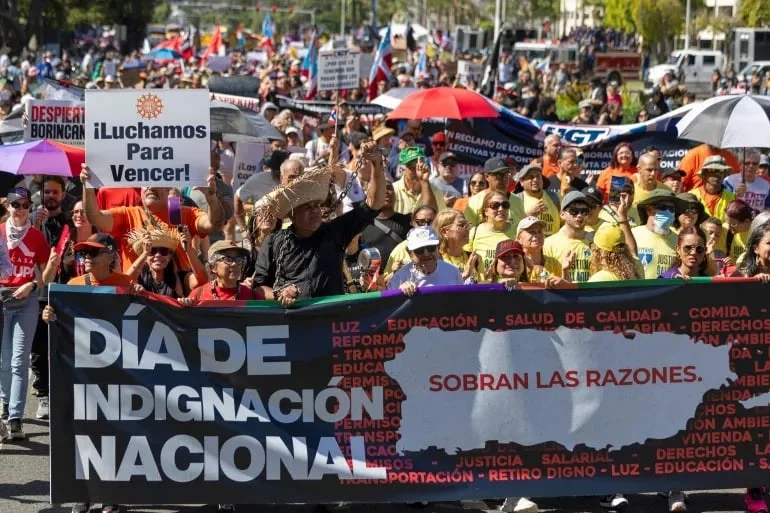
The streets of San Juan, Puerto Rico, transformed into a massive stage of public defiance on Friday, November 27, 2026, as approximately 8,000 citizens converged on the capital to protest the escalating cost of living and the persistent failure of essential public services. Dubbed the "Day of National Outrage," the mobilization brought together a diverse coalition of nearly 30 organizations, including influential labor unions, student groups, and religious institutions, all united by a singular grievance: the crushing burden of electricity costs that many residents can no longer afford.
The demonstration, which saw participants from dozens of municipalities arriving by bus to join the capital’s residents, marks a significant escalation in civil unrest since the inauguration of Governor Jenniffer Gonzalez in January 2025. By mid-afternoon, the sheer volume of protesters had forced the closure of one of the island’s primary arterial highways, signaling the severity of the economic desperation currently gripping the U.S. territory.
The Catalyst: A Crisis of Affordability
The primary driver of this public outcry is the unsustainable spike in electricity rates. Data provided by the U.S. Energy Information Administration (EIA) confirms that residential electricity bills have seen a sharp, rapid increase. Recent adjustments have pushed the average monthly residential bill from $229 to $271—a staggering 18% hike in a very short period.
To put these figures into perspective, the cost per kilowatt-hour (kWh) in Puerto Rico has consistently eclipsed the average rates found on the U.S. mainland. For a population already grappling with stagnant wages and high inflation on imported goods, the energy crisis acts as a multiplier of poverty. For many, electricity is no longer a guaranteed utility, but a luxury item that dictates whether a household can afford groceries or medical supplies.
"Where do we start? The anger is absolute," said 74-year-old Radames Garcia Badillo, a retiree who stood among the masses. His sentiment echoes a growing consensus among the island’s elderly and working-class populations, who feel that the privatization and management of the electrical grid have prioritized corporate solvency over the basic rights of the citizenry.
A History of Grid Instability
The current crisis is not an isolated event but rather the culmination of years of systemic failure. Puerto Rico’s electrical grid, managed by a combination of public and private entities, has been in a state of precariousness since the devastating impacts of Hurricane Maria in 2017. Years of underinvestment, deferred maintenance, and the catastrophic destruction of infrastructure have left the system vulnerable to constant outages.
The shift toward privatization, intended to stabilize the grid and invite necessary capital improvements, has instead become a lightning rod for political controversy. Protesters argue that the transition has resulted in higher costs for consumers without providing the promised reliability. Frequent blackouts, often occurring without warning, have hampered small businesses, disrupted hospital operations, and hindered the education of thousands of students across the island.
The visual presence of the protestors—who carried the traditional Puerto Rican flag, as well as the pre-1952 version of the ensign—was highly symbolic. These flags served as a visual manifestation of cultural pride and a rejection of the current administrative policies that many believe are dictated by external interests rather than the needs of the islanders.
Chronology of Escalation
The buildup to the November 27 demonstration was characterized by months of mounting frustration. Following the January 2025 transition of power to Governor Gonzalez, expectations were high for a reset in economic policy. However, the subsequent months saw the continuation of austerity measures and the approval of further rate hikes by the energy regulatory commissions.
- January 2025: Governor Jenniffer Gonzalez assumes office, inheriting a legacy of grid instability and fiscal volatility.
- Mid-2025: Initial complaints regarding the performance of private grid operators begin to circulate within the public discourse.
- Early 2026: Inflationary pressures on the island reach a tipping point, leading to the first of several small-scale protests.
- October 2026: The EIA reports the latest round of price increases, triggering widespread public backlash and the formal organization of the "Day of National Outrage."
- November 27, 2026: Approximately 8,000 citizens occupy major roads in San Juan, demanding immediate government intervention and a reversal of the latest rate hikes.
Political and Economic Implications
The scale of this protest presents a significant challenge to the Gonzalez administration. As a U.S. territory, Puerto Rico’s internal policies are often subject to the complex dynamics of federal oversight, specifically through the Financial Oversight and Management Board (FOMB). The FOMB has often advocated for fiscal discipline to address the island’s historic debt, a position that frequently puts them at odds with residents demanding subsidies for essential services.
Economists observing the situation suggest that the government is caught in a "policy trap." On one hand, the utility requires capital to modernize the aging grid, which necessitates rate hikes. On the other hand, the local economy cannot sustain these costs without suffering a contraction in consumer spending and a potential increase in the migration of the working-age population to the U.S. mainland.
The "Day of National Outrage" is likely to force the hand of local legislators. Political analysts suggest that the administration may be compelled to introduce emergency relief measures, such as temporary subsidies or a moratorium on further rate increases, to quell the growing dissent. However, such measures are often viewed as temporary bandaids rather than long-term solutions to the structural issues within the power sector.
A Broader Movement for Social Justice
Beyond electricity, the protest underscored a broader dissatisfaction with the state of public services. Demonstrators voiced concerns over the quality of public healthcare, the state of the education system, and the rising cost of living, which has made homeownership and basic rent increasingly unattainable for the average citizen.
The involvement of a wide coalition of organizations suggests that this movement is not merely a single-issue protest but a sign of a burgeoning civil society movement. By involving labor unions and religious organizations, the protest has secured a degree of institutional legitimacy that makes it difficult for the government to dismiss the participants as merely "fringe" agitators.
As the protest in San Juan concluded on Friday evening, the atmosphere remained tense but disciplined. The closure of the highway served as a powerful reminder of the public’s ability to disrupt the status quo when they feel their basic needs are being ignored. Whether this massive turnout will result in tangible policy changes remains to be seen, but it is clear that the status quo in Puerto Rico is under unprecedented strain.
For the international community, the events in San Juan serve as a reminder of the fragility of infrastructure and the high social cost of prioritizing fiscal austerity over public utility access. As the island looks toward the next quarter, the administration in San Juan faces the daunting task of reconciling its fiscal obligations with the undeniable, vocal demand for economic justice from its citizens. The "Day of National Outrage" has set the stage for a period of intense political negotiation, where the cost of silence may prove far higher for the government than the cost of reform.
