

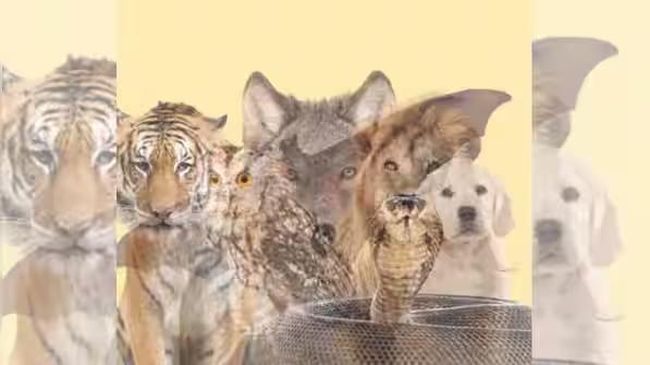
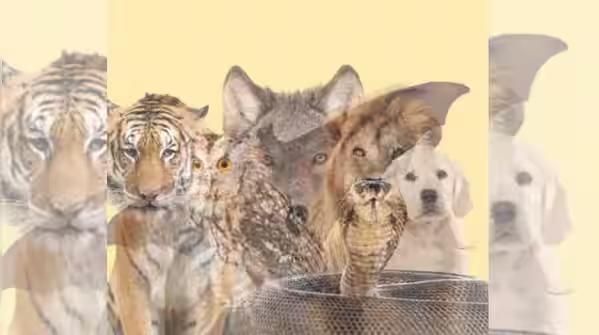
Optical illusion personality tests have long been a subject of fascination within the realms of psychology and pop culture, serving as a bridge between cognitive science and self-discovery. These visual stimuli are designed to challenge the brain’s perception, forcing the mind to interpret complex, layered imagery. In a recent analysis popularized by The Minds Journal and widely circulated in psychological circles, a specific composite image containing four distinct animals—a lion, a wolf, a snake, and an owl—has become a tool for exploring latent personality traits. While these tests are not clinical diagnostic instruments, they provide a framework for individuals to reflect on subconscious behaviors and emotional tendencies.
The Science Behind Optical Illusions and Perception
To understand why these tests are effective, one must first look at how the human brain processes visual information. The visual cortex does not merely record images like a camera; it interprets them based on prior experiences, current emotional states, and cognitive biases. When presented with an ambiguous image, the brain often relies on heuristics—mental shortcuts—to make sense of the visual data.
Psychologists suggest that the "first impression" of an image is often dictated by the observer’s internal focus. For instance, an individual experiencing high levels of stress may focus on details that represent threat or defense, while someone in a reflective state may gravitate toward symbols of wisdom or introspection. This phenomenon, often referred to as "perceptual priming," explains why different people can look at the same image and report seeing entirely different figures.
Chronology of the Perception Test
The image in question, which gained significant traction on September 9, 2026, was curated to isolate four distinct archetypes. The methodology involves a "rapid-response" approach, where the viewer is asked to identify the first animal they perceive within a few seconds of exposure. This time constraint is critical, as it bypasses the analytical, logical side of the brain and accesses the immediate, intuitive reaction.
Researchers in the field of visual perception have noted that the speed of identification can be influenced by cultural backgrounds, personal interests, and even recent life events. By examining the four specific animals—the lion, the wolf, the snake, and the owl—analysts have categorized common psychological profiles associated with each, providing a narrative for the viewer to interpret their own hidden traits.
Detailed Psychological Archetypes
1. The Lion: Manifestation of Suppressed Frustration
Participants who identify the lion first are often associated with individuals harboring deep-seated anger or emotional turbulence. In behavioral psychology, the lion is a symbol of power and dominance. However, in the context of this specific illusion, the preference for the lion often masks a tendency toward conflict avoidance.
Individuals in this category frequently feel that their frustrations are unvoiced. They prioritize harmony in their external environment, often at the expense of their own emotional health. This internal conflict—a desire to "roar" versus the compulsion to remain silent—suggests a significant amount of repressed energy. Experts suggest that for these individuals, acknowledging the existence of this anger is the first step toward healthier conflict resolution and personal assertiveness.
2. The Wolf: The Balance of Loyalty and Vigilance
The wolf is traditionally associated with pack dynamics, loyalty, and calculated survival. When a viewer identifies the wolf, it typically signals a personality defined by a dual nature: a profound sense of devotion to their inner circle contrasted with a highly guarded exterior.
These individuals tend to be observant, constantly analyzing their surroundings before committing to action. While they possess an innate need for security, they often struggle with the balance between vulnerability and self-protection. Research indicates that such individuals are highly reliable in professional and personal settings, though they may withhold their true thoughts until they feel completely safe, suggesting a need for a stable, trusting environment to thrive.
3. The Snake: The Underestimated Confidence
The snake has historically been a complex symbol in both mythology and psychology, representing transformation and hidden potential. Those who spot the snake first are often characterized by a strong sense of self-worth that remains largely invisible to the outside world.
This group possesses natural talents and high intelligence, yet they frequently hesitate to assert their authority or voice their opinions in large groups. This "hidden confidence" is not a lack of ability, but rather a lack of comfort in the spotlight. From an analytical perspective, this is often a byproduct of high levels of self-criticism. The challenge for these individuals is to bridge the gap between their internal competence and their external expression, allowing their natural leadership skills to emerge without the fear of judgment.

4. The Owl: The Reflective Observer
The owl is the universal symbol of wisdom, keen observation, and intellectual depth. Identifying the owl suggests an individual who prioritizes introspection and cognitive processing over impulsive action.
These individuals are often the "silent observers" in a room. While they may present a calm, friendly, and approachable demeanor, their minds are constantly working to connect disparate pieces of information. They are highly adept at identifying patterns that others might miss. Psychologically, this reflects a high degree of emotional intelligence and an inclination toward lifelong learning. Their strength lies in their ability to understand complex human dynamics, though they must be careful not to detach themselves too much from the present moment in favor of endless reflection.
Broader Implications and Societal Trends
The popularity of these personality tests reflects a growing societal trend: the desire for self-optimization and better self-awareness. In an era of constant digital stimulation, tools that facilitate a moment of pause and self-reflection are increasingly valuable.
While critics argue that such tests fall into the category of "Barnum effect"—the tendency for individuals to believe vague, generalized personality descriptions apply specifically to them—advocates point to the therapeutic potential of the exercise. By identifying with a specific archetype, individuals are encouraged to engage in self-reflection. Whether or not the test is scientifically "accurate" is arguably less important than the dialogue it initiates within the participant.

Conclusion and Data Reliability
It is essential to reiterate that these results should not be viewed as absolute, scientific truths. Psychology is a nuanced field that requires extensive clinical assessment, behavioral observation, and longitudinal data to form a complete personality profile. These optical illusions serve as a starting point—a "digital Rorschach test"—that can provide a snapshot of one’s current state of mind rather than a definitive diagnosis of character.
As we continue to navigate a complex, fast-paced world, the appeal of these tests lies in their ability to simplify the human experience into digestible categories. By examining our reactions to simple visual stimuli, we can gain subtle insights into our underlying motivations, fears, and strengths. Ultimately, the true value of such tests is not in the labels they provide, but in the introspection they inspire, encouraging us to look closer at the hidden corners of our own personalities.
For those interested in exploring the deeper facets of personality and psychology, engagement with professional counselors and evidence-based personality assessments—such as the Big Five or Myers-Briggs Type Indicator (MBTI)—remains the gold standard. However, for a quick moment of introspection and a bit of mental stimulation, the optical illusion remains a compelling and accessible tool in the modern digital age.
