
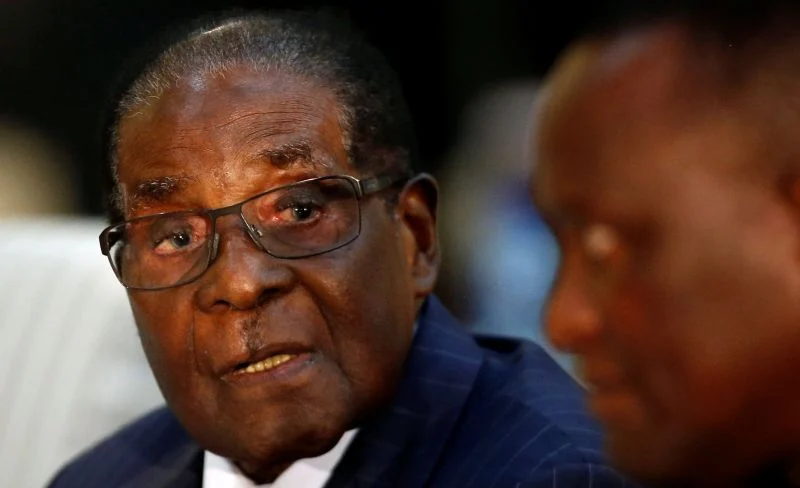
Robert Gabriel Mugabe officially relinquished his position as President of Zimbabwe on Wednesday, November 22, 2017, bringing to a close an extraordinary political career that spanned nearly four decades. The departure of the world’s oldest head of state followed a period of intense political pressure and a de facto military intervention, marking a seismic shift for the southern African nation.
The resignation of Robert Mugabe was met with widespread jubilation across Zimbabwe, as citizens poured into the streets to celebrate the end of the 93-year-old leader’s long tenure. The atmosphere was one of unbridled joy and relief, with citizens dancing, shouting, and embracing in an outpouring of emotion. Members of the Zimbabwean Parliament also reportedly echoed these sentiments, marking the conclusion of Mugabe’s 37-year grip on power.
Mugabe first ascended to power in 1980, the year Zimbabwe gained its independence. His leadership, however, became increasingly defined by widespread criticism for alleged authoritarianism, electoral manipulation, and a devastating impact on the nation’s economy. For years, international observers and domestic critics pointed to a pattern of human rights abuses and a systematic suppression of dissent under his rule.
The Early Years and the Fight for Independence
Robert Gabriel Mugabe was born on February 21, 1924, in Kutama, located in the northeastern part of what was then Salisbury, now Harare, the capital of Zimbabwe. At the time of his birth, the country was known as Southern Rhodesia, a British colony. His early life was marked by academic promise. Mugabe, a former teacher, distinguished himself by earning seven university degrees, a testament to his intellectual prowess.
His political journey began to gain momentum as he became a prominent figure in the fight against white minority rule. Mugabe played a crucial role in leading a bloody guerrilla war against the colonial administration. His activism led to his imprisonment for 10 years, beginning in 1964, following his conviction for "subversive speeches" deemed a threat to the existing regime.
Upon his release from prison in 1974, Mugabe emerged as a galvanizing force in the Rhodesian political landscape. His impassioned rhetoric ignited the spirit of the populace, urging them to resist the injustices of the racist colonial rulers. This period saw him traverse borders, venturing into neighboring Mozambique to spearhead a protracted guerrilla campaign for independence. The protracted struggle ultimately bore fruit, leading to Mugabe’s triumphant return to Rhodesia in 1979. The following year, he assumed the mantle of the nation’s first Prime Minister, presiding over the birth of a new era for the country, subsequently renamed Zimbabwe.
The Mugabe Era: Consolidation of Power and Economic Decline
As Prime Minister and later President, Mugabe’s initial years were characterized by efforts to foster national unity and rebuild a country ravaged by conflict. However, over time, his administration began to exhibit increasingly autocratic tendencies. The initial hope for a democratic and prosperous Zimbabwe gradually eroded under a system that concentrated power in the hands of the ruling party, ZANU-PF.
One of the most significant and controversial policy shifts under Mugabe’s leadership was the Fast Track Land Reform Programme, initiated in 2000. This program aimed to redistribute land from white commercial farmers to black Zimbabweans. While framed as a measure of historical redress and economic empowerment, the implementation was often chaotic and violent, leading to a drastic decline in agricultural output, a cornerstone of the Zimbabwean economy. This, coupled with widespread corruption and mismanagement, plunged the nation into severe economic crisis, marked by hyperinflation and widespread shortages of basic goods. By the early 2000s, Zimbabwe’s economy had contracted significantly, and millions of its citizens faced extreme poverty.
The international community largely condemned Mugabe’s policies, imposing sanctions on his government and key officials. Despite the economic turmoil and international pressure, Mugabe consistently maintained power through a series of elections that were frequently marred by allegations of fraud and intimidation. His political longevity was a subject of intense debate, with supporters often crediting him with liberating Zimbabwe from colonial rule and empowering the black majority, while critics pointed to his authoritarian grip and the devastating consequences for the nation’s development.
Personal Life and Succession Concerns
In his personal life, Robert Mugabe was married twice. His first wife, Sally Hayfron, a Ghanaian national, passed away in 1992 after a long illness. He later married Grace Marufu in 1996, who became a prominent figure in Zimbabwean politics in her own right, often seen as a potential successor. The question of succession loomed large in Zimbabwean politics for many years, with internal party struggles and speculation about who would eventually follow in Mugabe’s footsteps. Grace Mugabe’s increasing public profile and influence within the ruling party fueled these discussions, often creating divisions within ZANU-PF.
The Events Leading to the Resignation
The dramatic events that led to Mugabe’s resignation began to unfold in early November 2017. On November 6, Mugabe dismissed Vice President Emmerson Mnangagwa, a move widely interpreted as an attempt to pave the way for his wife, Grace Mugabe, to succeed him. This action triggered a swift and decisive response from the military.
On November 14, 2017, the Zimbabwe Defence Forces (ZDF) effectively placed Mugabe under house arrest and took control of state television, announcing that they were targeting "criminals" around the president who were responsible for "economic suffering." This marked a significant escalation, with the military asserting its control over the political landscape without explicitly declaring a coup. For several days, Mugabe remained a figurehead president, with uncertainty shrouding his intentions and the future of the country.
Negotiations reportedly took place between Mugabe, the military, and a delegation of Southern African Development Community (SADC) mediators. The pressure mounted as parliamentary impeachment proceedings were initiated by the ruling ZANU-PF party and the opposition Movement for Democratic Change (MDC). Faced with overwhelming political isolation and the imminent threat of impeachment, Mugabe ultimately chose to resign.
His resignation letter, read out by the Speaker of Parliament Jacob Mudenda on November 22, stated that he was stepping down to allow for a peaceful transition of power and to avoid further "tribulation." The news was met with ecstatic celebrations in Harare and other cities, with citizens taking to the streets in spontaneous demonstrations of joy and relief.
A New Chapter for Zimbabwe
The resignation of Robert Mugabe marked the end of an era and ushered in a new, albeit uncertain, chapter for Zimbabwe. Emmerson Mnangagwa, who had been dismissed as Vice President weeks earlier, was subsequently sworn in as the new President on November 24, 2017. His ascent to power signaled a potential shift in the country’s political direction, with many hoping for economic reforms and a renewed commitment to democratic principles.
The implications of Mugabe’s departure were far-reaching. Economically, there was cautious optimism that a new leadership might attract foreign investment and revive the nation’s struggling economy. Politically, the hope was for a move towards greater transparency, accountability, and respect for human rights. However, the deep-seated challenges that had plagued Zimbabwe for decades – including economic inequality, corruption, and the need for institutional reform – remained significant hurdles.
The legacy of Robert Mugabe is complex and deeply contested. He is remembered by some as a liberation hero who fought for Zimbabwe’s independence and empowered the black majority. By others, he is seen as a dictator whose rule was characterized by repression, economic mismanagement, and the erosion of democratic freedoms. His nearly four-decade reign left an indelible mark on Zimbabwe and the African continent, and his departure marked a pivotal moment in the nation’s history, the full consequences of which would unfold in the years to come. The international community watched closely, hoping that this transition would indeed pave the way for a more prosperous and democratic Zimbabwe.
