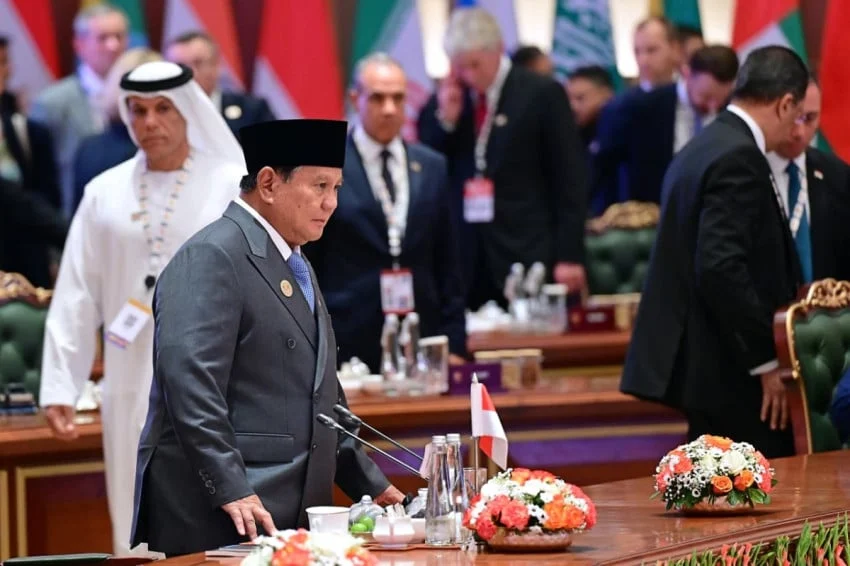
NEW DELHI — Indonesian President Prabowo Subianto delivered a powerful call for international solidarity on Saturday, September 12, 2026, addressing world leaders at the 18th BRICS Summit in New Delhi, India. Rooted in historical principles of anti-colonialism and equitable development, President Prabowo invoked traditional Indonesian wisdom to emphasize the critical necessity of unity among developing nations—collectively known as the Global South—in navigating complex contemporary geopolitical and economic landscapes.
Upon his arrival at the summit venue, President Prabowo was formally welcomed by Indian Prime Minister Narendra Modi, marking a significant diplomatic engagement between two of the world’s largest democracies. Against the backdrop of shifting global trade dynamics, supply chain vulnerabilities, and geopolitical fragmentation, the Indonesian leader’s address resonated deeply with the core objectives of the BRICS bloc: fostering multilateralism, reforming global governance structures, and safeguarding the interests of emerging economies.
The Bandung Spirit and Historical Continuity
At the heart of President Prabowo’s address was a historical reflection on the shared struggles of Asian and African nations. By drawing a direct line between contemporary geopolitical challenges and the historic 1955 Asian-African Conference held in Bandung, Indonesia, the president contextualized the modern Global South movement as a continuation of a decades-long pursuit of sovereignty and self-determination.
"There is an old saying in Indonesia, ‘United we stand, divided we fall,’" President Prabowo told the assembly of heads of state and government delegates. He elaborated that this proverb transcends a mere rhetorical flourish, serving instead as a foundational philosophy that historically empowered nations to break free from colonial domination and demand a seat at the international table.
"This simple wisdom reflects the spirit that united the countries of the Global South, the nations of Asia and Afrika, decades ago in Bandung," he added, invoking the memory of the historic summit that laid the groundwork for the Non-Aligned Movement. By reminding the international community of the Bandung principles—mutual respect for sovereignty, territorial integrity, non-aggression, and equitable economic cooperation—Prabowo positioned Indonesia as a consistent advocate for multilateral fairness.
Chronology and Arrival in New Delhi
The 18th BRICS Summit commenced under stringent security and high diplomatic expectations in New Delhi. President Prabowo’s participation follows a series of active international engagements aimed at expanding Indonesia’s strategic economic partnerships and multilateral diplomacy.
Upon landing at the Indira Gandhi International Airport, the Indonesian delegation was received by senior Indian government officials before proceeding to the official welcome ceremony hosted by Prime Minister Narendra Modi. The bilateral handshake between Modi and Prabowo underscored the deepening ties between Jakarta and New Delhi, particularly within the frameworks of Indo-Pacific cooperation and South-South dialogue.
The summit agenda in New Delhi focuses heavily on reforming international financial institutions, enhancing trade resilience among emerging markets, and addressing energy transitions in the developing world. As an influential voice within Southeast Asia and a prospective partner or member of the expanding BRICS architecture, Indonesia’s positioning at the summit has drawn intense scrutiny from global analysts and international media outlets.
Contextualizing BRICS and the Rise of the Global South
The BRICS grouping—originally comprising Brazil, Russia, India, China, and South Africa—has undergone significant structural expansion in recent years, welcoming additional member states to amplify the economic weight of the developing world. Collectively, the bloc represents a substantial portion of the global population, geographic territory, and combined Gross Domestic Product (GDP), challenging traditional Western-led economic paradigms.
In recent years, the discourse within BRICS has shifted from theoretical economic alignment to practical mechanisms of de-dollarization, alternative payment systems, and resilient supply chains. For nations like Indonesia, which maintains a strictly independent and active foreign policy—summed up locally as bebas aktif—engagement with BRICS offers a strategic platform to diversify trade partnerships without compromising non-aligned diplomatic postures.
Economic analysts note that the Global South currently accounts for a rapidly growing share of global economic growth, yet historical governance structures established post-World War II—such as the International Monetary Fund (IMF), the World Bank, and the United Nations Security Council—remain heavily skewed toward Western dominance. President Prabowo’s emphasis on unity directly addresses this structural imbalance, arguing that fragmented developing economies remain vulnerable to external economic shocks and protectionist policies.
Official Responses and Diplomatic Reactions
Diplomatic circles in New Delhi and Jakarta have responded positively to President Prabowo’s framing of international relations. Observers noted that invoking the Bandung spirit provides a unifying cultural and historical anchor for BRICS members and guest nations alike, bridging geographic and ideological divides among diverse participants.
Indian government representatives praised Indonesia’s constructive role in promoting regional stability in Southeast Asia and its active contribution to broader South-South cooperation. Meanwhile, trade and foreign policy experts in Jakarta highlighted that Prabowo’s speech signals Indonesia’s readiness to take on a more prominent leadership role on the global stage, advocating not only for national economic interests but for the collective welfare of developing nations worldwide.
"President Prabowo’s message is a timely reminder that economic resilience cannot be achieved in isolation," remarked a prominent international relations analyst based in Jakarta. "By recalling the solidarity of the Bandung Conference, Indonesia is reminding the world that the Global South possesses both the demographic magnitude and the moral authority to demand a fairer global economic architecture."
Broader Impact and Geopolitical Implications
The implications of President Prabowo’s address at the 18th BRICS Summit extend far beyond the immediate diplomatic proceedings in New Delhi. As global trade faces headwinds from rising tariffs, technological decoupling, and regional conflicts, the call for unity among emerging economies serves as a vital counterweight to protectionist tendencies.
Furthermore, Indonesia’s strategic balancing act—maintaining robust economic and diplomatic relations with both traditional Western partners and emerging blocs like BRICS—exemplifies the pragmatic foreign policy approach characteristic of Jakarta’s modern administration. By refusing to be drawn into binary geopolitical rivalries, Indonesia continues to position itself as a trusted bridge builder between developed and developing nations.
As the summit concludes, the focus will shift toward the implementation of joint communiqués, economic cooperation agreements, and multilateral frameworks discussed in New Delhi. Whether the solidarity championed by President Prabowo translates into concrete institutional reforms within global governance bodies remains a critical question for international policymakers. However, by firmly anchoring the current geopolitical discourse in the historical legacy of the Bandung Conference, Indonesia has successfully reaffirmed its enduring commitment to a multipolar, equitable, and interconnected world order.