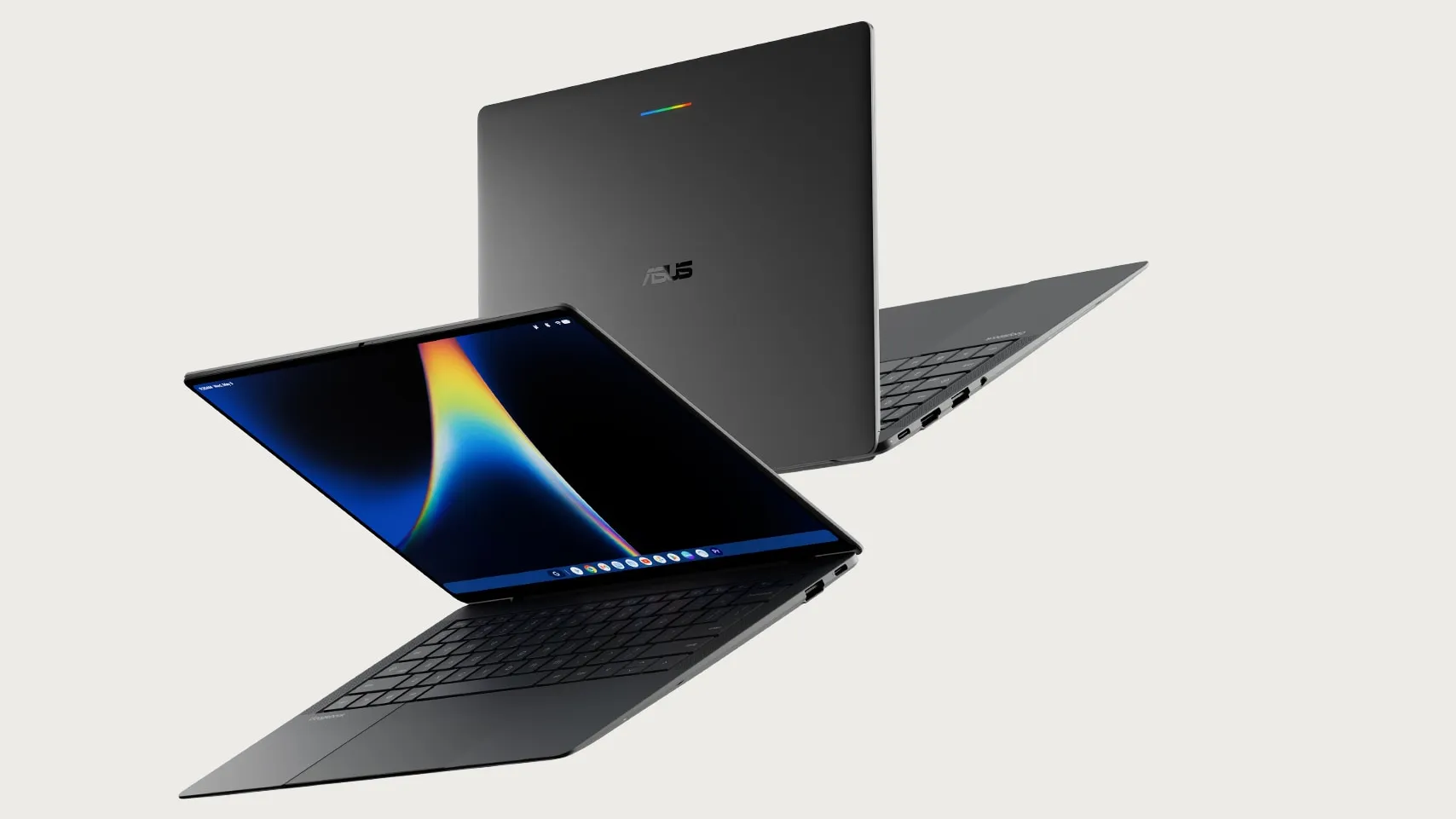
ASUS has officially announced the global launch of the Googlebook 14 (CX9406CAA), a groundbreaking ultraportable laptop that merges high-end enterprise hardware with Google’s newly unified operating ecosystem. Weighing a mere 0.99 kg, the device redefines expectations for lightweight mobile computing by packing flagship specifications into a featherlight chassis. Targeted at professionals, students, and tech enthusiasts who prioritize extreme portability without sacrificing performance, the Googlebook 14 is equipped with Intel’s cutting-edge Panther Lake processors, a stunning 3K OLED display, and a robust suite of integrated artificial intelligence services.
Main Facts and Core Specifications
At the heart of the ASUS Googlebook 14 is a fusion of advanced silicon engineering and premium display technology. The device is powered by Intel’s latest Panther Lake architecture, featuring options up to the Intel Core Ultra 7 355 processor, as well as an alternative Core Ultra 5 325 variant. Both configurations utilize an efficient 8-core setup designed to balance intensive multitasking with optimized power consumption. To complement these processors, ASUS has integrated up to 64GB of high-speed LPDDR5X RAM and up to 1TB of high-performance PCIe 4.0 NVMe solid-state storage, ensuring rapid boot times and seamless data handling for demanding applications.
The visual centerpiece of the laptop is its 14-inch OLED panel boasting a 16:10 aspect ratio and a crisp 3K resolution. Designed to cater to content creators and media consumers alike, the touchscreen display features a fluid 120Hz refresh rate and HDR capabilities with a peak brightness of 1,000 nits. Durability meets elegance on the screen surface, which is protected by Corning Gorilla Glass Victus paired with a specialized Gorilla Matte anti-glare coating. This combination drastically minimizes annoying reflections under harsh office lighting or outdoor environments while preserving vibrant color accuracy and deep contrast ratios typical of OLED technology.
Software Innovation: The Googlebook OS Ecosystem
Perhaps the most significant aspect of the Googlebook 14 is its software platform. Rather than running standard Windows or traditional ChromeOS, the device operates on Googlebook OS—a newly introduced operating system that represents a strategic convergence of ChromeOS and Android. This hybrid platform is engineered to bridge the gap between lightweight web-based applications and robust mobile app ecosystems, offering users native execution of Android applications alongside traditional desktop browsing and productivity tools.

To further elevate the user experience, ASUS and Google have bundled a 12-month subscription to Google AI Pro with every purchase of the Googlebook 14. This comprehensive package grants users deeply integrated access to advanced artificial intelligence tools, including Gemini, Flow, and Gemini Notebook. Additionally, subscribers receive up to 5TB of cloud storage, positioning the laptop not just as a standalone computing tool, but as an always-connected hub designed for cloud-centric modern workflows.
Chronology and Development Background
The unveiling of the Googlebook 14 marks a pivotal milestone in a multi-year collaborative trajectory between ASUS and Google. Over the past decade, ASUS has been a primary hardware partner in Google’s ecosystem initiatives, producing various Chromebook models ranging from budget-friendly educational devices to premium enterprise machines. The development of the Googlebook 14 began in earnest following Intel’s roadmap announcements regarding the Panther Lake architecture, which promised revolutionary performance-per-watt metrics.
Planning for the CX9406CAA started in late 2024, with engineering teams focusing heavily on thermal management within an ultra-thin chassis weighing under one kilogram. By utilizing advanced magnesium-aluminium alloys and Nano Ceramic Technology for surface treatment, engineers achieved structural rigidity that meets stringent military-grade durability standards (MIL-STD 810H). The formal announcement in September 2026 precedes a strategic global roll-out planned for October 2026, positioning the laptop as a premier holiday-season release for both retail and enterprise markets.
Design and Build Quality
Despite its featherlight 0.99 kg weight, the ASUS Googlebook 14 does not compromise on structural integrity. The chassis is forged from a premium magnesium-aluminium alloy finished in an understated yet sophisticated Dusk Ash colorway. To mitigate the wear and tear associated with daily mobile use, ASUS incorporated its proprietary Nano Ceramic Technology. This specialized coating shields the exterior surfaces from scuffs, fingerprints, and scratches, maintaining a pristine aesthetic over long-term usage.
Ergonomics and connectivity have also received careful attention. The keyboard layout is optimized for tactile feedback despite the slim profile, accompanied by a spacious, precision glass touchpad. Furthermore, the inclusion of a 70Wh internal battery ensures that mobile professionals can maintain a full workday of productivity away from wall outlets, supported by fast-charging capabilities over USB-C.

Market Positioning and Pricing Strategy
When the ASUS Googlebook 14 hits global retail shelves in October 2026, it will occupy a distinct tier within the ultraportable segment. The flagship configuration featuring the Intel Core Ultra 7 355 processor, 64GB of RAM, and a 1TB SSD is slated for a starting price of USD 1,299 (approximately Rp 21 million). This pricing strategy pits the device directly against premium Windows ultraportables such as the Dell XPS series, Apple’s MacBook Air, and high-end enterprise Chromebooks.
Industry analysts note that the price point reflects not only the physical hardware—such as the 3K OLED panel and Panther Lake silicon—but also the bundled software value, including the Google AI Pro subscription and extensive cloud storage allowances. While official regional availability dates for Southeast Asian markets like Indonesia have not yet been explicitly detailed, historical product launches suggest that local distribution typically follows within a quarter of the initial global release window.
Broader Industry Impact and Implications
The introduction of the Googlebook 14 carries significant implications for the broader personal computer market. By introducing Googlebook OS on high-end hardware, Google and ASUS are challenging the long-held assumption that premium, high-specification internals must be paired with Windows or macOS. The combination of Intel’s Panther Lake processing power and a unified Android-ChromeOS environment signals a maturation of lightweight operating systems capable of handling professional workloads.
Furthermore, the deep integration of artificial intelligence services like Gemini directly into the operating system core reflects a growing industry trend. As consumers and enterprises increasingly demand on-device and cloud-augmented AI assistance, hardware manufacturers are finding that ecosystem partnerships are just as critical as raw processing speeds. For ASUS, the Googlebook 14 serves as a showcase of manufacturing prowess, demonstrating that extreme portability, rugged durability, and uncompromising computational power can successfully coexist in a sub-one-kilogram form factor.