A concert featuring legendary Italian tenor Andrea Bocelli at the Jakarta International Expo (JIExpo) in Kemayoran, Central Jakarta, descended into chaos on Tuesday night, November 3, 2026, after a mass protest aimed at forcibly shutting down the event erupted into physical clashes with law enforcement officers.
The demonstration, organized by hardline groups and led by figures including Habib Bahar bin Smith under the banner of elements associated with the Islamic Brotherhood Front (FPI), highlights growing domestic tensions in Indonesia regarding international cultural events and geopolitical conflicts in the Middle East. The incident underscores the complex challenges security forces face in balancing public safety, freedom of expression, and the enforcement of permits for international artists performing in the country.
Chronology of the Protest and Escalation
The tensions surrounding the Andrea Bocelli concert did not materialize overnight. Earlier in the day, groups opposing the concert had gathered at prominent locations in the capital, including the Horse Statue (Patung Kuda) area near the National Monument (Monas), where demonstrators waved Palestinian flags and voiced fierce opposition to the Italian tenor’s performance in Jakarta.
By Tuesday evening, the protest shifted from a demonstration of sentiment into an aggressive attempt to disrupt the event directly. Hundreds of protesters converged on the JIExpo Kemayoran complex, intending to breach the security perimeter and halt the concert from taking place inside the venue.
Because Indonesian National Police (Polri) and private security personnel had anticipated potential disturbances, the venue was already under heavy guard. Confronted by locked gates and a heavily fortified security line, the crowd failed to break through the initial barriers. Frustrated by their inability to enter, the demonstration quickly deteriorated into a riot.
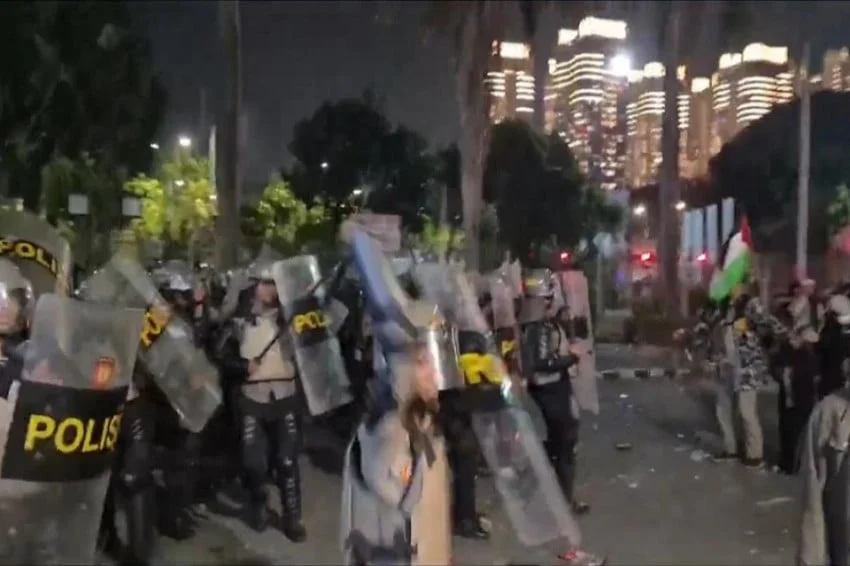
For several hours, the area outside the main gates of JIExpo Kemayoran transformed into a battleground. Rioters began hurling rocks, iron bars, and portions of roadside barricades at police officers deployed to secure the venue. The atmosphere grew increasingly tense as the crowd attempted to overwhelm the police lines. Initially holding their ground using defensive shield formations to absorb the barrage of projectiles, law enforcement officers eventually received orders to take decisive action. Police deployed crowd control measures and pushed the aggressive crowds back, successfully dispersing the rioters and restoring order to the surrounding thoroughfares.
Geopolitical Grievances and the Root Cause of the Protest
The fierce opposition to Andrea Bocelli’s concert stems directly from geopolitical sentiments surrounding the Israeli-Palestinian conflict. Demonstrators targeted the globally acclaimed blind tenor due to historical statements and past performances linked to Israel.
Specifically, protest organizers and participants highlighted an event from 2010 in which Bocelli performed at a high-profile fundraising gala for the Israel Defense Forces (IDF). Although the event occurred more than a decade prior, activist groups in Indonesia—where public solidarity with Palestine is exceptionally strong—resurfaced the connection ahead of the Jakarta concert.
Protesters argued that hosting an artist with such a background in the Indonesian capital was insensitive to the ongoing humanitarian crises in Gaza and constituted a tacit endorsement of military actions against Palestinians. These grievances served as the primary rallying cry for the groups mobilizing against the concert, framing the artistic performance not merely as a cultural event, but as a political flashpoint.

Security and Law Enforcement Response
The escalation at JIExpo Kemayoran places the spotlight squarely on Indonesia’s security apparatus and its management of public demonstrations tied to international controversies. The Jakarta Metropolitan Police (Polda Metro Jaya) deployed substantial personnel to secure the venue following intelligence regarding planned demonstrations.
Law enforcement officials faced a difficult operational dilemma: ensuring the safety of thousands of concertgoers who had purchased tickets to see the renowned tenor, while managing a volatile, aggressive crowd determined to stop the show. The transition from peaceful flag-waving at symbolic landmarks like Patung Kuda to violent assaults on police lines at Kemayoran forced authorities to shift posture from passive monitoring to active riot containment.
While police successfully prevented the protesters from breaching the venue and halted the escalation of property damage, questions remain regarding how future international tours involving artists with controversial pasts will be vetted and secured. Security analysts note that while freedom of assembly and expression are constitutionally protected rights in Indonesia, acts of violence, property destruction, and attempts to shut down legal commercial events through force cross a clear legal boundary that requires firm police intervention.
Broader Implications for Indonesia’s Entertainment and Tourism Sectors
The violent disruption of the Andrea Bocelli concert carries significant implications for Indonesia’s burgeoning entertainment and live-event tourism sectors. In recent years, Jakarta has positioned itself as a major destination for international musicians, touring acts, and cultural festivals, drawing fans from across Southeast Asia and boosting the national economy through tourism, hospitality, and creative industries.
Incidents of politically motivated violence and forced cancellations threaten to undermine confidence among international promoters, management agencies, and global artists looking to include Indonesia in their tour itineraries. Promoters invest millions of dollars in logistics, venue rentals, and security; environments where concerts risk becoming targets of mass mobilization and physical conflict could lead international acts to bypass Jakarta in favor of more predictable markets in the region, such as Singapore, Bangkok, or Kuala Lumpur.
Furthermore, the involvement of prominent hardline figures like Habib Bahar bin Smith illustrates the persistent influence of religious and political nationalism in domestic Indonesian affairs, particularly when intersecting with global issues like the Middle East conflict. The ability of these groups to rapidly mobilize crowds and pivot from symbolic demonstrations to direct confrontation poses ongoing challenges for civil authorities seeking to maintain public order and project an image of stability and tolerance to the international community.
Reactions and Moving Forward
As of Wednesday morning, local authorities and event organizers are assessing the damages sustained around the JIExpo complex following the overnight skirmishes. While police have detained several individuals identified as instigators of the violence, investigations are ongoing to determine the full extent of the coordination behind the forced entry attempts.
Representatives from the entertainment industry have expressed concern over the safety of performers and attendees, calling for stronger assurances from the government that legal events can proceed without interference. Meanwhile, civil society organizations and human rights observers emphasize the importance of differentiating between peaceful advocacy and unlawful vigilantism.
The events at Kemayoran serve as a stark reminder of how global geopolitics can rapidly localize, transforming cultural stages into battlegrounds of public opinion and physical confrontation. For Indonesia, navigating these complex intersections of international solidarity, domestic activism, and economic development will require careful policy coordination, robust intelligence gathering, and an unwavering commitment to the rule of law.