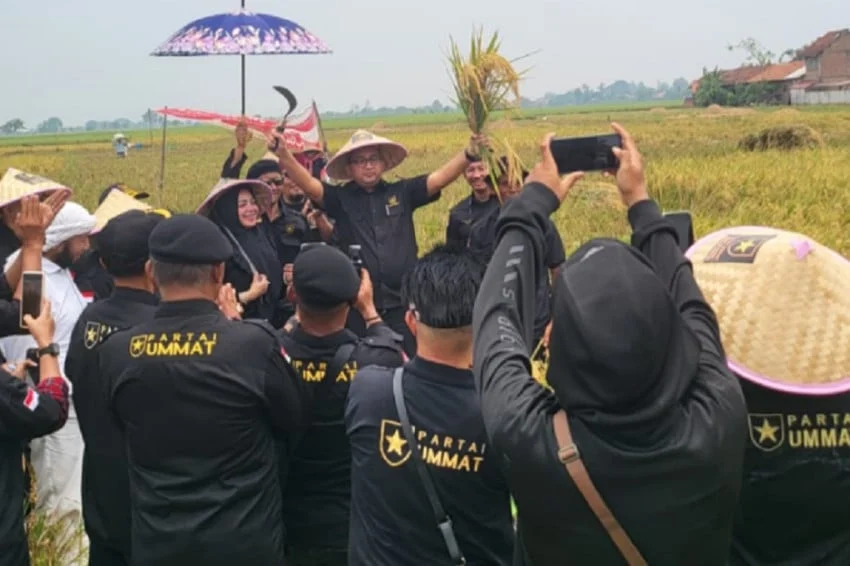
BEKASI — In a concerted effort to champion national food sovereignty and grassroots economic empowerment, Heikal Safar, the Daily Executive Chairman of the Central Leadership Board (DPP) of the Ummat Party, spearheaded a grand harvest celebration and a community free lunch program in Sukamulya Village, Sukatani Subdistrict, Bekasi Regency. The event, which drew participation from hundreds of local farmers, agricultural extension workers, and regional party officials, underscored the critical need to elevate the status and financial security of Indonesian agricultural workers amidst intensifying global competition.
The grand harvest served as both a celebration of local agricultural productivity and a strategic platform for dialogue concerning the systemic challenges faced by rural farming communities. Joining Heikal Safar at the event was Nofalia Heikal Safar, Chairperson of the Economic Empowerment Commission of the DPP Ummat Party, alongside high-ranking regional figures including Firdaus, a key functionary representing the Bekasi Regency and City DPD Ummat, and prominent Bekasi community leader Ustaz Haryono. The delegation also included executive members from the central, provincial, and municipal branches of the party, alongside a robust turnout of local residents and farmers belonging to agricultural cooperatives fostered by the party.
Addressing Structural Disparities in Indonesia’s Agricultural Sector
During the proceedings, Heikal Safar delivered a critical assessment of the current state of Indonesian agriculture, pointing out that despite the nation’s fertile landscapes and strategic emphasis on self-sufficiency, the economic well-being of ordinary farmers remains unevenly distributed across various regions. He emphasized that Indonesian agriculture must undergo continuous structural reinforcement—particularly in terms of technological modernization, access to subsidized capital, and supply chain efficiency—to remain competitive against agricultural giants in Southeast Asia, notably Thailand and Vietnam.
"The prosperity of our farmers is the foundational pillar of true national food security," Heikal stated during his address to the farming community in Sukamulya. "While we celebrate the hard work that yields abundant crops today, we must look critically at the structural gaps that prevent local farmers from reaping the full economic rewards of their labor. In an era where regional competitors are aggressively modernizing their agricultural sectors through advanced technology and precision farming, Indonesia must accelerate its support systems for the grassroots peasantry."
The event in Sukatani Subdistrict was deliberately designed to merge celebratory cultural traditions of the harvest season with actionable community welfare initiatives. The integrated free lunch program, organized concurrently with the harvesting activities, aimed to alleviate immediate nutritional needs among low-income farming families while fostering a sense of solidarity between political leadership and agrarian communities.
Broader Context of National Food Security and Policy Implications
The initiative in Bekasi unfolds against a broader national backdrop wherein the Indonesian government and various socio-political stakeholders are intensely focused on achieving and sustaining long-term food self-sufficiency. Recent macroeconomic data indicates significant national efforts over the past two years to boost production across multiple primary commodities and build robust domestic rice reserves. However, analysts note that macro-level agricultural surpluses do not automatically translate to micro-level prosperity for smallholder farmers, who frequently grapple with high production costs, fluctuating gate prices, climate volatility, and dependency on traditional intermediaries.

By focusing on Bekasi Regency—a historically strategic agricultural zone situated on the eastern periphery of Indonesia’s sprawling capital economic region—the Ummat Party’s leadership sought to draw national attention to the vulnerability of peri-urban agriculture. Rapid industrialization and urban expansion in regions surrounding Jakarta have progressively encroached upon productive arable land, placing immense pressure on local farmers to sustain productivity despite shrinking spatial footprints and escalating environmental challenges.
Chronology and Event Proceedings
The day’s events commenced in the early morning hours as Heikal Safar and the accompanying delegation arrived at the designated agricultural fields in Desa Sukamulya. Following traditional welcoming rituals performed by local farming groups, the leaders participated directly in the manual harvesting of paddy crops, symbolizing a hands-on approach to understanding the physical demands of agricultural labor.
Following the harvest, the delegation engaged in an extensive dialogue session with representatives of local farming cooperatives and individual agrarian workers. Farmers voiced concerns regarding the accessibility of subsidized fertilizers, the rising costs of mechanized farming equipment, and the challenges posed by unpredictable weather patterns linked to shifting climate cycles. In response, Nofalia Heikal Safar outlined prospective frameworks for community-based economic empowerment, emphasizing the necessity of establishing cooperative marketing channels that bypass exploitative middlemen and ensure fairer profit margins for primary producers.
The morning program culminated in a communal free lunch session, bringing together party officials, community elders, and hundreds of local farmers in a shared dining space set up directly adjacent to the harvested fields. This communal gathering served to reinforce social cohesion and provided an informal environment for open communication between rural constituents and political representatives.
Strategic Implications for Regional Economic Empowerment
The engagement in Sukamulya Village highlights a growing trend among political and civic organizations to anchor national policy debates in localized, grassroots actions. Economic analysts observing the event note that sustainable food security cannot be achieved solely through centralized government stockpiling or large-scale agricultural estates; rather, it requires robust institutional backing for independent smallholders who constitute the vast majority of Indonesia’s agricultural workforce.
By incorporating targeted components of economic empowerment—such as advocacy for technological adoption, cooperative strengthening, and direct consumer-producer linkages—initiatives like the one led by Heikal Safar aim to bridge the gap between high-level agricultural policy and daily farm-level realities. The emphasis on modernizing farming techniques to match the standards of regional exporters like Thailand and Vietnam serves as a timely reminder of the competitive pressures facing Indonesian agriculture in the globalized marketplace.
As the event concluded, participants and organizers expressed a shared commitment to maintaining ongoing channels of communication and support. The leadership of the Ummat Party pledged to bring the specific grievances and recommendations gathered from the Bekasi farming community to broader legislative and public forums, ensuring that the voices of rural agricultural workers continue to shape national conversations concerning food sovereignty, economic justice, and sustainable community development.