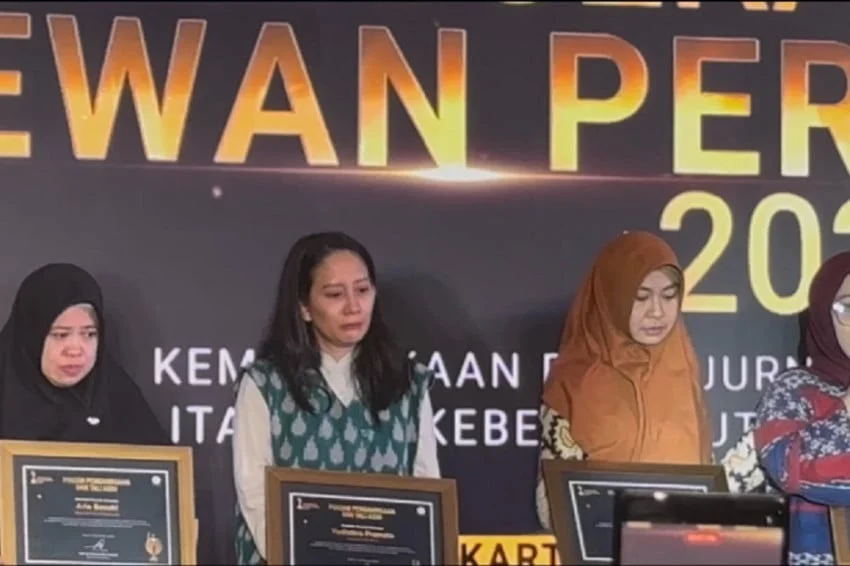
The grand ballroom of the annual Press Award ceremony descended into a profound and heavy silence on Wednesday evening, October 28, 2026, as the Indonesian Press Council (Dewan Pers) turned its attention from celebration to solemn commemoration. In an emotional highlight of the evening, the wives of five photojournalists who mysteriously vanished while on assignment in the turbulent waters surrounding Mount Anak Krakatau stepped forward to receive official honors and financial assistance. The awards served as a poignant national acknowledgment of the extreme hazards journalists face in the line of duty, bringing to light the enduring grief of families left in limbo as search and rescue operations continue long after the initial tragedy.
Visibly overwhelmed by emotion, the five women struggled to hold back tears as they accepted plaques of recognition and tokens of financial support, known locally as tali asih. Among them was Rodiyah Nasution, wife of iNews photojournalist Yudistiro Pranoto—affectionately known as Yudis—who was among the missing reporting crew. Throughout the ceremony, Rodiyah was seen repeatedly wiping away tears with a tissue, a heartbreaking symbol of the persistent sorrow and uncertainty that has defined the lives of these families since the fateful expedition. The poignant scene resonated deeply with the attendees, drawing visible sympathy from press freedom advocates, government officials, and media colleagues alike.
Background Context of the Tragedy and the Danger of Mount Anak Krakatau
The honors presented by the Press Council trace back to one of the most harrowing maritime incidents in recent Indonesian journalistic history. The waters surrounding Mount Anak Krakatau—a notoriously volatile volcanic island situated in the Sunda Strait between the islands of Java and Sumatra—have long been recognized by geologists and mariners as hazardous territory. Characterized by unpredictable weather patterns, strong underwater currents, and sudden seismic or volcanic activity from the active crater, the region demands extreme caution from anyone traversing its waves.
In 2026, a team of photojournalists and media crew members embarked on a reporting expedition to document the environmental and geological developments surrounding the volcano. Such assignments are crucial for keeping the public informed about potential natural disasters, yet they inherently place media workers on the front lines of environmental peril. When communication with the boat carrying the journalists abruptly ceased, it triggered a massive, multi-agency search and rescue (SAR) operation spanning hundreds of square kilometers of open sea. Despite exhaustive efforts by national rescue teams, the primary vessel and the majority of the journalists remained unaccounted for, leaving behind a trail of unanswered questions and profound grief for their loved ones.
Chronology of Search Efforts and Developments
In the wake of the disappearance, national and regional authorities launched extensive search operations, deploying naval vessels, specialized diving teams, and aerial surveillance units to comb the treacherous waters of the Sunda Strait and surrounding island chains.

Progress in the investigation and search efforts has been agonizingly slow, characterized by sporadic breakthroughs. Recently, search and rescue teams made a significant milestone when they successfully located and recovered members of the ship’s crew (ABK). The discovery of the vessel’s crew prompted authorities to pivot and expand their search parameters further afield. SAR teams subsequently extended their sweep toward the remote waters of Enggano Island, located off the western coast of Sumatra, acting on maritime drift calculations and intelligence gathered from the rescued crew members. Despite these ongoing efforts, the primary bodies of the missing journalists have yet to be recovered, leaving the families in a prolonged state of ambiguous loss.
Official Responses and Statements from the Press Council
During Wednesday’s ceremony, leadership from the Indonesian Press Council emphasized that while financial compensation and awards cannot replace a missing husband and father, the institution bears a moral obligation to stand by the families of fallen or missing media workers.
Maha Eka Swasta, Chairman of the Commission for Information and Communication at the Press Council, delivered a heartfelt address during the event. He expressed deep admiration for the resilience demonstrated by the five wives throughout the grueling ordeal. Swasta voiced his hope that the families would be granted continued fortitude, patience, and strength as they navigate the immense psychological and financial burdens left in the wake of the tragedy. He reiterated the Press Council’s ongoing commitment to advocating for the welfare of journalists’ families and ensuring that the sacrifice of those who risk their lives to deliver the news is never forgotten by the nation.
Broader Implications for Press Safety and Journalist Welfare in Indonesia
The tragic incident at Mount Anak Krakatau and the subsequent recognition ceremony have ignited a broader national conversation regarding journalist safety, maritime protocol, and the adequacy of hazard insurance within Indonesia’s media industry. Media watchdogs and press freedom organizations have renewed calls for stringent adherence to safety standards during high-risk environmental reporting.
Experts point out that while frontline reporting on natural disasters and volcanic activity is essential for public safety, media organizations must prioritize risk assessment, provide comprehensive safety gear—such as advanced GPS trackers, satellite communication devices, and certified flotation equipment—and ensure that robust insurance policies are in place for all field personnel. The disappearance of the five photojournalists serves as a stark reminder of the human cost of journalism. It underscores the urgent need for media houses and regulatory bodies to establish stronger safety nets, ensuring that when disaster strikes, the dependents of those who serve the public right to know are adequately supported and cared for in the long term.