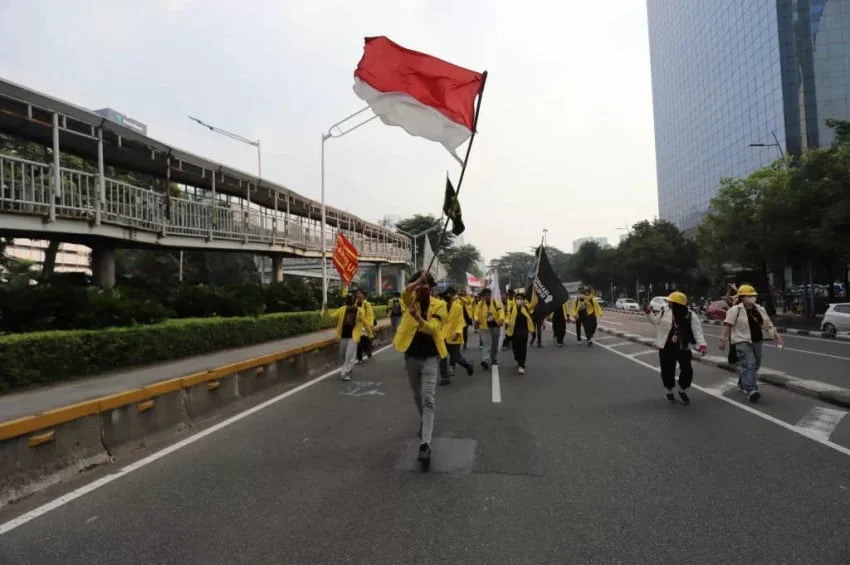
Jakarta is bracing for widespread traffic disruptions and heightened security measures as a coalition of university students, spearheaded by the Student Executive Board of the University of Indonesia (BEM UI), alongside various civil society organizations, prepares for a major mass demonstration. Scheduled for Wednesday, October 28, 2026, the synchronized rallies aim to address critical national policy issues, governance transparency, and socio-economic welfare. In anticipation of the demonstrations, the Jakarta Metro Police (Polda Metro Jaya) has announced comprehensive, situational traffic management plans across four primary convergence zones in Central Jakarta, urging commuters to seek alternative routes to mitigate severe congestion.
The impending protests underscore a recurring dynamic in contemporary Indonesian politics, where student movements act as a primary barometer of public dissatisfaction and a crucial check on legislative and executive power. As thousands of demonstrators mobilize, civil authorities, law enforcement agencies, and human rights watchdogs are placed under intense scrutiny regarding crowd control protocols, constitutional freedoms, and the maintenance of public order.
Main Facts and Mobilization Zones
The demonstration is slated to commence at approximately 10:00 AM Western Indonesia Time (WIB) on Wednesday, October 28, 2026. Organizers have identified four strategic focal points in Central Jakarta where protestors will gather, deliver speeches, and present their demands: the legislative complex of the People’s Consultative Assembly and the House of Representatives (DPR/MPR RI) in Senayan, the landmark Hotel Indonesia (HI) Roundabout, the National Monument (Monas) square, and the Tugu Tani historical monument.
Polda Metro Jaya’s Traffic Management Directorate (TMC) officially released advisory notices via its digital channels, specifically the Instagram account @tmcpoldametro, warning motorists of imminent gridlock. The police administration confirmed that tactical, situational traffic diversions will be implemented dynamically depending on crowd density and movement along major arterial roads, including Jalan Jenderal Sudirman, Jalan M.H. Thamrin, Jalan Medan Merdeka Barat, and surrounding corridors.
Commuters traveling through Central Jakarta on Wednesday have been strongly advised to reschedule non-essential trips, utilize the city’s integrated mass rapid transit systems (MRT, LRT, and TransJakarta), and closely monitor real-time traffic updates provided by law enforcement agencies.
Chronology of Events Leading to the October 28 Mobilization
The mobilization scheduled for October 28 is the culmination of weeks of rising socio-political tensions and organizational groundwork laid by student syndicates and labor coalitions. The timeline leading up to the protest highlights a systematic escalation of public discourse regarding legislative accountability and economic pressures.
Early October 2026 witnessed closed-door and open-air consolidation meetings among major student alliances, prominently featuring BEM UI, BEM Universitas Gadjah Mada (UGM), and regional student confederations. These forums centered on legislative drafts, public transparency concerns, and the rising cost of living, which organizers claim disproportionately affects marginalized communities.
By mid-October, formal notification letters regarding the planned mass assembly were submitted to the Jakarta Metro Police in compliance with Law No. 9 of 1998 concerning Freedom of Expression in Public Spaces. Simultaneously, student leaders toured various university campuses across Greater Jakarta to galvanize support, distribute manifestos, and establish internal marshaling protocols designed to maintain peaceful conduct and prevent infiltration by external agitators.
On Monday, October 26, 2026—just 48 hours prior to the scheduled mobilization—national institutions stepped in to address potential security and human rights concerns. Notably, the National Commission on Human Rights (Komnas HAM) issued a public reminder to law enforcement agencies, setting a cooperative yet cautious tone for the impending demonstrations.
Underlying Context and Background of the Protest Movement
The decision by BEM UI and civil society groups to stage a major protest on October 28 holds deep symbolic and political resonance. Historically commemorated as Youth Pledge Day (Hari Sumpah Pemuda) in Indonesia, October 28 serves as a historical reminder of youth-led unification and nationalist advocacy. Modern student movements frequently leverage this date to voice systemic grievances against the ruling administration and legislative bodies.
Observers note that contemporary student grievances extend beyond single-issue politics. The coalition’s platform encompasses a broad spectrum of demands, including anti-corruption measures, judicial independence, environmental protections, and economic reforms aimed at curbing inflation and stabilizing employment opportunities for fresh graduates. The complexity of these demands reflects a maturing student movement that utilizes data-driven advocacy alongside traditional street mobilization.
Furthermore, the choice of multiple decentralized locations—ranging from the symbolic heart of the capital at Monas and the HI Roundabout to the seat of legislative power at the DPR/MPR complex—demonstrates advanced logistical planning. By spreading out across key municipal hubs, the demonstrators aim to maximize public visibility while testing the logistical and tactical capacity of security forces.
Official Responses and Human Rights Imperatives
The scale of the planned protest has triggered proactive engagements from both law enforcement authorities and independent oversight bodies. The primary operational objective for Polda Metro Jaya is balancing the constitutional right of citizens to assemble with the parallel necessity of maintaining public safety, preventing property damage, and ensuring the uninterrupted flow of emergency services.
In a significant development preceding the protests, Chairperson of the National Commission on Human Rights (Komnas HAM), Anis Hidayah, publicly urged the security apparatus to strictly adhere to human rights principles throughout the management and containment of the demonstrations. Anis emphasized that the freedom of expression in public spaces is a fundamental constitutional right explicitly guaranteed by the 1945 Constitution (UUD 1945) and national human rights legislation.
"The primary duty of the security apparatus is to ensure the conducive execution of this right, ensuring it is carried out peacefully, without the use of excessive force, and free from physical violence," Anis stated during a press briefing in Jakarta.
Anis further stressed that both law enforcement officers and protest organizers share a collective responsibility to maintain order. She reminded security personnel that standard operating procedures (SOP) regarding riot control must prioritize de-escalation, dialogue, and restraint. Conversely, she urged student leaders and civilian marshals to actively police their own ranks, ensuring that demonstrations remain strictly non-violent and isolated from opportunistic provocations.
Broader Impact, Economic Implications, and Traffic Management
Mass demonstrations in the capital invariably generate ripple effects across various sectors, ranging from municipal administration and commercial activity to public psychology. Central Jakarta houses numerous vital national institutions, international embassies, corporate headquarters, and major financial districts. Consequently, large-scale assemblies inevitably prompt commercial adjustments, with several downtown offices implementing hybrid work arrangements or encouraging remote operations for their staff on the day of the rally.
The implementation of situational traffic engineering by Polda Metro Jaya represents a critical logistical intervention designed to prevent total gridlock in the metropolitan area. Historically, road closures around the DPR/MPR complex and the HI Roundabout force TransJakarta to suspend or reroute multiple bus corridors, impacting hundreds of thousands of daily commuters who rely on public transportation.
Municipal authorities have coordinated closely with public transport operators to ensure real-time adjustments are communicated effectively through digital platforms and station announcements. While temporary transit modifications cause inconvenience, transport analysts generally praise the proactive communication strategy employed by the police traffic directorate, which helps mitigate widespread panic and reduces travel delays.
Long-Term Political Significance
Political analysts view the October 28 mobilization as a critical litmus test for civil-military relations, democratic health, and civic space in Indonesia. As the nation navigates complex socio-economic transitions, the capacity of the government to absorb, respond to, and respect peaceful dissent serves as a vital indicator of democratic consolidation.
The involvement of BEM UI and allied civil society networks highlights the persistence of organized intellectual opposition within the public sphere. Unlike decentralized digital activism, physical mobilizations require physical endurance, financial coordination, and institutional resilience—qualities that continue to make student movements a formidable force in shaping national political discourse.
As Wednesday morning approaches, all eyes remain fixed on Central Jakarta. The success of the day will ultimately be measured not only by the peaceful articulation of student demands and the responsiveness of legislative bodies, but also by the professional restraint demonstrated by security forces in upholding democratic norms and human rights obligations.