President Joko Widodo, accompanied by a high-level delegation of government officials and energy executives, conducted a significant field inspection of the PT Trans Pacific Petrochemical Indotama (TPPI) refinery in Tuban, East Java, on Wednesday, November 11, 2015. This visit marked a pivotal moment in the administration’s efforts to revitalize national energy assets that had long remained dormant or underutilized due to complex legal and financial entanglements. The presidential entourage included Minister of State-Owned Enterprises (SOE) Rini Soemarno, Pertamina President Director Dwi Soetijpto, Pertamina Vice President of Corporate Communication Wianda Pusponegoro, and Director General of Oil and Gas at the Ministry of Energy and Mineral Resources, IGN Wiratmaja.
The visit was characterized by a blend of formal state business and informal community engagement, a hallmark of President Widodo’s "blusukan" (impromptu visit) style of governance. Before arriving at the main gates of the TPPI facility, the delegation took the opportunity to walk through the local residential areas surrounding the refinery. This interaction allowed the President and his ministers to engage directly with the residents of Tuban, many of whom expressed enthusiasm at the sight of the nation’s leaders in their neighborhood. During this walk, numerous residents approached the officials for photographs, a request that was met with openness by Minister Rini Soemarno and the Pertamina leadership.
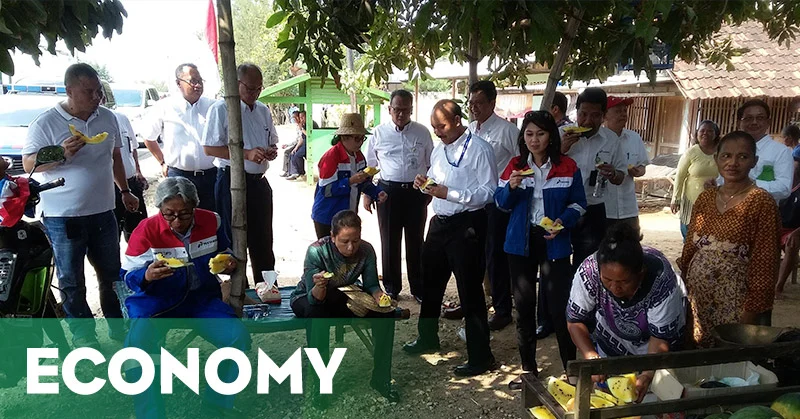
A notable human-interest moment occurred when the procession paused at a local residence that also served as a stall selling fresh produce. In a gesture of support for the local agricultural economy, the entire group stopped to sample watermelons grown in the fields adjacent to the TPPI refinery. Minister Rini Soemarno was seen encouraging the delegation and the accompanying press corps to taste the fruit, highlighting its quality and the productivity of the local soil. "Come on, try the watermelon first. This watermelon is delicious," Minister Soemarno remarked while sharing slices with the group. This brief interlude served as a symbolic bridge between the high-level industrial objectives of the day and the immediate livelihoods of the people living in the shadow of the massive petrochemical complex.
The Strategic Importance of the TPPI Refinery
Following the brief stop, the delegation proceeded to the TPPI refinery site to assess the progress of its operational restart. The TPPI facility is regarded as one of the most sophisticated refineries in Southeast Asia, capable of processing light condensate into both petroleum products and essential aromatics for the petrochemical industry. However, for several years prior to 2015, the facility had faced severe operational halts stemming from a mountain of debt and a series of legal disputes involving its previous management and the state.
The revitalization of TPPI was a cornerstone of the Jokowi administration’s strategy to achieve energy sovereignty and reduce Indonesia’s chronic reliance on imported fuel. At the time of the visit, Indonesia was grappling with a significant current account deficit, much of which was driven by the high cost of importing refined oil products. By bringing TPPI back online under the management of the state-owned energy giant Pertamina, the government aimed to save billions of dollars in foreign exchange reserves.
The refinery has a nameplate capacity of approximately 100,000 barrels per day (bpd). When operating at full capacity, it can produce significant volumes of gasoline (RON 92), diesel, and liquefied petroleum gas (LPG), alongside petrochemical precursors like paraxylene, benzene, toluene, and orthoxylene. The ability to produce these chemicals domestically is vital for the Indonesian textile and plastics industries, which otherwise must rely on expensive imports.
Chronology of the Revitalization Effort
The journey to the November 2015 visit began years earlier, characterized by a complex history of financial restructuring. PT Trans Pacific Petrochemical Indotama was established in the mid-1990s but was severely impacted by the 1997-1998 Asian Financial Crisis. Over the following decade, the company struggled with massive debts to various state entities, including Pertamina and the SKK Migas (the Special Task Force for Upstream Oil and Gas Business Activities).
By 2012, the refinery had largely ceased operations. The breakthrough came in 2015 when the government, through the Ministry of SOE and the Ministry of Finance, orchestrated a plan for Pertamina to take over the operational control and eventually the majority ownership of the plant. The goal was to convert the outstanding debt into equity, thereby giving the state a controlling stake in the asset.
In October 2015, just weeks before the President’s visit, the refinery successfully commenced a trial restart of its primary distillation unit. The November 11 inspection was designed to verify that the facility was on track to reach stable production levels. President Widodo’s presence was intended to send a clear message to both domestic and international stakeholders that the government was committed to resolving the legal "knots" that had previously paralyzed the facility.

Supporting Data and Economic Implications
The economic rationale for the TPPI takeover was supported by staggering figures provided by the Ministry of Energy and Mineral Resources. At the time, it was estimated that the full operation of TPPI could reduce Indonesia’s fuel imports by up to 15 percent. In monetary terms, this was projected to save the state approximately $2 billion to $2.2 billion per year in import costs.
Furthermore, the production of aromatics at the Tuban site was expected to provide a massive boost to the domestic manufacturing sector. For example, paraxylene is a primary raw material for purified terephthalic acid (PTA), which is used to make polyester. Before the restart, Indonesian textile manufacturers were heavily dependent on aromatics imported from Singapore and South Korea. By sourcing these materials from Tuban, local industries could significantly reduce their logistics costs and improve their global competitiveness.
During the site visit, Pertamina CEO Dwi Soetijpto briefed the President on the technical milestones achieved. He noted that the refinery was already beginning to contribute to the national gasoline supply, which was particularly critical during periods of high seasonal demand. The integration of TPPI into Pertamina’s wider refinery network was described as a move toward "operational synergy," allowing the state company to optimize its crude oil sourcing and product distribution across the archipelago.
Official Responses and Policy Context
President Joko Widodo, speaking to the media following the inspection, emphasized that the reactivation of TPPI was a matter of national pride and economic necessity. He stated that the government would no longer tolerate strategic assets sitting idle due to administrative or legal hurdles. The President directed his ministers to ensure that all remaining legal issues surrounding the refinery’s past ownership be handled transparently but firmly, so as not to disrupt future operations.
Minister Rini Soemarno echoed this sentiment, highlighting the role of SOEs as "agents of development." She noted that the synergy between Pertamina and TPPI was a template for how the government intended to rescue other distressed strategic assets. "We are focusing on results. The people of Tuban and the people of Indonesia need this refinery to work. The watermelon we ate today is a reminder that this region has great potential, and the refinery is a part of that ecosystem," Soemarno added.
The Director General of Oil and Gas, IGN Wiratmaja, provided a technical perspective, noting that the government was also looking into upgrading the facility further. The long-term plan involved the "Tuban Project," a massive refinery and petrochemical complex (GRR Tuban) that would eventually be integrated with the existing TPPI site, creating a world-class energy hub in East Java.
Broader Impact on National Energy Security
The visit to Tuban in late 2015 served as a catalyst for a broader shift in Indonesia’s energy policy. It marked the beginning of a more aggressive stance on refinery development, which had seen little to no new investment for over two decades. Following the TPPI success, the government moved forward with the Refinery Development Master Plan (RDMP) to upgrade existing facilities in Balikpapan, Cilacap, Dumai, and Balongan.
The social impact on the Tuban regency was also significant. The restart of the refinery meant the return of thousands of jobs, both directly within the plant and indirectly through the local service economy. The "watermelon stop" by the President was not merely a photo opportunity; it was a recognition of the local community as stakeholders in the nation’s industrial progress. For the residents of Tuban, the presence of the President signaled that their region was at the forefront of the national economic agenda.
In conclusion, the November 11, 2015, visit to the TPPI refinery was much more than a routine inspection. It was a multifaceted event that combined the technicalities of energy infrastructure with the warmth of local community engagement. By sampling the local harvest and then walking the floors of a multi-billion dollar industrial complex, the leadership demonstrated a holistic approach to development—one that seeks to balance macro-economic stability with the micro-economic realities of the Indonesian people. The successful revitalization of TPPI stands as a testament to the power of political will in overcoming long-standing institutional barriers for the benefit of national energy security.