President Joko Widodo, accompanied by a high-level delegation including State-Owned Enterprises (SOE) Minister Rini Soemarno and Pertamina President Director Dwi Soetijpto, conducted a strategic working visit to the PT Trans Pacific Petrochemical Indotama (TPPI) refinery in Tuban, East Java, on Wednesday, November 11, 2015. The visit was aimed at inspecting the facility’s readiness to resume full operations after a prolonged period of inactivity, marking a significant milestone in the Indonesian government’s push for national energy sovereignty. However, before reaching the industrial complex, the presidential entourage took a moment to engage in a spontaneous interaction with the local community, highlighting the administration’s signature "blusukan" (impromptu visit) style of governance.
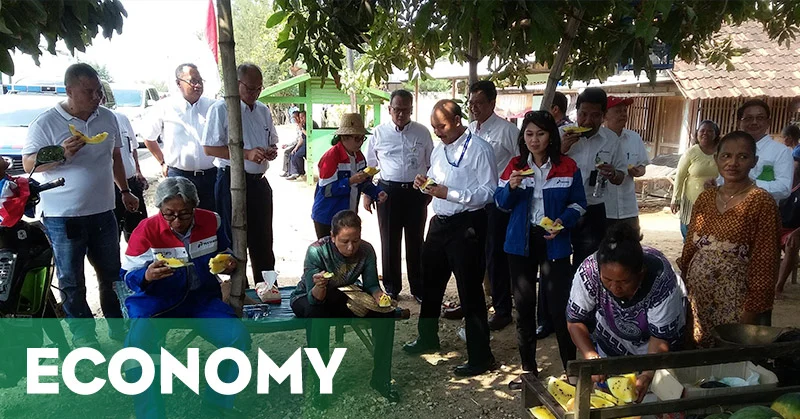
As the motorcade traversed the rural roads leading to the refinery, the group stopped at a local residence where a resident was selling fresh watermelons harvested from nearby fields. Amidst a crowd of local citizens who had gathered to catch a glimpse of the national leaders, Minister Rini Soemarno and the Pertamina leadership joined the President in sampling the local produce. The informal gathering served as a brief respite before the technical inspection of the multi-billion dollar facility. Minister Rini Soemarno expressed her appreciation for the quality of the local agricultural products, encouraging the delegation to taste the fruit while interacting with the villagers. This moment of levity underscored the socio-economic connection between the massive industrial asset of the TPPI refinery and the surrounding agricultural community of Tuban.
The Strategic Importance of the TPPI Refinery
The visit to the TPPI refinery was not merely ceremonial; it represented a critical step in the Jokowi administration’s plan to reduce the nation’s heavy reliance on imported fuel. The TPPI facility is one of the most sophisticated refineries in Southeast Asia, capable of processing condensate into high-value petrochemical products and motor spirits. For years, the facility had been underutilized or dormant due to a complex web of financial disputes, legal challenges, and debt restructuring issues involving the state and private stakeholders.
The revival of TPPI is central to Indonesia’s broader strategy of achieving energy independence. By processing condensate domestically, the refinery can produce significant quantities of Gasoline (specifically Premium/RON 88), Diesel (Solar), and Liquefied Petroleum Gas (LPG). Furthermore, its petrochemical wing produces aromatics such as Paraxylene, Benzene, Orthoxylene, and Toluene, which are essential raw materials for the domestic textile and plastics industries. Reactivating this "sleeping giant" is estimated to save the Indonesian government billions of dollars in foreign exchange reserves by substituting imports with domestic production.
Chronology of the TPPI Crisis and Recovery Efforts
To understand the weight of the 2015 presidential visit, one must look at the turbulent history of PT Trans Pacific Petrochemical Indotama. Established in the late 1990s, the refinery was intended to be a crown jewel of Indonesia’s industrial sector. However, the 1997-1998 Asian Financial Crisis left the company burdened with massive debts. Over the following decade, the refinery faced a series of operational halts and ownership disputes.
By 2011, the facility had largely ceased operations as its debt to the state oil company, Pertamina, and other creditors ballooned. The legal complexities were further exacerbated by allegations of corruption and mismanagement involving former executives. For several years, the facility sat idle, a symbol of wasted industrial potential.
Upon taking office in 2014, President Joko Widodo prioritized the resolution of the TPPI impasse. The government orchestrated a roadmap to settle the company’s debts and integrate its operations more closely with Pertamina. By late 2015, through a series of ministerial decrees and corporate restructuring, the refinery was brought back online. The November visit served as a formal validation that the facility was once again contributing to the national energy grid.
Technical Capacity and Economic Impact
The TPPI refinery boasts a processing capacity of approximately 100,000 barrels per day (bpd) of condensate. During the inspection, Director General of Oil and Gas IGN Wiratmaja and Pertamina’s leadership detailed the facility’s output potential. At full capacity, the refinery is expected to produce:

- Gasoline (Premium): Approximately 61,000 barrels per day.
- Diesel (Solar): Approximately 10,000 barrels per day.
- LPG: Approximately 200 metric tons per day.
- Petrochemicals: Significant volumes of Paraxylene and Benzene, reducing the need for raw material imports for the Indonesian manufacturing sector.
From an economic perspective, the operation of TPPI is a game-changer. Data from the Ministry of Energy and Mineral Resources indicates that the full operation of the Tuban refinery could reduce fuel imports by up to 15%. In 2015, this was estimated to provide a relief of nearly USD 2.2 billion per year to the national trade balance. By utilizing domestic condensate—much of which is produced in the nearby Cepu Block—the government creates a closed-loop value chain that maximizes domestic resources.
Official Responses and Ministerial Directives
During the visit, Minister Rini Soemarno emphasized that the government would ensure the long-term sustainability of the refinery. She noted that the synergy between the Ministry of BUMN, the Ministry of Energy, and Pertamina was essential to prevent the facility from falling back into financial distress. "The goal is clear: we must optimize every asset we have to serve the people. TPPI is no longer a problem child; it is now a strategic partner in our energy security," she stated.
Pertamina President Director Dwi Soetijpto echoed these sentiments, highlighting that the integration of TPPI into Pertamina’s refining system would streamline logistics and distribution in East Java and Central Java. He noted that the proximity of the refinery to major consumption hubs allows for more efficient fuel delivery, further lowering costs.
The presence of Vice President Communication Pertamina Wianda Pusponegoro also signaled a new era of transparency regarding the refinery’s operations. The government sought to reassure the public and investors that the legal and financial clouds hanging over TPPI were being cleared through systematic state intervention and professional management.
Social Implications and Community Engagement
The "watermelon stop" made by the President and his ministers was more than a photo opportunity; it reflected the administration’s attempt to humanize large-scale industrial projects. For the people of Tuban, the TPPI refinery has long been a source of both hope and frustration. While it offers the potential for high-skilled employment and local economic stimulation, its years of inactivity left many local businesses and workers in limbo.
By stopping to eat with the locals, President Jokowi signaled that the benefits of the refinery’s revival must trickle down to the grassroots level. The administration has frequently stressed that industrial zones must coexist harmoniously with local agricultural sectors. In Tuban, where the land is fertile for crops like watermelons and corn, the government’s challenge is to ensure that industrial expansion does not come at the expense of the local farmers’ livelihoods.
Analysis: The Path Forward for Indonesia’s Energy Sector
The 2015 visit to TPPI can be seen as a precursor to the Refinery Development Master Plan (RDMP) that would follow in subsequent years. It set the tone for a more aggressive approach to domestic refining capacity. For decades, Indonesia had lagged behind its neighbors in refining technology, often exporting crude oil only to import refined products at a premium.
The revival of TPPI proved that with enough political will, even the most complex "legacy" problems in the energy sector could be addressed. However, analysts point out that the long-term success of such projects depends on consistent policy and the insulation of state companies from political interference. The TPPI case remains a textbook example of how state intervention can salvage critical infrastructure, provided it is backed by sound technical management and financial transparency.
As the delegation left the refinery and the watermelon stalls of Tuban, the message was clear: Indonesia was moving toward a more self-reliant energy future. The sight of the President of the Republic and the Minister of SOEs sharing fruit with villagers on the doorstep of a massive petrochemical plant serves as a lasting image of a government attempting to balance high-level economic strategy with the everyday realities of its citizens. The success of the TPPI refinery in the years following this visit would ultimately be the true measure of the administration’s success in turning energy potential into national prosperity.