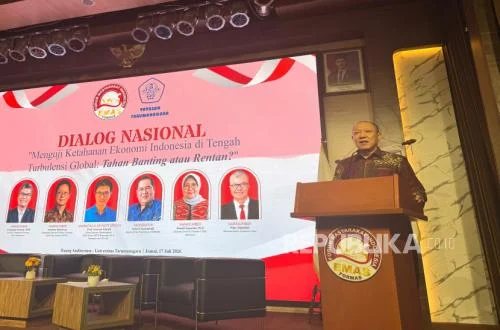
JAKARTA – The Forum Masyarakat Indonesia Emas (Formas), or the Golden Indonesia Community Forum, convened a crucial National Dialogue aimed at formulating concrete policy recommendations for the government to navigate the complex landscape of global uncertainty. Held at the Universitas Tarumanagara campus in Jakarta on Friday evening, July 17, 2026, the scientific forum brought together a distinguished panel of economists, academics, and business leaders to critically assess Indonesia’s economic fortitude. The dialogue, themed "Testing Indonesia’s Economic Resilience Amidst Global Turbulence: Resilient or Vulnerable?", underscored the pressing need for proactive and adaptive strategies to safeguard the nation’s economic stability and propel its journey towards the "Indonesia Emas 2045" vision.
Contextualizing the Imperative: A Nation at a Crossroads
The year 2026 finds the global economy grappling with a confluence of multifaceted challenges, ranging from persistent geopolitical conflicts to rapid technological disruption and a discernible weakening of global purchasing power. These external pressures have created a volatile environment, casting a shadow of uncertainty over even the most robust economies. It is against this backdrop that Formas, an organization deeply committed to Indonesia’s long-term prosperity and societal well-being, initiated this high-level discourse. The forum served as a timely platform for intellectual exchange and collaborative problem-solving, reflecting a proactive stance by civil society and academia to contribute meaningfully to national policy formulation. The very essence of the dialogue’s theme – questioning whether Indonesia is "resilient or vulnerable" – highlighted a shared recognition of the severe tests currently confronting the nation’s economic structure.
The call for such a dialogue was not merely academic; it was a direct response to tangible domestic challenges. Yohanes Handojo Budhisedjati, the General Chair of Formas, emphasized in his introductory remarks that the initiative was taken to address an ongoing phase of economic instability and inflationary pressures that were beginning to trigger recessionary trends across various domestic sectors. This internal vulnerability, exacerbated by external shocks, necessitated a comprehensive and integrated approach to policy-making, moving beyond conventional responses to embrace innovative and forward-looking solutions. Formas, with its focus on the "Golden Indonesia 2045" vision – a national aspiration for Indonesia to become a developed, prosperous, and equitable nation by its centenary of independence – views economic resilience as a foundational pillar for achieving these ambitious goals. The dialogue was thus positioned as a critical step in ensuring that current policy decisions are aligned with long-term national objectives, preventing short-term reactive measures from undermining future growth potential.
The Dialogue Unfolds: Navigating the Storm
The proceedings commenced with an impactful opening address by Serian Wijatno, who not only serves as the Chairman of the Dialogue Committee but also holds the influential position of Chairman of Formas’s Expert Council. Wijatno, widely recognized as a keen social and community observer, employed a powerful metaphor to illustrate Indonesia’s current economic predicament, likening it to a ship valiantly braving a tempestuous sea. This "storm" was attributed to the combined forces of escalating geopolitical conflicts, transformative technological disruptions, and a significant decline in global and domestic purchasing power. His analogy resonated deeply with the audience, painting a vivid picture of the challenges ahead.
Wijatno further invoked a timeless piece of wisdom, stating, "A calm sea never made a skilled sailor," a poignant metaphor that framed the current economic challenges not merely as obstacles, but as crucible moments for national growth and character. He passionately asserted that these global challenges represent a genuine test of the nation’s economic resilience, an opportunity for Indonesia to demonstrate its capacity for adaptation, innovation, and strategic foresight. This perspective shifted the narrative from one of passive victimhood to active agency, encouraging a mindset of strength and determination in the face of adversity.
Crucially, Wijatno stressed that the dialogue was meticulously designed to be critically analytical, with the explicit goal of generating economic policy recommendations that are not only realistic and clear but also immediately actionable by policymakers. He firmly distinguished the forum’s intent from mere academic discourse or theoretical discussions, emphasizing the urgency and practicality required in the current global climate. This commitment to tangible outcomes highlighted Formas’s dedication to bridging the gap between intellectual deliberation and concrete policy implementation, ensuring that the insights garnered would translate into meaningful governmental action.
Distinguished Voices and Diverse Perspectives
The dialogue attracted a highly influential lineup of speakers, each bringing their unique expertise and perspectives to the table. The panel included prominent economists such as Piter Abdullah, Hendri Saparini, and Anthony Budiawan, alongside Wijayanto Samirin, an expert known for his insights into economic development and policy. Their collective presence signaled the breadth and depth of the intellectual exchange that characterized the event. The esteemed gathering also saw the participation of Ahmad Sudiro, the Rector of Universitas Tarumanagara, whose presence underscored the vital role of academic institutions in fostering critical national dialogues. Furthermore, a significant contingent of leading figures from the business community and national academics enriched the discussions, ensuring that the recommendations formulated would be grounded in both theoretical rigor and practical experience.
The format of the dialogue was designed to encourage robust debate and collaborative synthesis. Following initial presentations by the key speakers, who delved into various facets of global economic turbulence and Indonesia’s specific vulnerabilities and strengths, the forum transitioned into interactive panel discussions. These sessions allowed for a deeper exploration of complex issues, with experts challenging prevailing assumptions and proposing alternative frameworks. Breakout sessions, inferred as a logical component for "formulating recommendations," likely facilitated more focused discussions on specific policy areas, allowing participants to drill down into the granular details of potential interventions. The active engagement from the audience, comprising economists, policymakers, students, and civil society representatives, further enriched the discourse, ensuring a multi-stakeholder perspective on the challenges and solutions at hand.
Deep Dive into Global Headwinds and Indonesia’s Economic Landscape
To fully appreciate the urgency of Formas’s dialogue, it is imperative to examine the global economic headwinds that necessitated such a gathering in 2026, and to assess Indonesia’s unique position within this turbulent environment.
Geopolitical Conflicts: The enduring impact of geopolitical tensions, notably the protracted conflict in Eastern Europe and escalating frictions in the Middle East and parts of Asia, continues to ripple through global markets. These conflicts have led to significant disruptions in supply chains, particularly for energy and food commodities, causing price volatility and contributing to inflationary pressures worldwide. For Indonesia, a major commodity exporter but also a net importer of certain essential goods, these dynamics present a double-edged sword: while higher commodity prices might boost export revenues, they also increase import costs and domestic inflation, potentially eroding purchasing power. The threat of further escalation or new conflicts adds an element of unpredictable risk to long-term investment and trade planning.
Technological Disruption: The accelerating pace of technological advancement, particularly in areas like artificial intelligence, automation, and advanced robotics, is fundamentally reshaping industries and labor markets. While offering immense opportunities for increased productivity and innovation, it also poses significant challenges. The "future of work" demands a highly skilled workforce, and countries like Indonesia must invest heavily in education and vocational training to avoid widening skill gaps and increasing unemployment in traditional sectors. Digital transformation, while opening new avenues for economic growth, also necessitates robust cybersecurity infrastructure and inclusive digital access to prevent a widening digital divide.
Weakening Purchasing Power and Inflation: Globally, many economies are battling persistent inflation, driven by a combination of supply-side constraints, elevated energy and food prices, and accommodative monetary policies of the past. Central banks worldwide have responded with aggressive interest rate hikes, which, while aimed at curbing inflation, risk stifling economic growth and potentially triggering recessions. In Indonesia, the impact of global inflation translates into higher domestic prices for basic necessities, squeezing household budgets and leading to a decline in real purchasing power. This erosion of consumer spending, a crucial driver of Indonesia’s economy, could dampen domestic demand and slow overall economic expansion. Data for mid-2026 suggests that while Indonesia’s inflation rate has shown signs of stabilization, it remains a key concern, necessitating careful calibration of monetary and fiscal policies by Bank Indonesia and the government.
Indonesia’s Economic Resilience: Strengths and Vulnerabilities
Despite these formidable challenges, Indonesia possesses inherent strengths that contribute to its economic resilience. The nation’s large domestic market, with a population exceeding 280 million, provides a significant buffer against external shocks, as domestic consumption remains a primary driver of GDP growth. Its abundant natural resources, including coal, palm oil, nickel, and other minerals, continue to attract foreign investment and contribute substantially to export revenues. Furthermore, Indonesia’s relatively stable political environment and prudent fiscal management, characterized by a commitment to maintaining a manageable debt-to-GDP ratio, offer a degree of confidence to investors. In 2026, analysts projected Indonesia’s GDP growth to be in the range of 4.8-5.2%, a respectable figure amidst a global slowdown, but slightly below pre-pandemic potentials, highlighting the impact of global turbulence.
However, vulnerabilities persist. Indonesia’s economy remains somewhat reliant on commodity exports, making it susceptible to volatile global prices. While efforts are underway to diversify the economy and move up the value chain, this transition is a long-term endeavor. Import dependence for certain manufactured goods and raw materials also exposes the country to supply chain disruptions and currency fluctuations. The potential for capital outflows in response to global interest rate differentials or perceived risks could put pressure on the Rupiah. Moreover, structural issues such as infrastructure gaps in certain regions, bureaucratic complexities, and persistent income inequality continue to pose challenges to inclusive and sustainable growth. The dialogue aimed to squarely address these vulnerabilities and propose mechanisms to mitigate them.
Towards Actionable Recommendations: The Policy Imperative
The central objective of the Formas National Dialogue was to translate the extensive discussions and expert analyses into a concrete set of policy recommendations for the government. While the specific recommendations would be formalized post-event, the tenor of the discussions pointed towards several key areas of focus:
- Economic Diversification and Value-Added Industries: Reducing reliance on raw commodity exports by promoting downstream processing, manufacturing, and services sectors. This includes incentives for industrial upgrading and fostering innovation.
- Strengthening Domestic Supply Chains: Building greater self-sufficiency in critical sectors like food, pharmaceuticals, and essential goods to insulate the economy from global disruptions.
- Fiscal Prudence and Targeted Social Safety Nets: Maintaining a healthy fiscal balance while ensuring adequate funding for social protection programs to support vulnerable populations amidst inflationary pressures and economic slowdowns. This could involve direct cash transfers, food subsidies, or unemployment benefits.
- Flexible and Adaptive Monetary Policy: Empowering Bank Indonesia to employ a range of tools to manage inflation and stabilize the Rupiah, while also supporting sustainable economic growth.
- Investment in Human Capital: Prioritizing education, vocational training, and reskilling programs to equip the workforce with the competencies required for the digital economy and emerging industries. This includes fostering STEM education and digital literacy.
- Ease of Doing Business Reforms: Streamlining regulations, reducing bureaucratic hurdles, and enhancing legal certainty to attract both domestic and foreign investment, thereby stimulating job creation and economic activity.
- Energy Transition and Green Economy: Accelerating the shift towards renewable energy sources and promoting sustainable practices across all sectors, not only for environmental benefits but also to enhance energy security and attract green investments.
- Regional and International Cooperation: Actively engaging in multilateral forums and regional blocs (e.g., ASEAN) to advocate for stable trade environments, collaborative problem-solving, and shared economic prosperity.
- Digital Infrastructure Development: Expanding access to high-speed internet and digital services, particularly in remote areas, to foster digital inclusion and support the growth of the digital economy.
Statements and Reactions from Key Stakeholders
The impact of such a high-profile dialogue extends beyond the immediate discussions, generating broader reactions and engagement from various sectors. A spokesperson from the Coordinating Ministry for Economic Affairs, speaking anonymously to acknowledge the ongoing nature of policy review, welcomed the initiative by Formas. "The government is always open to constructive input from all segments of society, especially from expert bodies and academic institutions," the spokesperson stated. "The challenges highlighted by Formas are indeed at the forefront of our policy considerations, and we are continuously working on comprehensive strategies to ensure Indonesia’s economic resilience and stability. We look forward to reviewing the detailed recommendations from this dialogue."
Rector Ahmad Sudiro, representing Universitas Tarumanagara, reiterated the university’s commitment to serving as a vital hub for critical intellectual discourse. "Our role as an academic institution is not only to educate but also to provide platforms for thought leadership and to contribute to national development through rigorous research and informed debate," Sudiro remarked. "We are proud to host this important dialogue and facilitate the convergence of diverse minds to address the nation’s most pressing economic challenges. The insights generated here will undoubtedly enrich policy discussions at the highest levels."
Representatives from the business sector, while not quoted directly in the initial report, would undoubtedly welcome such initiatives. Leading business associations, for instance, have consistently advocated for policy predictability, reduced regulatory burdens, and strong macroeconomic stability to foster investment and growth. The dialogue’s focus on concrete, actionable recommendations would align with their calls for a more conducive business environment, enabling them to navigate global uncertainties more effectively.
Broader Impact and Implications for Indonesia’s Future
The Formas National Dialogue holds significant implications for Indonesia’s economic future and its standing on the global stage. Firstly, it elevates the quality of public discourse surrounding complex economic issues, moving beyond simplistic narratives to encourage data-driven analysis and nuanced policy discussions. This intellectual rigor is crucial for fostering a well-informed citizenry and ensuring that policy decisions are based on sound economic principles.
Secondly, the dialogue underscores the vital role of civil society organizations and academic institutions as independent thought leaders and constructive partners in national development. By proactively identifying challenges and proposing solutions, Formas exemplifies how non-governmental actors can contribute significantly to shaping robust national strategies, complementing the government’s efforts.
Finally, the success of Indonesia in navigating the "turbulent global waters" will not only secure its own prosperity but also enhance its leadership role within ASEAN and among developing nations. A resilient Indonesian economy, capable of absorbing shocks and adapting to new realities, serves as a beacon of stability and a model for sustainable growth in the region. The recommendations stemming from this dialogue are thus not just about managing immediate crises, but about laying a stronger foundation for Indonesia to realize its ambitious vision of "Indonesia Emas 2045" – a future characterized by enduring prosperity, equity, and global influence. The collective wisdom harnessed through such forums represents a powerful national asset in the ongoing quest for economic excellence.