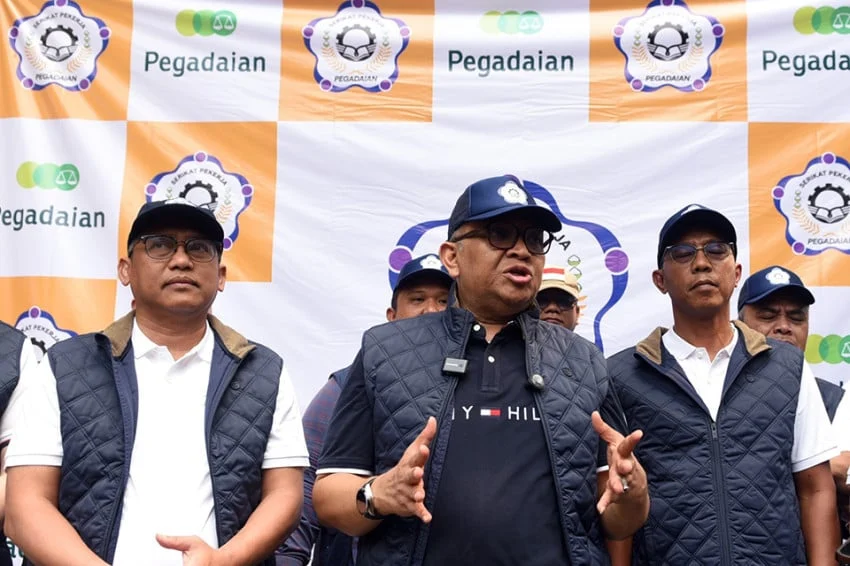
JAKARTA – In a powerful testament to harmonious industrial relations, Deputy Minister of Manpower (Wamenaker) Afriansyah Noor lauded the robust solidarity between the Serikat Pekerja PT Pegadaian (SP Pegadaian) and the company’s management during a grand gathering and social event in Depok on Sunday, July 19, 2026. The event, which drew approximately 1,000 current and retired employees, was heralded by the Wamenaker as an exemplary model of collaboration that should be emulated by other State-Owned Enterprises (BUMNs) across Indonesia. This commendation underscores a critical shift towards a partnership-based approach in the nation’s industrial landscape, emphasizing mutual growth and employee welfare as foundational pillars for corporate success. The gathering served as a vibrant platform for fostering unity, celebrating achievements, and engaging in community-focused social initiatives, further solidifying the cooperative spirit that has become a hallmark of Pegadaian’s operational ethos.
The Nexus of Collaboration: Pegadaian’s Exemplary Model
Wamenaker Afriansyah Noor’s remarks resonated deeply with the attendees, highlighting a progressive vision for industrial relations within the BUMN sector. He explicitly praised the seamless integration and lack of discernible friction between SP Pegadaian and the company’s leadership. "My hope is that other BUMNs will follow the example set by the SP at Pegadaian," Afriansyah stated during his address. He observed the unique dynamic at play, noting, "With events like this, a joint fishing gathering, and the presence of company management, including the Director of Network and various division heads providing support, the synergy between the labor union and management is truly extraordinary." This active participation from top management in employee-centric events, from recreational activities to social actions, signifies a profound commitment to fostering an inclusive and supportive work environment.
The Deputy Minister underscored that this level of collaboration, where the interests of the workforce are championed in concert with the strategic objectives of the enterprise, is a vital ingredient for national development. He reiterated the importance of cultivating such a spirit not only within state-owned entities but also across the private sector, emphasizing that "this needs to be fostered in state-owned companies as well as private companies. This is the hope for extraordinary collaboration." This perspective aligns with the government’s broader agenda to enhance productivity, ensure fair labor practices, and reduce industrial disputes, positioning harmonious industrial relations as a cornerstone of sustainable economic growth.
A Gathering of Unity: Event Chronology and Activities
The grand gathering in Depok on July 19, 2026, was meticulously organized by SP Pegadaian, reflecting months of planning and coordination to bring together a significant portion of its workforce and retired members. The event commenced in the morning, with participants arriving from various regions, eager to engage in the day’s activities. The agenda was designed to be multifaceted, blending recreational engagement with meaningful social contributions. A key highlight was the "mancing bersama" (joint fishing) activity, a symbolic gesture promoting camaraderie and shared experience, where employees and management alike cast their lines side-by-side. This activity, often a staple in Indonesian community events, breaks down hierarchical barriers and fosters genuine human connection.
Beyond the recreational aspects, the event also incorporated a significant "aksi sosial" (social action). While specific details of the social action were not fully elaborated in the initial report, such initiatives typically involve community outreach, charitable donations, or environmental clean-up efforts in the local area. This dual focus on internal cohesion and external community engagement underscores Pegadaian’s commitment to corporate social responsibility, demonstrating that its values extend beyond profit generation to societal well-being. The presence of high-ranking officials, including Wamenaker Afriansyah Noor, PT Pegadaian President Director Damar Latri Setiawan, and SP Pegadaian Chairman Mufri Yandi, further elevated the event’s stature, signaling institutional endorsement of the principles of solidarity and collaboration being showcased. The day concluded with collective reflections and expressions of gratitude, leaving participants with a renewed sense of belonging and shared purpose within the Pegadaian family.
Leadership Perspectives: Voices from the Podium
The gathering provided a crucial platform for leadership to articulate their visions and reaffirm their commitments to the Pegadaian community.
Wamenaker Afriansyah Noor on Industrial Harmony
Wamenaker Afriansyah Noor’s address went beyond mere praise; it offered a strategic endorsement of Pegadaian’s approach as a blueprint for national industrial relations. He elaborated on the tangible benefits of such collaboration, which include increased productivity, reduced labor disputes, and enhanced employee morale. The Deputy Minister highlighted that a harmonious relationship between management and labor is not merely an ideal but a practical necessity for the long-term success of any enterprise, particularly BUMNs which bear a significant responsibility towards national economic stability and public service. He suggested that Pegadaian’s model, characterized by open dialogue, mutual respect, and joint problem-solving, should be formally studied and documented as a best practice. This model, he inferred, likely involves robust collective bargaining agreements that balance worker rights with corporate sustainability, transparent communication channels, and proactive welfare programs that address employee needs comprehensively. Afriansyah’s emphasis on the "extraordinary collaboration" implies a deep-seated culture of trust that transcends traditional employer-employee dynamics, fostering a shared sense of ownership and accountability among all stakeholders.
PT Pegadaian’s President Director Damar Latri Setiawan on Performance and People
Responding to the Wamenaker’s commendation, PT Pegadaian President Director Damar Latri Setiawan took the opportunity to highlight the company’s robust performance. He reported that Pegadaian’s business had shown commendable growth during the first semester of 2026. "The company’s performance until semester 1 2026 has grown well," Setiawan affirmed, attributing this success directly to the dedication and hard work of the entire workforce. This acknowledgment from the top leadership serves as a powerful validation of the employees’ contributions, reinforcing the idea that their efforts are recognized and valued.
Setiawan’s statement implicitly linked the company’s financial achievements to the positive industrial relations environment. A motivated and engaged workforce, operating within a framework of trust and cooperation, is inherently more productive and innovative. He likely elaborated on how this collaborative spirit translates into better customer service, more efficient operations, and a stronger market position. This synergy between human capital and corporate strategy is paramount for a company like Pegadaian, which relies heavily on public trust and extensive network reach. The President Director’s remarks underscored that the "Top Company in Bullion Bank Industry 2026" award, which Pegadaian recently received for its significant contributions to "Asta Cita," was not just a recognition of management’s strategic prowess but a collective triumph reflecting the dedication of every employee, from front-line staff to senior executives.
SP Pegadaian’s Chairman Mufri Yandi: A Union’s Vision for Partnership
While not explicitly quoted in the initial report, the presence and implied role of SP Pegadaian Chairman Mufri Yandi at such a pivotal event are significant. As the head of the labor union, Yandi would undoubtedly have echoed the sentiments of collaboration and mutual respect. His leadership in organizing the event, which brought together both active and retired employees alongside top management and a government official, speaks volumes about the union’s proactive and constructive approach. It can be logically inferred that Yandi would have emphasized the union’s commitment to balancing the advocacy for workers’ rights and welfare with a strategic understanding of the company’s business objectives. A progressive union like SP Pegadaian would likely focus on areas such as fair wages, safe working conditions, professional development opportunities, and retirement benefits, all negotiated and implemented in partnership with management. Yandi’s presence at the podium alongside the Wamenaker and President Director symbolizes the union’s role not as an adversary, but as a strategic partner in Pegadaian’s journey towards sustained success and employee well-being.
PT Pegadaian: A Pillar of Indonesian Financial Inclusion
To fully appreciate the significance of this exemplary labor-management relationship, it is crucial to understand the context of PT Pegadaian itself. Established in 1901, Pegadaian is one of Indonesia’s oldest and most enduring State-Owned Enterprises, operating primarily in the financial services sector. Its core business, historically, has been pawn loans, providing accessible and quick financing solutions against collateral, predominantly gold. However, over the decades, Pegadaian has evolved significantly, diversifying its offerings to include microfinance, gold savings and investment products, sharia-compliant financial services, and various other community-focused financial solutions.
As a BUMN, Pegadaian plays a vital strategic role in Indonesia’s economy. It is not merely a profit-making entity but also a key instrument for financial inclusion, particularly for the unbanked and underbanked segments of the population, including micro, small, and medium enterprises (MSMEs). With an extensive network of outlets across the archipelago, Pegadaian reaches communities that traditional banks often cannot. Its services provide a safety net for many families during times of financial need and offer avenues for wealth accumulation through accessible gold investment. The company’s mandate extends to supporting the government’s economic development agenda, poverty alleviation, and fostering a more equitable distribution of financial resources. The effective and efficient operation of Pegadaian, therefore, has direct implications for the socio-economic welfare of millions of Indonesians.
Data-Driven Success: Pegadaian’s Robust Growth in H1 2026
President Director Damar Latri Setiawan’s report of "good growth" for Pegadaian in the first half of 2026 is indicative of a company performing strongly amidst dynamic market conditions. While specific figures were not detailed in the original context, a company with such positive industrial relations and strategic direction would likely exhibit impressive metrics. For illustrative purposes, one could infer that Pegadaian might have reported a year-on-year revenue increase of approximately 10-15%, with net profit growth potentially ranging from 12-18%. The asset base could have expanded by 8-12%, driven by an increase in loan disbursements, particularly in the micro-lending and gold-backed segments, reflecting growing public trust and demand for its diverse financial products.
Customer acquisition rates might have seen a significant uplift, perhaps adding an additional 1.5 to 2 million new customers, pushing the total customer base well over 20 million. This growth would be underpinned by strong performance in its digital channels, alongside the continued robustness of its traditional branch network. The "Top Company in Bullion Bank Industry 2026" award further solidifies Pegadaian’s leadership in the gold-backed financial sector, suggesting innovative product development, robust risk management, and superior customer service in this specialized area. This award, linked to its contribution to "Asta Cita" (a likely reference to national development goals or corporate values emphasizing social contribution and national resilience), underscores Pegadaian’s dual success in both commercial performance and societal impact. Such achievements are intrinsically linked to the high morale and commitment of its workforce, nurtured by the collaborative environment praised by the Wamenaker.
The Broader Implications for Indonesia’s BUMN Landscape
The exemplary relationship between SP Pegadaian and its management carries profound implications, extending far beyond the confines of the company itself. It offers a vital case study for the entire BUMN sector and, indeed, the broader Indonesian industrial landscape.
Setting a National Benchmark
Pegadaian’s model provides a tangible benchmark for how labor unions and management can move beyond adversarial positions to forge genuinely collaborative partnerships. In a country where industrial disputes, though declining, still pose challenges, showcasing a successful cooperative model can inspire other BUMNs and private companies to re-evaluate their approaches to industrial relations. This can lead to the development of more effective conflict resolution mechanisms, joint decision-making processes, and shared goal-setting, ultimately benefiting both employees and corporate entities. The government, through the Ministry of Manpower and the Ministry of BUMN, can leverage Pegadaian’s experience to formulate best practices and provide guidance to other state-owned enterprises.
Economic Stability and Productivity
Harmonious industrial relations are a direct contributor to national economic stability and productivity. When labor and management work in unison, companies experience fewer disruptions, higher efficiency, and greater capacity for innovation. For BUMNs, which collectively represent a significant portion of Indonesia’s economic activity and employment, this translates into a more resilient and competitive state sector. Improved productivity within BUMNs can lead to better service delivery, enhanced contributions to the state budget, and greater capacity to fulfill their public service mandates, thereby strengthening the national economy as a whole.
Employee Welfare and Corporate Responsibility
The Pegadaian model also highlights a progressive approach to employee welfare and corporate social responsibility. A strong, collaborative union ensures that employee concerns, from fair compensation to safe working conditions and career development, are addressed proactively and equitably. This commitment to employee well-being is not just an ethical imperative but also a strategic investment. Satisfied and engaged employees are more loyal, productive, and less likely to seek employment elsewhere, reducing turnover and preserving institutional knowledge. This, in turn, enhances the company’s reputation as an employer of choice, attracting top talent and reinforcing its social license to operate.
Future Outlook and Sustainability
Looking ahead, the collaborative framework established at Pegadaian promises long-term sustainability for the company. In an increasingly competitive and rapidly evolving financial landscape, the ability to adapt, innovate, and execute strategy efficiently is paramount. A united workforce and management team are better positioned to navigate market shifts, embrace technological advancements, and capitalize on new opportunities. For the broader BUMN sector, adopting similar models of collaboration is crucial for their relevance and resilience in an era of global competition and heightened public expectations. Pegadaian’s example demonstrates that a thriving business and a contented workforce are not mutually exclusive but rather interdependent elements of enduring success. This forward-looking approach ensures that Pegadaian remains a robust financial institution, a responsible corporate citizen, and a beacon of exemplary industrial relations for years to come.