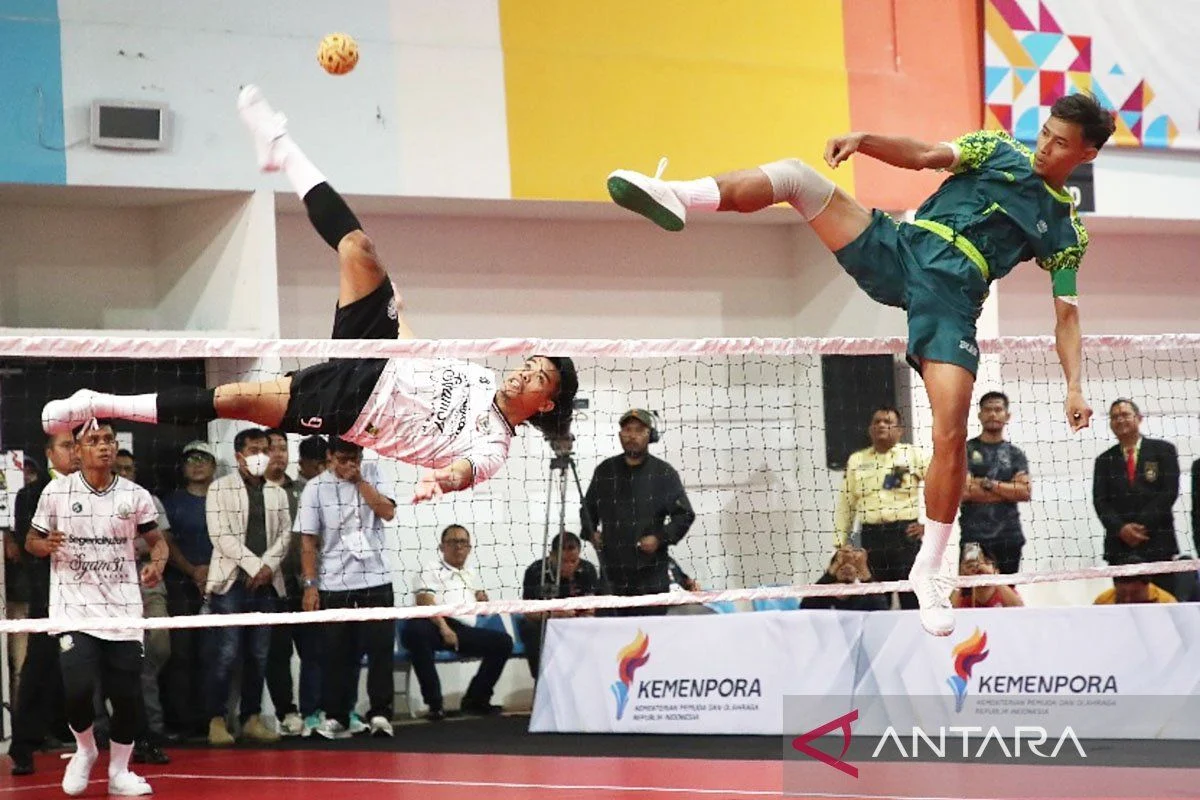
Sepak Takraw, a captivating traditional Southeast Asian sport, continues to enthrall audiences and participants across the region, blending the aerial grace of volleyball with the dynamic footwork and acrobatic kicks reminiscent of football, all while strictly prohibiting the use of hands. This unique fusion of athleticism has cemented its popularity in nations such as Indonesia, Thailand, Malaysia, and the Philippines, offering a spectacle of skill, agility, and strategic prowess.
The very name "Sepak Takraw" is a linguistic testament to its origins and nature. Derived from the Malay word "Sepak," meaning "to kick," and the Thai word "Takraw," referring to a woven rattan ball, the term literally translates to "kick rattan ball." This nomenclature accurately reflects the core mechanics of the sport. The sport’s formal codification and wider recognition as Sepak Takraw gained traction following a match between Malaysia and Thailand in Kuala Lumpur in 1960.
Prior to this, in Malaysia, the game was known as "Sepak Raga Jaring," or net-raga kick. The addition of the term "Jaring" (net) is attributed to Hamid Mydin, widely regarded as a pivotal figure in the sport’s development, who introduced it in Penang in 1945. This distinction was crucial to differentiate it from the older, traditional "Sepak Raga" which was played without a net, often involving players forming a circle and keeping a woven ball aloft using their feet, knees, and heads.
Often dubbed "kick volleyball," Sepak Takraw is a team-based sport typically contested by two to four players per side. The playing court closely resembles that of a badminton court, emphasizing the agility and quick reflexes required. The rules are stringent yet elegant: players are permitted to use only their feet, knees, shoulders, chest, and head to strike the ball over the net. This restriction elevates the sport beyond mere physical exertion, demanding exceptional coordination, balance, and an intricate understanding of body control.
Internationally, the governance of Sepak Takraw falls under the purview of the International Sepaktakraw Federation (ISTAF), established in 1988. ISTAF plays a crucial role in standardizing rules, organizing global championships, and promoting the sport worldwide. The sport is recognized by various local names across different countries, underscoring its deep-rooted presence in the cultural fabric of Southeast Asia. These include Sepak Raga (Indonesia, Brunei, Malaysia, Singapore), Sipa (Philippines), Chinlone (Myanmar), and Takraw (Thailand), among others.
The Deep Roots of Sepak Takraw
The origins of Sepak Takraw are believed to trace back to Malaysia, with historical accounts suggesting its practice as far back as 500 years ago. It gained prominence within royal courts during the 15th century, indicating an early appreciation for its sophisticated skill set and entertaining nature. By the 16th century, the game had spread to Indonesia, where it was known as Sepak Raga. Its popularity then blossomed across Southeast Asia throughout the 1940s, coinciding with the initial efforts to formalize its rules and structure.
The first official competition of this net-based iteration of the sport, then called "Sepak Raga Jaring," was held in Penang in 1945. This marked a significant step towards its modern form. The establishment of the Malaysian Sepak Raga Federation in Penang in 1960 was another milestone, paving the way for its inclusion in the Southeast Asian Peninsula Games in 1965. It was during this period that the sport was officially christened "Sepak Takraw," solidifying its identity.
Interestingly, some historical perspectives suggest that Sepak Takraw may have been introduced to Southeast Asia by Chinese travelers, sharing common ancestral links with football. This theory posits that the sport evolved from "Cuju," an ancient Chinese martial exercise identified by FIFA as one of the earliest forms of modern football. Cuju involved a group of soldiers kicking a leather ball, with the objective of keeping it airborne for as long as possible, emphasizing leg control and coordination. This historical parallel highlights the enduring human fascination with games involving kicking and aerial ball control.
Core Mechanics and Rules of Play
The fundamental gameplay of Sepak Takraw involves two teams competing on a court divided by a net. The sport is characterized by its dynamic rallies, where players utilize their feet, head, chest, and knees to propel the woven rattan ball over the net. The objective is to land the ball within the opponent’s court in a manner that they cannot legally return.
Player Positions and Roles:
In a standard Sepak Takraw team, there are typically three players on the court at any given time, each fulfilling distinct roles:
- Tekong (Serve Specialist): Positioned at the back of the court, the Tekong is responsible for initiating play with a powerful and accurate serve. They are the only player allowed to touch the ball with their hands during the service motion, which involves tossing the ball to themselves before kicking it over the net. Their serve is crucial for setting the tone of the game.
- Feeder (Set-up Player): The Feeder’s primary role is to set up attacking opportunities for the Striker. They are skilled at receiving the ball and delivering precise passes, often using their feet or head, to position the ball for an offensive play.
- Striker (Attacker): The Striker is the primary offensive player, tasked with scoring points. They are known for their acrobatic kicks, often involving leaps and spins, to deliver powerful shots over the net that are difficult for the opponents to defend.
The Flow of a Match:
A Sepak Takraw match begins with a coin toss to determine which team serves first. The serving team’s Tekong then executes the serve, aiming to place the ball strategically into the opponent’s court.
Once the serve is in play, the game unfolds as a rapid exchange of aerial volleys. Teams have a maximum of three touches to return the ball over the net, similar to volleyball, but with the crucial restriction of not using hands. This necessitates intricate teamwork and precise ball control among the players. The Feeder and Striker often work in tandem, with the Feeder setting up the Striker for a powerful overhead kick, often referred to as a "spike" in volleyball terminology.
Scoring System:
Points are awarded when a team successfully grounds the ball in the opponent’s court or when the opposing team commits a fault. Faults can include hitting the ball out of bounds, touching the net with any part of the body while playing the ball, or using hands to propel the ball.
A standard set in Sepak Takraw is played to 21 points, with a two-point lead required to win. Matches are typically played as best-of-three sets, meaning the first team to win two sets claims victory. This format ensures that matches are often competitive and exciting, with teams needing to maintain a high level of performance throughout.
Global Reach and Evolution
While firmly rooted in Southeast Asia, Sepak Takraw has steadily gained international recognition. ISTAF actively promotes the sport through various tournaments, including the Sepak Takraw World Cup, Asian Games, and regional championships. The sport’s visually spectacular nature and the incredible athleticism it demands have drawn increasing attention from sports enthusiasts worldwide.
The sport’s evolution continues, with ongoing discussions and adjustments to rules aimed at enhancing its playability and spectator appeal. The International Olympic Committee (IOC) has also shown interest in Sepak Takraw, with discussions periodically held regarding its potential inclusion in future Olympic Games. Such a development would undoubtedly propel the sport to unprecedented global prominence, further solidifying its place as a major international athletic spectacle.
The recent resolution of dual leadership issues within Indonesian Sepak Takraw, as reported by ANTARA News, signifies a positive step towards greater national and international coherence for the sport. The International Sepaktakraw Federation (ISTAF) has reportedly welcomed this development, underscoring the importance of unified governance for the sport’s growth. Such internal stability is crucial for fostering talent, organizing effective training programs, and ensuring seamless participation in international competitions. The successful resolution of these leadership challenges in Indonesia is a testament to the collaborative efforts of sports bodies like KONI (Indonesian National Sports Committee) and KOI (Indonesian Olympic Committee), indicating a shared commitment to the advancement of Sepak Takraw.
The journey of Sepak Takraw, from its ancient origins to its current status as a dynamic international sport, is a compelling narrative of cultural heritage, athletic innovation, and growing global appeal. Its unique blend of skills, its visually stunning aerial maneuvers, and its deeply ingrained regional identity make it a sport that continues to captivate and inspire. As it gains further traction on the world stage, Sepak Takraw stands poised to achieve even greater recognition and admiration for its extraordinary display of human agility and sporting excellence.