In the contemporary professional landscape, the traditional office environment has undergone a significant transformation, giving way to a hybrid and hyper-mobile work culture. As professionals, digital nomads, and students increasingly transition between coffee shops, coworking spaces, transit hubs, and international travel, the hardware requirements for their primary computing devices have shifted accordingly. A laptop is no longer merely a stationary workstation; it is a critical tool that must withstand the physical rigors of daily travel while maintaining high-performance standards. This evolution in usage has forced manufacturers to rethink material science, structural engineering, and portability, leading to a new category of devices that prioritize both resilience and aesthetics.
The Evolution of Hardware Portability and Durability
For decades, the industry faced a persistent trade-off: high-performance laptops were typically bulky, heavy, and fragile, while thin-and-light devices often sacrificed structural integrity to shave off grams. This dichotomy posed a persistent problem for mobile users who required power for data-heavy tasks like video editing, software development, or complex analysis, but could not afford the physical burden of a heavy machine.
Industry data suggests that the "mobile-first" consumer now accounts for nearly 40% of the premium laptop market. With this demographic, the failure rate of hardware due to accidental damage—such as drops, pressure in crowded bags, and exposure to fluctuating temperatures—is notably higher than that of enterprise desktop users. Consequently, the industry has pivoted toward adopting military-grade testing protocols, most notably the MIL-STD 810H standard, as a baseline expectation for high-end consumer hardware.
Defining Modern Durability: Beyond the Marketing Buzzwords
It is imperative for consumers to distinguish between "ruggedized" hardware—often used in industrial or military settings—and the "durable premium" laptops currently entering the consumer market. A durable laptop in today’s context is defined by three pillars: structural material innovation, thermal management, and precision engineering.
The term "tahan banting" or "shock-resistant" is frequently misinterpreted by consumers. In a technical sense, no commercially available laptop is entirely immune to catastrophic impact. Instead, modern engineering focuses on energy dissipation. By utilizing advanced alloys or composite materials, engineers can create a chassis that flexes slightly under pressure rather than cracking or permanently deforming. This, combined with internal shock-mounting for sensitive components like the Solid State Drive (SSD) and the motherboard, allows the device to survive the minor accidents inherent in a mobile lifestyle.
The Material Revolution: The Case of Ceraluminum
One of the most significant recent developments in this sector is the introduction of proprietary materials, such as ASUS’s Ceraluminum. Traditional laptop construction has long relied on aluminum or magnesium alloys. While aluminum is visually appealing and offers decent heat dissipation, it is prone to scratches and can dent under relatively low-impact pressure.
Ceraluminum represents a convergence of ceramic and aluminum technology. By subjecting an aluminum alloy to a high-voltage electrochemical process, manufacturers can create a surface layer that is significantly harder than standard aluminum. Technical analysis indicates that this material is approximately 30% lighter and three times more resistant to surface wear and impact than traditional metals. For the mobile professional, this means a device that retains its aesthetic integrity after months of being pulled in and out of backpacks, while providing a structural rigidity that protects the delicate display and internal circuitry.
Case Study: ASUS Zenbook S14 OLED (UX5406AA)
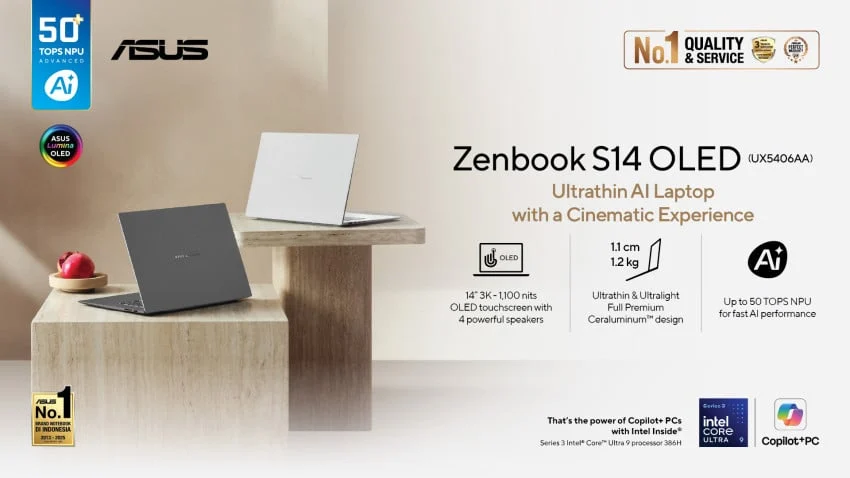
The ASUS Zenbook S14 OLED (UX5406AA) serves as a quintessential example of how current manufacturing trends are addressing the needs of the mobile workforce. With a weight of approximately 1.2 kg and a thickness profile starting at just 1.19 cm, the device is engineered to minimize the "weight tax" on the user.
However, the internal specifications are where the device bridges the gap between portability and performance. The inclusion of the Intel Core Ultra 9 Processor 386H signals a move toward power-efficient yet high-performance computing, crucial for users who cannot always rely on an external power source. The integration of a 3K 120Hz OLED display also addresses the visual fatigue associated with long-duration work sessions in varied lighting conditions, providing high color accuracy and brightness that is rarely found in ultra-portable chassis designs.
The Impact of Military-Standard Testing
The industry-wide adoption of the US MIL-STD 810H standard has provided a uniform benchmark that allows consumers to compare device durability objectively. This testing regimen involves subjecting the laptop to a series of rigorous procedures:
- Vibration Testing: Simulating the constant movement experienced during train, bus, or air travel.
- Temperature Extremes: Ensuring components do not fail in environments ranging from freezing temperatures to extreme heat.
- Altitude Simulation: Testing how the laptop operates in pressurized cabins, which is vital for frequent flyers.
- Drop and Shock Testing: Assessing how the chassis handles sudden impacts.
These tests do not guarantee that a laptop will survive a fall from a second-story window, but they do ensure that the device can handle the daily "wear and tear" of a professional lifestyle. For businesses, this translates to lower total cost of ownership (TCO) and fewer service requests, while for individuals, it ensures the longevity of a significant financial investment.
Strategic Implications for the Mobile Workforce
The broader implication of these technological advancements is that the barrier to entry for a high-performance, mobile work life has lowered. As devices become lighter and more resilient, the necessity for a dedicated "home office" diminishes. This shift empowers a more fluid, globalized workforce that can maintain productivity regardless of physical location.
Furthermore, the integration of AI-ready processors, like those found in the Intel Core Ultra series, alongside durable hardware, suggests that laptops are becoming central hubs for complex computational tasks that were previously restricted to desktop workstations. We are entering an era where the hardware is finally catching up to the nomadic ambition of the workforce.
Future Outlook and Industry Trajectory
Looking toward 2026 and beyond, the trend in laptop manufacturing will likely move toward sustainable, self-healing, or even more advanced composite materials. Manufacturers are currently investigating ways to further reduce the weight of components without sacrificing heat dissipation, as thinner devices often struggle with thermal throttling under heavy loads.
The demand for premium, durable devices is not merely a trend; it is a structural change in the market. As consumers prioritize longevity over planned obsolescence, the emphasis on build quality—evidenced by the use of materials like Ceraluminum and the adherence to rigorous military-grade standards—will become the primary differentiator for top-tier technology brands.
For the modern professional, the choice of a laptop is no longer just about clock speed and RAM; it is about finding a reliable partner that can endure the unpredictability of a fast-paced career. By understanding the engineering behind these devices, from the hinge mechanics to the molecular composition of the chassis, users can make more informed decisions, ensuring their technology supports their mobility rather than restricting it.
Conclusion
The convergence of portability and resilience represents a significant achievement in modern consumer electronics. Whether through the implementation of innovative materials or the rigorous application of global durability standards, companies like ASUS are responding to the clear demand for hardware that is as robust as it is sleek. For those who find their office in the world around them, the current generation of premium laptops offers a level of security and performance that allows for greater flexibility, creativity, and professional freedom than ever before. As the industry continues to evolve, the standard for what constitutes a "mobile laptop" will undoubtedly continue to rise, keeping pace with the demands of an increasingly interconnected and mobile global economy.