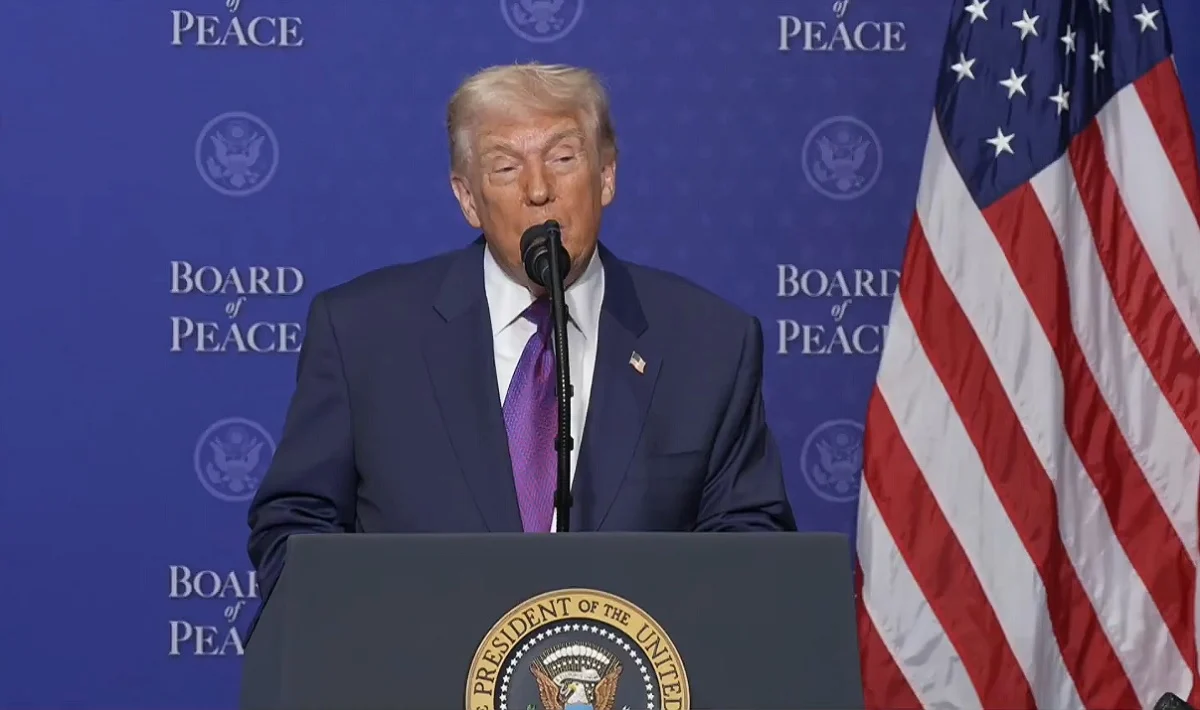
President Donald Trump has officially announced the formation of a specialized "AI Force" and the forthcoming appointment of a federal "AI Czar" to oversee the rapid expansion of machine intelligence within the United States. This strategic move, unveiled on Saturday, September 19, 2026, signals a definitive pivot toward a more aggressive, state-backed integration of artificial intelligence into the national security and economic infrastructure of the country. Drawing parallels to the establishment of the U.S. Space Force during his initial term in office, the President aims to centralize oversight of a sector that has become the new frontier of global geopolitical competition.
The announcement, delivered via the President’s Truth Social platform, characterized the initiative as a necessary evolution in maintaining American technological hegemony. Beyond the creation of a new military-style command structure, the administration has launched an unconventional public inquiry: a digital poll asking citizens whether the current term "artificial intelligence" remains accurate or if it should be rebranded to better reflect the technology’s expanding scope.
The Strategic Rationale: Parallels to Space Force
The creation of the AI Force is modeled after the U.S. Space Force, which was signed into law in December 2019. At the time, the Space Force was the first new branch of the U.S. Armed Forces created since the Air Force in 1947. President Trump’s decision to mirror this structure suggests he views artificial intelligence not merely as a commercial tool, but as a critical domain of warfare and national defense.
By categorizing AI as a distinct "force," the administration is signaling a shift toward centralized federal coordination. Historically, AI research and deployment in the U.S. have been fragmented across various departments, including the Department of Defense (DoD), the National Institute of Standards and Technology (NIST), and private sector titans. The new "AI Force" is expected to streamline these efforts, ensuring that advancements in large language models, autonomous systems, and neural networks are prioritized for national security applications.
The Hunt for an AI Czar
A central pillar of the President’s announcement is the search for an "AI Czar." The requirement for the position—as described by the President—is explicitly meritocratic: "only individuals with high IQs need apply." This phrasing suggests that the administration intends to bypass traditional bureaucratic vetting in favor of recruiting top-tier talent from the private sector, academia, or the defense-tech industry.
The "Czar" will likely serve as a Cabinet-level advisor or a direct liaison to the White House, tasked with navigating the complexities of AI safety, ethical implementation, and, most importantly, competitive speed. Industry experts anticipate that the appointee will hold significant sway over federal AI budget allocations, research priorities, and the regulatory environment that governs the Silicon Valley tech giants.
Chronology of the 2026 AI Surge
The path to this announcement has been marked by a rapid escalation in technological capability and public concern. The following timeline tracks the critical developments leading to the President’s decision:
- January 2026: Leading research labs release next-generation multimodal systems, demonstrating capabilities in autonomous complex reasoning that surpass previous benchmarks.
- March 2026: A series of high-profile cybersecurity incidents involving AI-generated phishing and automated intrusion tools triggers intense debate within the intelligence community regarding the "AI arms race."
- May 2026: Congress holds a closed-door summit with industry CEOs, resulting in a fractured consensus on whether to enforce a pause on training large models.
- August 2026: International competitors announce major state-funded initiatives to dominate the AI compute market, prompting fears in Washington of a "compute deficit."
- September 19, 2026: President Trump formalizes the "AI Force" initiative, explicitly rejecting calls for restrictive regulation.
Stance on Regulation vs. Innovation
One of the most consequential aspects of the President’s announcement is his firm rejection of the "slowing down" narrative. For the past two years, a vocal contingent of researchers and policy advocates has argued that without strict oversight and "red lines" on AI training, society risks catastrophic safety failures.
President Trump has dismissed these warnings as "hoaxes." In his statement, he explicitly prioritized speed and national competitiveness over the cautious, safety-first approach advocated by some corners of the tech industry. His stance is that regulation acts as a drag on economic output and military preparedness. "We will not in any way hamper or restrict the growth of this incredible industry," he wrote. "Instead, we will support, assist, and supervise its development."
This approach represents a "pro-innovation" deregulatory strategy. By framing the AI Force as a body that will "assist" rather than "restrict," the administration is clearly aligning itself with the accelerationist movement, which argues that the best way to manage AI risks is to achieve technological dominance before geopolitical rivals do.
Implications for the Global Tech Landscape
The move to create an AI Force is likely to trigger significant reactions from both domestic and international stakeholders.
Domestic Industry Impact
The U.S. tech sector, particularly companies heavily invested in generative AI, may view this move as a double-edged sword. On one hand, government support and potential procurement contracts from the AI Force could provide a massive financial boost. On the other, the involvement of a federal "Czar" introduces a new layer of political oversight that could complicate corporate autonomy. Companies will be watching closely to see how the "supervision" mentioned by the President translates into day-to-day operations.
Geopolitical Competition
Global reactions will likely be swift. In the context of the U.S.-China technology rivalry, the AI Force is a clear signal that the United States intends to formalize its commitment to leading in AI development. International bodies that have been calling for global AI treaties or unified regulatory frameworks may find the U.S. less inclined to agree to restrictions that could hamper its own military and economic capabilities.
Public Perception and the Naming Debate
The President’s decision to poll the public on the name "artificial intelligence" serves a twofold purpose. First, it engages his base directly, fulfilling a populist appeal to simplify complex, jargon-heavy governmental policy. Second, it touches on a legitimate linguistic debate within the field. Many researchers argue that "artificial intelligence" is an imprecise term that fails to capture the statistical nature of machine learning or the nuances of Large Language Models (LLMs). Whether a government-sponsored rebranding effort will gain traction in the scientific community, however, remains to be seen.
Analysis: The Future of AI Governance
The formation of the AI Force marks a transition in the U.S. approach to emerging technology. By shifting from a decentralized, largely industry-led development model to a centralized, government-monitored one, the administration is treating AI as a "national asset."
The success of this initiative will hinge on several factors:
- Talent Acquisition: Can the administration attract the world’s best AI researchers to work under a government mandate?
- Resource Management: How will the AI Force manage the massive energy and hardware requirements needed to maintain a competitive advantage?
- Security vs. Openness: Balancing the need for classified military AI advancements with the necessity of an open-source ecosystem that fosters widespread economic innovation will be the primary challenge for the new AI Czar.
As the United States moves forward with this initiative, the global community will be watching to see how a "pro-acceleration" policy influences the safety profile of the technology. The rejection of the "hoax" of AI risk suggests that the administration is betting on the idea that the greatest risk to the United States is not the technology itself, but rather the failure to be the first to master it.
In the coming weeks, the appointment of the AI Czar will be the most anticipated personnel announcement in Washington. This individual will effectively become the architect of the next decade of American technological strategy. As the administration moves to formalize this branch of governance, it is clear that the era of "laissez-faire" AI development in the United States has officially come to an end, replaced by a new, state-driven mandate for supremacy.