The journey of George Tawlon Manneh Oppong Ousman Weah remains one of the most remarkable and improbable narratives in modern political and sporting history. From humble beginnings playing football on sandy lots in the Liberian capital of Monrovia, Weah ascended to the absolute pinnacle of global athletics, capturing the prestigious FIFA World Player of the Year and Ballon d’Or honors in the 1990s. Yet, rather than fading into the comfortable retirement typical of legendary athletes, Weah redirected his fierce competitive drive, unmatched global recognition, and deep-seated patriotism toward the service of his homeland. In December 2017, this trajectory culminated in a historic democratic milestone when Weah was officially elected as the 25th President of Liberia. This monumental transition from the turf of Europe’s elite football stadiums to the Executive Mansion in Monrovia not only redefined the boundaries of post-athletic careers but also marked a profound moment of democratic transition for a West African nation recovering from decades of civil conflict.
Early Life and the Genesis of a Sporting Prodigy
Born on October 1, 1966, in the Clara Town suburb of Monrovia, George Weah experienced a childhood shaped by the socio-economic challenges common to many urban centers in West Africa. Raised largely by his paternal grandmother, Emma Klonh Brown, Weah discovered his passion for association football at an early age. In the absence of professional training facilities or regulation pitches, he honed his natural athletic abilities on makeshift fields, playing barefoot on hard-packed sandy lots alongside neighborhood peers.
Despite the lack of formal infrastructure, Weah’s extraordinary raw talent was immediately apparent to local scouts and observers. His early career path wound through several Liberian clubs, including Invincible Eleven, Mighty Barolle, Bongrange Bonguine, and Young Survivors of Claretown. During his teenage years, his leadership and exceptional scoring prowess propelled Young Survivors—a side competing entirely without the benefit of a professional coach—to a remarkable promotion into the nation’s top-tier football division. This feat captured the attention of regional talent scouts, setting the stage for his departure from domestic football and his first major international breakthrough in Central Africa.
Continental Breakthrough and the Move to European Football
In 1987, Weah signed a three-year contract with Tonnerre Yaoundé, a prominent club in Cameroon. The transition to the Cameroonian top flight proved seamless for the young striker. In his debut season, Weah played a pivotal role in guiding Tonnerre to the Cameroonian league championship. His combination of imposing physical stature, explosive acceleration, and clinical finishing did not go unnoticed by scouts representing European clubs.
Later that same year, at the age of 22, Weah made the monumental leap to European football when he was signed by AS Monaco, then competing in the French Division 1. Under the tutelage of renowned manager Arsène Wenger—who would famously recall spotting Weah’s raw potential on a grainy VHS tape—the young Liberian developed into a devastating modern forward. Over five seasons with Monaco, spanning from 1987 to 1992, Weah netted 57 goals across all competitions. His tenure in the principality was highlighted by capturing the French Cup (Coupe de France) in 1991, cementing his status as one of the most promising young talents in European football.
Conquering European Leagues: PSG and AC Milan
Weah’s reputation for relentless work ethic, technical brilliance, and unyielding competitive spirit earned him a high-profile transfer to Paris Saint-Germain (PSG) in 1992. In the French capital, Weah’s career reached new heights. Blessed with exceptional pace that allowed him to launch devastating counter-attacks from deep positions, alongside a remarkably accurate and powerful shot, he became a central figure in PSG’s domestic and continental ambitions.
During his spell with PSG, Weah led the club to the French league title, multiple domestic cup victories, and an unforgettable run to the semi-finals of the UEFA Champions League in the 1994–1995 season. Across 123 official appearances for the Parisian powerhouse, he contributed 37 goals and 3 assists, firmly establishing himself among the elite strikers of his generation. His crowning moment in European club football, however, arrived following his transfer to Italian giants AC Milan in the summer of 1995.
In the rigorous landscape of Serie A, Weah enjoyed the absolute peak of his professional playing career. Purchased for a substantial transfer fee, he immediately integrated into the Rossoneri squad, helping AC Milan capture the Serie A league titles in the 1995–1996 and 1998–1999 seasons. It was during this tenure that Weah produced one of the most iconic individual moments in football history: a magnificent, length-of-the-field solo goal against Hellas Verona in September 1996, where he collected the ball deep inside his own penalty area and dribbled past seven opposing players before slotting it into the net.
Historical Accolades: The Golden Year of 1995
The year 1995 stands as a watershed moment not only for George Weah personally, but also for African football history. In December of that year, Weah was awarded the prestigious FIFA World Player of the Year accolade, becoming the first—and to date, only—African player to receive the award. Furthermore, he was awarded the Ballon d’Or in 1996, having finished as the top scorer in the UEFA Champions League during the 1994–1995 campaign.
These honors carried profound sociological and cultural significance. For decades, European and South American players had dominated global football awards. Weah’s triumph broke traditional barriers, projecting a positive, globally recognized symbol of African excellence onto the world stage. His accomplishments in Italy yielded 51 goals and 1 assist in 114 appearances for AC Milan, after which he enjoyed brief, twilight spells in the English Premier League with Chelsea and Manchester City, as well as a brief stint in the United Arab Emirates with Al-Jazira before retiring from professional play.
Retirement, Humanitarian Advocacy, and Entry into Politics
Upon hanging up his boots, Weah faced a critical juncture in his life. Many legendary athletes choose roles within sports administration, coaching, or commercial media. Weah, however, chose a path shaped by the harrowing realities faced by his home country. Throughout his playing career, Liberia had been ravaged by consecutive civil wars (1989–2003) that resulted in hundreds of thousands of deaths, widespread displacement, and the near-total destruction of national infrastructure.
Deeply moved by the plight of his compatriots—particularly child soldiers, orphans, and impoverished youth—Weah utilized his immense personal fortune and global platform to engage in humanitarian work. He served as a UNICEF Goodwill Ambassador, funding educational programs, healthcare initiatives, and grassroots sports projects aimed at rehabilitating war-torn youth.
As his involvement in social causes deepened, Weah recognized that philanthropy alone could not resolve the systemic structural failures plaguing Liberia. This realization catalyzed his transition into active politics. In 2005, just two years after the formal conclusion of the Second Liberian Civil War, Weah announced his candidacy for the presidency of Liberia under the banner of the Congress for Democratic Change (CDC).
The 2005 Election and the Pursuit of Higher Education
Weah’s initial foray into presidential politics in 2005 was met with both overwhelming enthusiasm and intense political skepticism. His immense popularity among the youth and the urban poor made him a formidable candidate, but political opponents and critics swiftly pointed to his lack of formal academic credentials and political experience as disqualifying liabilities. In the runoff election, Weah was defeated by Ellen Johnson Sirleaf, a Harvard-educated economist who would go on to become Africa’s first elected female head of state.
Rather than withdrawing from public life following the defeat, Weah demonstrated a long-term commitment to self-improvement and statecraft. Acknowledging criticisms regarding his educational background, he enrolled in high school classes in Liberia before moving to the United States, where he attended DeVry University in Miami, ultimately earning a bachelor’s degree in business administration in 2011, followed by a master’s degree in public administration from Keller Graduate School of Management in 2013.
Having fortified his academic credentials and gained legislative experience by winning election as a Senator for Montserrado County in 2014, Weah positioned himself as a seasoned, viable alternative for the nation’s highest office ahead of the 2017 general elections.
The 2017 Presidential Election: Victory and Democratic Transition
By December 2017, the political landscape of Liberia was ripe for change. The incumbent administration, led by President Ellen Johnson Sirleaf, had stabilized the nation and maintained post-war peace, but citizens continued to grapple with pervasive corruption, high unemployment rates, and inadequate public infrastructure.
Running on a populist platform centered on economic revitalization, infrastructure development, anti-corruption measures, and free education, Weah galvanized a massive coalition of young voters and marginalized citizens. In the runoff election held in late December 2017, Weah decisively defeated the incumbent Vice President, Joseph Boakai, securing a historic electoral mandate.
International observers, including delegations from the Economic Community of West African States (ECOWAS), the African Union, and the European Union, praised the peaceful nature of the vote and the subsequent transfer of power. For Liberia, the 2017 election represented a monumental constitutional milestone: the first peaceful, democratic transfer of power from one elected leader to another in the country in over 70 years.
Global Reactions and Official Responses
The international community responded to Weah’s electoral victory with a mixture of celebration, diplomatic caution, and cautious optimism. Heads of state, international sporting organizations, and global humanitarian agencies flooded the newly elected president with congratulatory messages.
FIFA President Gianni Infantino expressed immense pride in the achievement of the former World Player of the Year, noting that Weah’s journey from the football pitch to the presidency demonstrated the transformative power of dedication, resilience, and leadership. Similarly, leaders across Africa hailed the election as a testament to the maturation of democratic institutions within the region.
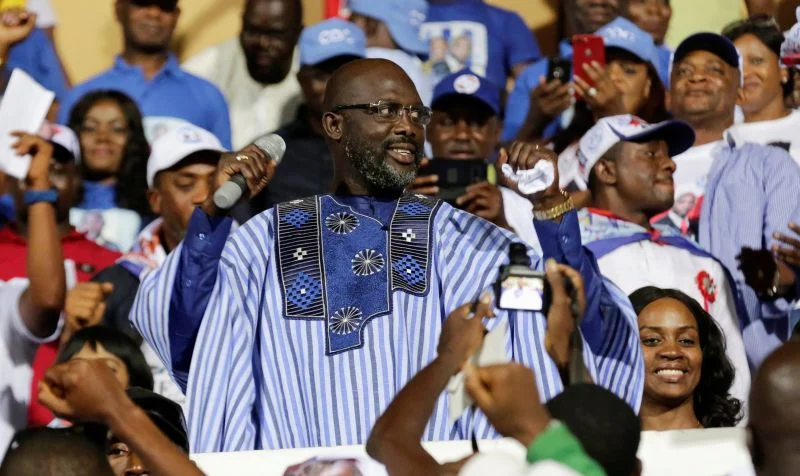
Domestically, reactions among the Liberian populace were rapturous. Jubilant crowds flooded the streets of Monrovia, waving party flags, singing, and celebrating what they perceived as the dawn of a new era led by a man who genuinely understood the struggles of the common citizen. Economists and political analysts, however, offered a more tempered perspective, emphasizing the immense structural challenges awaiting the incoming administration.
Implications and Challenges of the Weah Presidency
The ascension of George Weah to the presidency carried profound domestic and international implications. Economically, Liberia faced severe fiscal deficits, heavy reliance on foreign aid, high inflation, and an economy heavily dependent on commodity exports such as iron ore and rubber.
Furthermore, the expectations of the Liberian electorate—particularly the vast demographic of unemployed youth who viewed Weah as a personal savior—were exceedingly high. Fulfilling campaign promises related to job creation, infrastructure overhaul, and educational reform required navigating a complex web of bureaucratic inertia, institutional corruption, and limited national revenue streams.
Political analysts noted that Weah’s presidency would serve as a crucial stress test for the viability of celebrity politics in developing democracies. While his star power provided an unmatched ability to unify a fragmented populace and attract international attention and investment, governing a post-conflict nation required technical governance skills, rigorous policy implementation, and coalition-building.
A Legacy Beyond Sports
The narrative of George Weah transcends the traditional boundaries of sports history. From a barefoot child running across the sandy fields of Monrovia to a global football icon hoisting the Ballon d’Or in European stadiums, and finally to taking the oath of office as the President of Liberia, Weah’s life trajectory remains entirely unique.
As his administration set to work following the historic December 2017 election, the former striker faced the ultimate match of his life—one played not on a grass pitch for ninety minutes, but across an entire nation striving for peace, prosperity, and sustainable development. Whether judged by his dazzling athletic achievements on the European stage or his courageous foray into the complex arena of statecraft, George Weah firmly cemented his place in history as a defining figure of the late 20th and early 21st centuries.