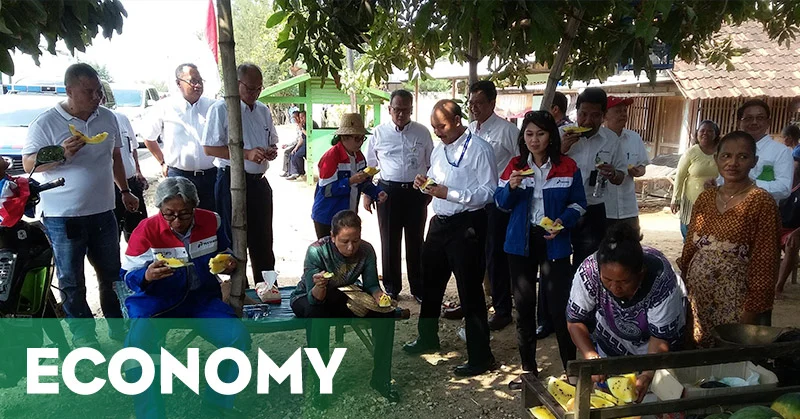
The transformation of industrial landscapes in Indonesia often carries profound implications for local communities, blending high-level state governance with grassroots economic interaction. This dynamic was visibly illustrated on a Wednesday morning in November 2015, when senior government officials and top corporate executives made an impromptu stop at a local fruit stall in Tuban, East Java. Prior to conducting an official presidential inspection of the strategically vital PT Trans Pacific Petrochemical Indotama (TPPI) refinery, then-State-Owned Enterprises (SOE) Minister Rini Soemarno, alongside then-Pertamina President Director Dwi Soetjipto and their respective entourages, paused to sample fresh local watermelons grown by residents living in the immediate vicinity of the industrial plant.
While the primary objective of the high-profile delegation was to review the operational readiness and economic revitalization of the long-dormant TPPI refinery alongside President Joko Widodo, the brief interlude offered a humanizing glimpse into the interplay between mega-infrastructure projects and local agrarian life. The event underscored the dual realities of the region: a multi-million-dollar energy asset poised to secure the nation’s fuel supply, and the everyday agricultural livelihoods of Tuban residents operating in its shadow.
Chronology of the Presidential Visit and Local Interlude
The sequence of events on November 11, 2015, began early in the morning as President Joko Widodo—commonly known as Jokowi—touched down in East Java to oversee the reactivation of the TPPI facility, a vital petrochemical plant that had faced years of financial distress, operational halts, and legal complexities. Accompanying the President was a formidable delegation of state officials and energy sector leaders. Alongside SOE Minister Rini Soemarno and Pertamina CEO Dwi Soetjipto, the official party included Pertamina Vice President of Corporate Communication Wianda Pusponegoro and Director General of Oil and Gas at the Ministry of Energy and Mineral Resources, IGN Wiratmaja Puja.
Before formally entering the secured perimeter of the TPPI complex, the high-level entourage took time to interact directly with the local populace. The arrival of the presidential motorcade drew considerable attention from residents of Tuban, many of whom gathered along the access roads. Breaking away from strict protocol for a brief moment, the officials walked along the perimeter, greeting citizens and obliging requests for photographs.
During this walkabout, the delegation encountered a small roadside establishment run by a local resident who was selling freshly harvested watermelons. Drawn in by the local produce, the officials, led by Minister Rini Soemarno, decided to take a short break. Gathering around the modest stall, the state officials and corporate executives partook in tasting the locally grown fruit, which had been cultivated in the agricultural fields flanking the industrial zone.
"Ayo-ayo coba dulu semangkanya. Enak ini semangkanya," remarked Minister Rini Soemarno to her colleagues and the gathered crowd, encouraging everyone to sample the refreshing fruit produced by Tuban’s farmers. After enjoying several slices of the locally sourced watermelon and engaging in brief pleasantries with the vendor and nearby residents, the delegation resumed its official itinerary, heading directly into the TPPI refinery complex to commence the presidential inspection.
Strategic Importance and Background of the TPPI Refinery
To fully understand the significance of the presidential visit to Tuban, it is essential to examine the historical and economic context of the PT Trans Pacific Petrochemical Indotama (TPPI) facility. Established to bolster Indonesia’s domestic petrochemical and refining capacities, the plant had long been considered a critical asset for national energy security. However, its path prior to late 2015 was fraught with severe operational instability, financial restructuring hurdles, and prolonged shutdowns.
Constructed to produce a variety of petrochemical products and refined fuels—including aromatics, premium gasoline, and diesel—the TPPI refinery holds a strategic geographic position in Tuban, East Java. Its production capacity was designed to significantly reduce Indonesia’s heavy reliance on imported refined petroleum products, a persistent challenge that strained the country’s current account deficit. Despite its immense potential, the facility struggled with debt burdens and governance issues throughout the late 2000s and early 2010s, leading to extended periods where production was entirely suspended.
Recognizing the urgent need to secure domestic energy supplies and curb fuel import dependency, the administration under President Joko Widodo prioritized the revival of idle state assets upon taking office in 2014. The intervention strategy involved bringing the facility under the operational umbrella of state-owned energy giant Pertamina. By leveraging Pertamina’s financial strength and supply chain infrastructure, the government aimed to integrate the Tuban refinery into the national fuel distribution network.
The visit in November 2015 served as a critical milestone in this turnaround effort. It marked a transition from legal and financial restructuring to active operational monitoring, signaling to the market and the public that the state was fully committed to bringing the troubled asset back to full capacity.
Economic Implications for the Tuban Region

The coexistence of a massive petrochemical refinery and local agricultural activities, as highlighted by the impromptu watermelon tasting, points to the complex socioeconomic dynamics at play in Tuban. Industrial megaprojects inherently transform regional economies, introducing both opportunities and disruptions for local communities.
On one hand, the reactivation of the TPPI refinery promised significant macroeconomic benefits. By increasing domestic production of fuel and petrochemical raw materials, the plant contributed to lowering national logistics costs and stabilizing local fuel prices. For the immediate region, the facility was expected to generate employment opportunities, stimulate secondary industries, and foster regional economic growth through increased demand for goods and services.
On the other hand, traditional livelihoods—such as agriculture and fishing, which historically dominated parts of Tuban—frequently face environmental and spatial pressures resulting from heavy industrialization. The presence of farming plots right up to the edges of the refinery zone, as observed during the ministers’ stop, illustrates the tight spatial integration between traditional agrarian practices and modern heavy industry.
Economic analysts note that successful state-led infrastructure projects must carefully balance national strategic imperatives with local community welfare. Spontaneous interactions, such as officials purchasing produce from local vendors, while largely symbolic, underscore the importance of maintaining a visible connection between high-level policy execution and the grassroots populations whose daily lives are directly impacted by industrial development.
Official Responses and Stakeholder Perspectives
The inspection of the TPPI refinery drew extensive coverage from national media, reflecting the high stakes involved in the restructuring of the petrochemical sector. Representatives from the Ministry of State-Owned Enterprises and Pertamina emphasized that bringing the facility back online was a monumental step forward for Indonesia’s energy independence.
Pertamina management, spearheaded by Dwi Soetjipto, maintained that integrating TPPI into the state-owned enterprise framework would optimize national refining capacity. Company officials repeatedly highlighted that the facility’s output would directly alleviate the burden on existing refineries, such as those in Cilacap and Balongan, by sharing the burden of meeting domestic fuel demands.
Furthermore, communication teams led by figures like Wianda Pusponegoro frequently underscored the collaborative effort required across various government ministries—including the Ministry of Energy and Mineral Resources and the Ministry of Finance—to untangle the complex web of debts and contractual obligations that had historically paralyzed the plant. The integration of technical oversight from the Directorate General of Oil and Gas ensured that safety, environmental standards, and regulatory compliance were rigorously maintained as production lines were brought back to life.
Broader Impact on National Energy Security
The events of November 11, 2015, in Tuban extend far beyond a mere anecdote of ministers enjoying local fruit. They encapsulate a pivotal era in Indonesian economic policy, characterized by a pragmatic push to reclaim control over vital strategic assets.
The successful revival of the TPPI refinery served as a case study for the Jokowi administration’s broader strategy regarding troubled state-owned enterprises. Rather than abandoning or liquidating distressed strategic assets, the government opted for aggressive state intervention, leveraging corporate consolidation to restore operational viability.
In the years following the 2015 inspection, the facility has played an increasingly vital role in supplying feedstock for domestic industries and contributing to national fuel resilience. While challenges related to global oil price volatility, supply chain disruptions, and environmental compliance continue to require vigilant management, the foundational steps taken in late 2015 laid the groundwork for long-term stability.
Ultimately, the image of state leaders pausing among local farmers and fruit vendors before entering a high-security industrial plant serves as a poignant reminder of the multifaceted nature of national development. It reflects a moment where the grand ambitions of state energy security intersected quietly with the simple harvest of Tuban’s soil, capturing a snapshot of governance rooted—however briefly—in the everyday realities of the Indonesian people.