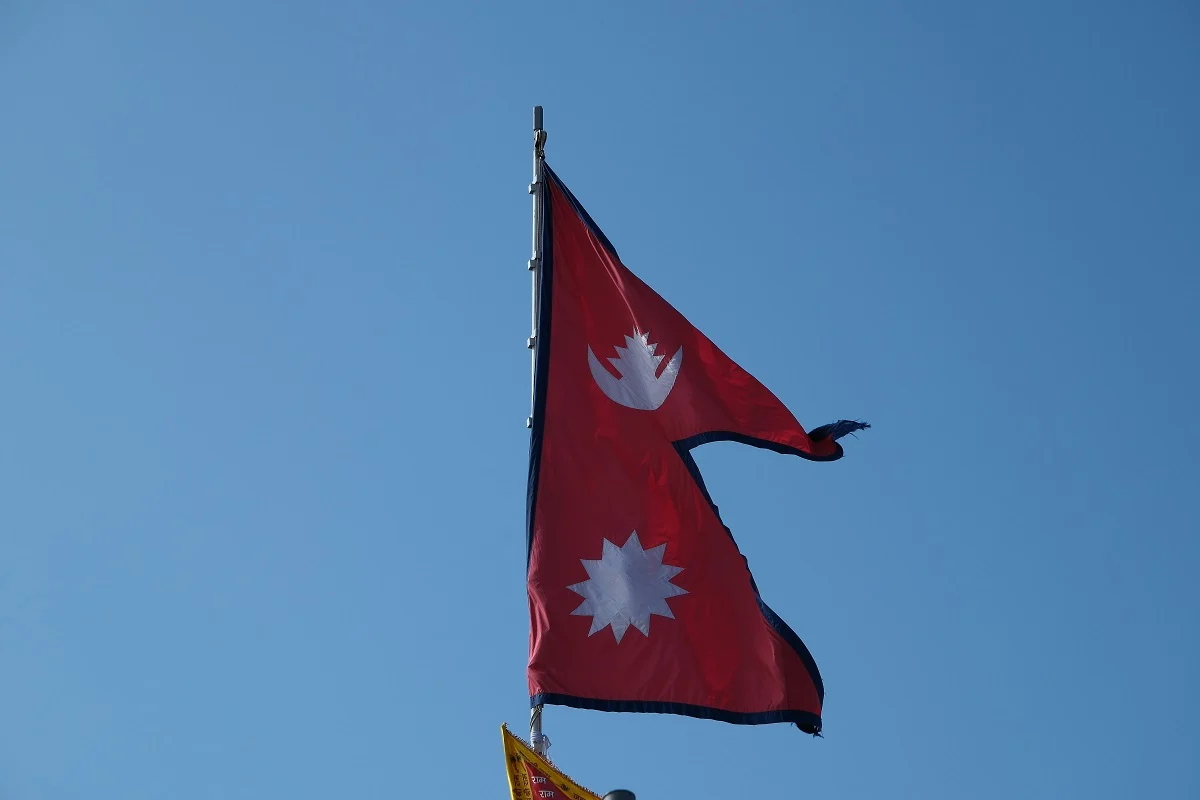
In a world where international standards often dictate the uniformity of symbols, the national flag of Nepal stands as a profound anomaly. While over 75 percent of the world’s sovereign nations adhere to the conventional rectangular or square format, Nepal maintains a distinct identity through its unique double-pennon shape—two stacked triangles that defy the geometric norms established by global maritime and colonial history. This departure from the standard is not merely an aesthetic choice; it is a deep-seated reflection of a nation that has historically navigated its own path, shielded from the pressures of colonization and maritime homogenization.
The Geometric Anomaly in Global Vexillology
To understand why Nepal’s flag is so radically different, one must first consider the global context of flag design, a field known as vexillology. Historically, the rectangular flag became the international standard largely due to the rise of European naval power during the 17th and 18th centuries. Rectangles were practical; they were easy to manufacture, durable when catching the wind, and highly visible from the deck of a ship or a distant coastline. As European powers expanded their reach, they imposed these design conventions upon their colonies and trading partners.
Nepal, however, remained largely isolated within the Himalayan mountain range. Because it was never colonized by European powers and played no part in the historical maritime trade that necessitated standardized signal flags, it felt no pressure to conform. The flag of Nepal consists of two stacked triangular pennons—a design rooted in ancient Hindu and Buddhist traditions where triangular flags, or "panjis," were commonly flown at temples and religious sites to denote sacred spaces or divine presence.
Historical Roots and the Legacy of the Licchavi Dynasty
The origins of the Nepali flag are shrouded in the mists of antiquity. While modern versions of the flag were formally adopted on December 16, 1962, alongside the formation of a new constitution, the underlying design traces its lineage back centuries. Academic researchers, including notable Nepali historian Dayaram Shrestha, have sought to connect the design to the era of the Licchavi Dynasty. Specifically, records suggest that such pennons were in use as early as 450 AD during the reign of King Mandev.
In the pre-modern era, flags served primarily as markers of authority. They were instruments of the battlefield, used by monarchs to distinguish their troops from those of rival factions. The triangular shape was inherently aerodynamic, preventing the fabric from tearing easily in the fierce mountain winds of the Himalayas. Over time, these triangular banners transitioned from military insignias to symbols of the state itself, retaining their religious and cultural significance long after the fall of the kingdoms that first commissioned them.
Symbolism Within the Triangles
The aesthetics of the Nepali flag are laden with profound symbolic meaning that reflects the national identity. The base color is crimson, which is the national color of Nepal and represents the rhododendron, the country’s national flower. This vibrant red also symbolizes the bravery and victory of the Nepali people in war. The deep blue border signifies peace and harmony, reflecting the nation’s long-standing connection to Buddhism and the peaceful philosophy of its people.
The two primary symbols contained within the triangles—the moon in the upper pennon and the sun in the lower—serve as celestial manifestations of the nation’s endurance. Historically, these symbols represented the hope that the nation of Nepal would survive as long as the sun and moon remained in the sky. Furthermore, they are often interpreted as symbols of the two major royal families and the cooling influence of the moon, which balances the fiery, active nature of the sun. The combination creates a duality that reflects the balance between the harsh mountain environment and the spiritual tranquility sought by the local populace.

The Pressure to Conform: A Comparative Analysis
In the mid-19th century, as the world moved toward a more interconnected global system, most Asian nations felt the necessity to adopt the rectangular format to ensure recognition in international diplomatic circles. During this period, the British Empire and other colonial powers formalized the "rules" of flag design. Despite this, Nepal stood firm.
Vexillologist and researcher Scot Guenter has argued that Nepal’s refusal to switch to a rectangular format is a testament to its unique geopolitical position. By remaining a buffer state between the massive empires of China and India, Nepal was able to preserve its indigenous customs. While other nations were busy redesigning their symbols to suit Western sensibilities, Nepal maintained its traditional temple pennons, effectively treating its flag as a living piece of cultural heritage rather than a static diplomatic tool.
Modern Implications and National Pride
In the contemporary era, the flag of Nepal has become a global curiosity and a source of intense national pride. Its unique shape makes it instantly recognizable, even in the crowded field of international summits or Olympic ceremonies. However, the non-standard shape presents technical challenges. For instance, in international events, the flag is often placed within a white rectangular field to maintain consistency with the proportions of other nations’ flags, a concession that sometimes causes controversy among purists who prefer the raw, jagged edges of the authentic design.
From a sociological perspective, the flag acts as a "cultural anchor." In a rapidly globalizing world, the maintenance of the triangular design signifies a rejection of the "cookie-cutter" approach to statehood. It reminds citizens and the international community that Nepal’s sovereignty is not a colonial grant but an ancient, unbroken continuity.
Official Responses and Preservation Efforts
The government of Nepal has consistently defended the design as a vital part of its constitutional identity. Article 8 of the Constitution of Nepal provides a detailed geometric construction for the flag, ensuring that its proportions are mathematically precise. This constitutional protection prevents any dilution of the design, ensuring that future generations continue to recognize the significance of the two triangles.
Former politicians and cultural advocates, such as Biraj Bista, have often highlighted that while the design may seem complex to outsiders, it is second nature to the Nepali people. There is no desire to modernize the flag to fit a rectangular mold; instead, there is a push to educate the global public on the history behind the pennons. The flag is treated as a sacred object, and the precision required to draft it—a process involving complex geometric steps—is often taught in schools to instill a sense of national pride and mathematical appreciation.
The Broader Impact: A Symbol of Resilience
Ultimately, the story of Nepal’s flag is the story of a nation that has successfully navigated the tides of history without losing its soul. While the world has largely moved toward standardized, predictable symbols, Nepal’s flag serves as a reminder that history, culture, and geography play an indispensable role in defining a nation.
The implications of this unique design extend beyond just aesthetics; they serve as a case study for cultural preservation. In an age where digital media and international organizations push for uniformity, the Nepali flag stands as a defiant, beautiful, and deeply meaningful exception. It proves that a nation does not need to conform to global norms to be recognized, respected, or remembered. As Nepal continues to integrate further into the global economy, its flag will undoubtedly remain the most visible, and perhaps the most important, symbol of its enduring, independent spirit. The double-pennon shape is not just a quirk of geometry; it is the physical manifestation of a nation that looks toward the stars—the sun and the moon—while standing firmly on its own ancient, mountainous ground.