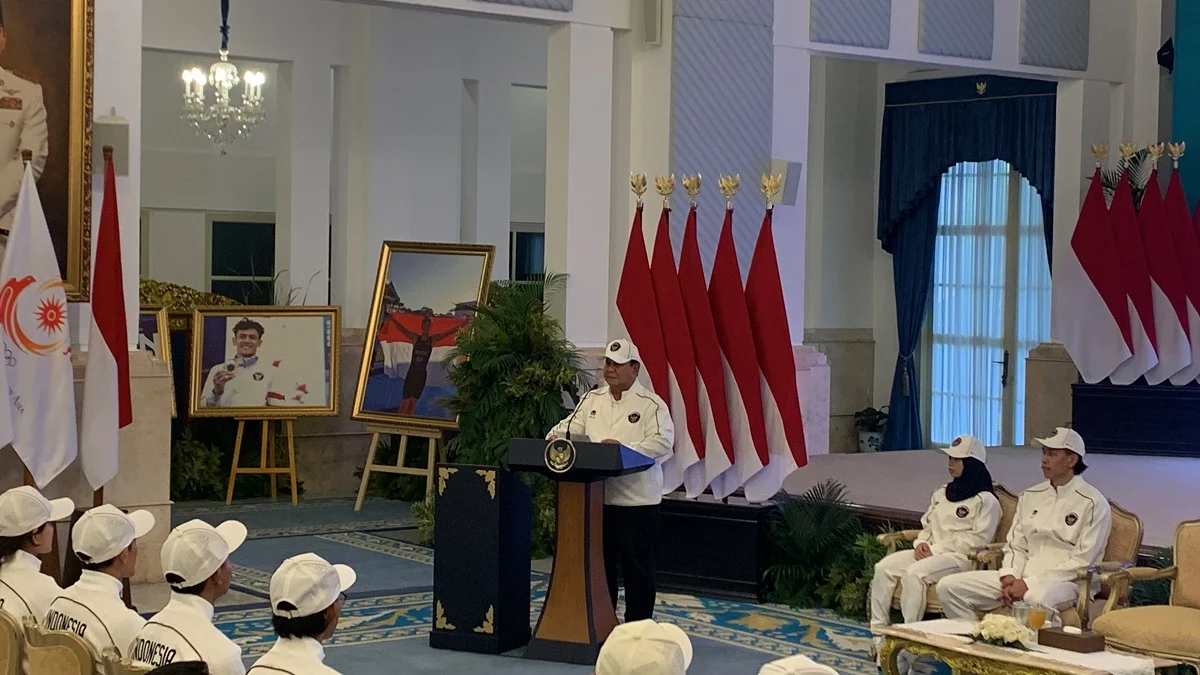
JAKARTA — In a decisive move to bolster national sports morale and reward athletic excellence, President Prabowo Subianto has officially announced a staggering Rp3 billion financial reward for any Indonesian athlete who secures a gold medal at the upcoming 20th Asian Games in Aichi-Nagoya, Japan. The announcement was made during the official send-off ceremony for the Indonesian contingent at the State Palace in Jakarta, setting a historic benchmark for government appreciation of elite athletes representing the nation on the international stage.
The grand send-off gathered 432 elite Indonesian athletes, coaches, and sports officials, all poised to fly the national flag in Japan. President Prabowo emphasized that the government is fully committed to elevating the welfare of athletes who bring glory to the country. By contrasting the rewards with regional multi-sport events, the administration aims to underscore the immense prestige and competitive difficulty of the Asian Games, which serves as the premier athletic championship on the continent.
Substantial Financial Incentives and Career Fast-Tracks
Detailing the remuneration structure during his address, President Prabowo highlighted a significant scaling of incentives compared to standard regional tournaments. While gold medalists at the Southeast Asian (SEA) Games traditionally receive a benchmark reward of Rp1 billion, the administration has tripled the figure for the Asian Games to match the grueling global and continental competition levels.
"I was given a report by Mr. Erick, saying, ‘Sir, for the SEA Games, a gold medal gets Rp1 billion.’ But this is the Asian Games, a gold medal gets Rp3 billion," President Prabowo stated during the ceremony, acknowledging the reports provided by sports leadership.
Beyond monetary compensation, the government has instituted comprehensive structural support for athletes across the podium. Silver and bronze medalists, who frequently miss out on top-tier financial windfalls, will receive substantial backing, particularly concerning career acceleration. President Prabowo confirmed that athletes securing silver and bronze medals would benefit from guaranteed career advancements, whether within state institutions, the military, police, or partnering corporate entities.

"And ask all the sports leaders here, those who won silver and bronze medals, their careers will also be accelerated," Prabowo affirmed. He strongly rejected the notion of government frugality when it comes to honoring national heroes, asserting that the state must generously reward those who elevate Indonesia’s standing globally. "We must not be stingy, right? If they perform well, we must give them proper honor," he added.
Background and Context of the Aichi-Nagoya 2026 Asian Games
The 20th Asian Games, officially known as Aichi-Nagoya 2026, represents a monumental quadrennial event scheduled to take place in the Aichi Prefecture and its capital city, Nagoya, in Japan. Running from September 19 to October 4, 2026, the Games will gather thousands of athletes from 45 member states of the Olympic Council of Asia (OCA) to compete across dozens of sports disciplines.
For Indonesia, the 2026 edition carries immense expectations following the historic success of the 2018 Asian Games hosted in Jakarta and Palembang, where Indonesia finished a remarkable fourth in the overall medal standings with 31 gold, 24 silver, and 43 bronze medals. Replicating or approaching that level of success on foreign soil requires meticulous training regimens, international training camps, sports science integration, and robust financial backing.
The Indonesian contingent heading to Aichi-Nagoya 2026 comprises 432 athletes competing across core and emerging sports. In his address, President Prabowo reminded the athletes of the immense responsibility resting on their shoulders, noting that they carry the hopes, dreams, and pride of Indonesia’s 287 million citizens. This psychological framing is designed to instill deep national pride while mitigating performance anxiety through tangible proof of state backing.
Evolution of Government Bonuses for Indonesian Athletes
The announcement of the Rp3 billion gold medal bonus reflects an ongoing evolution in Indonesia’s sports financing policy. Over the past decade, successive administrations have recognized that inconsistent financial support forces many athletes into premature retirement or financial instability post-competition.
Historically, athletic bonuses in Indonesia were relatively modest, often distributed months or years after the conclusion of a major event, accompanied by bureaucratic delays. However, following the professionalization of the Ministry of Youth and Sports and the Indonesian National Olympic Committee (KOI), reward disbursements have streamlined significantly.

During the 2018 Asian Games, the government similarly provided substantial cash incentives—approximately Rp1.5 billion for individual gold medalists—alongside opportunities to become Civil Servants (PNS) or members of the Indonesian National Armed Forces (TNI) and the Indonesian National Police (Polri). Doubling the gold medal bonus to Rp3 billion for the 2026 Games accounts for inflation, rising living costs, and the need to globally benchmark athlete compensation against regional sporting powerhouses like Singapore, Malaysia, and Thailand, all of which aggressively reward podium finishes.
Broader Economic and Societal Implications
The implementation of multi-billion-rupiah rewards and guaranteed career pathways carries far-reaching implications for the Indonesian sports ecosystem. Analysts and sports economists point out several key structural impacts expected from this policy:
- Increased Participation and Grassroots Motivation: Knowing that elite athletic success can secure financial independence and career stability encourages parents to support their children’s pursuits in professional sports rather than viewing athletics solely as an extracurricular pursuit.
- Professionalization of Sports Federations: With heightened financial stakes, national sports governing bodies (PB) are compelled to operate with greater transparency, accountability, and scientific rigor. Selection processes must remain purely merit-based to ensure that only the nation’s absolute best athletes secure spots on the flight to Japan.
- Soft Power and National Branding: International sporting success remains one of the most effective tools for national branding. High medal counts at events as prestigious as the Asian Games project national discipline, economic progress, and developmental maturity on the global stage.
- Mental Resilience and Morale: Knowing that the highest office in the country directly acknowledges and rewards their efforts provides psychological armor for athletes facing intense pressure from international competitors.
Preparation and Final Countdown to the Games
As the contingent prepares for departure, sports science units, nutritionists, and coaching staffs have entered the final tapering phase. Training camps both domestically and abroad have focused on acclimatization to Japanese weather conditions, timezone adjustments, and tactical refinement.
The Indonesian contingent features established world-class contenders in traditional strongholds such as badminton, weightlifting, sport climbing, pencak silat, and wushu, alongside rising hopefuls in aquatics and cycling. Sports ministry officials have expressed confidence that the combination of intensive preparation and unprecedented financial motivation will drive the contingent toward surpassing pre-tournament medal projections.
Ultimately, President Prabowo’s bold commitment at the State Palace serves as both a challenge and a promise. As the 432 athletes prepare to step onto the arenas of Aichi-Nagoya, they do so not only with the weight of 287 million citizens behind them but with the concrete backing of a nation ready to reward excellence without hesitation.