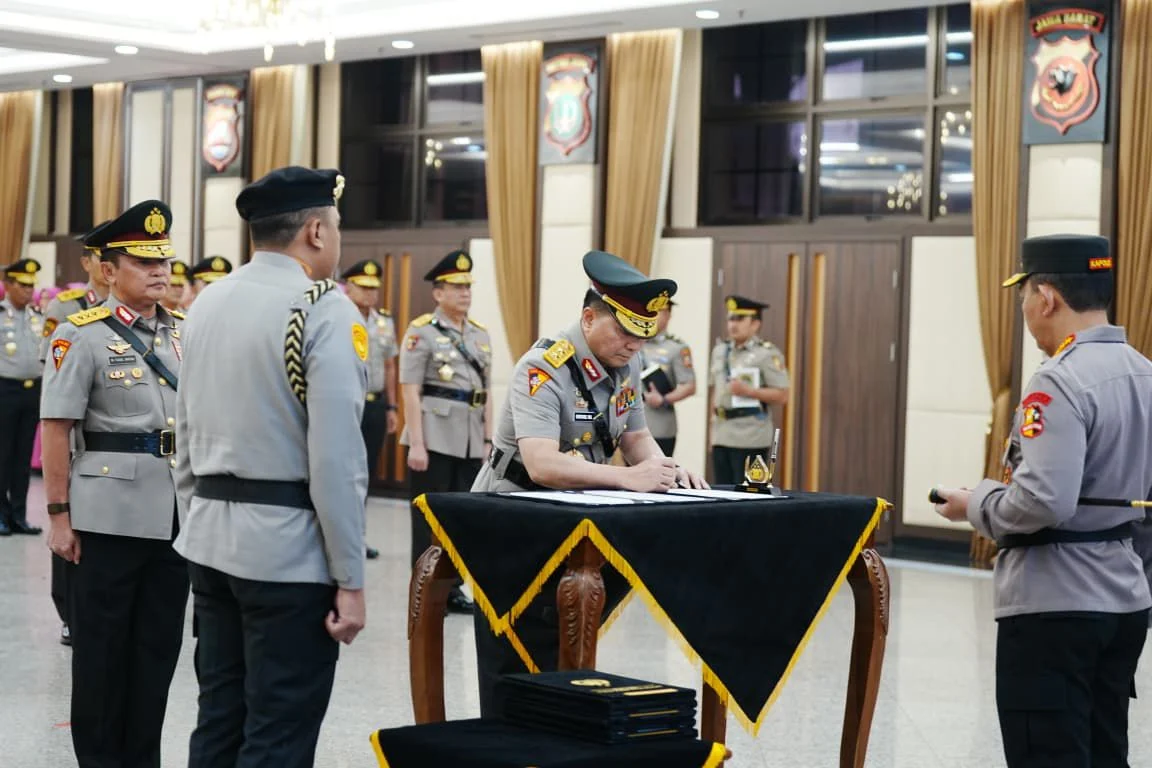
The Indonesian National Police (Polri) has undergone a significant structural realignment, marking a pivotal shift in the leadership landscape of the organization. Following the issuance of official Telegram letters—specifically ST/1877/VIII/KEP./2026, ST/1878/VIII/KEP./2026, and ST/1879/VIII/KEP./2026—the National Police Chief, General Listyo Sigit Prabowo, has effectively reshuffled the hierarchy of the force. This comprehensive reorganization, which affects 424 high-ranking officers (pati) and mid-ranking officers (pamen), aims to optimize institutional efficiency, address retirement vacancies, and align leadership competencies with the evolving security challenges facing the nation.
The most notable development in this latest wave of appointments is the elevation of Inspector General Roycke Harry Langie, formerly the North Sulawesi Regional Police Chief, to the rank of Commissioner General (Komjen). His appointment as the Assistant to the National Police Chief for Operations (Astamaops) fills the void left by the retirement of Komjen Pol Fadil Imran, a figure who played a central role in various domestic security initiatives.
The Dynamics of Organizational Renewal
The process of "mutasi" (rotation and promotion) within the Indonesian National Police is a routine yet critical mechanism for career management and organizational rejuvenation. As stated by the Head of the Public Relations Division of the National Police, Inspector General Johnny Eddizon Isir, these changes are not merely administrative; they are strategic decisions intended to ensure that the leadership of the police force remains agile and capable of addressing modern threats, ranging from cybercrime and narcotics trafficking to internal institutional governance.
"Mutasi jabatan is an integral part of the organization’s dynamics and personnel career development. Every placement is meticulously calculated based on organizational needs, individual competency, and the specific challenges inherent to the assigned duty," Irjen Pol Johnny Eddizon Isir emphasized in an official statement released on Tuesday, September 15, 2026.
The sheer scale of this move—involving 424 personnel—highlights the National Police’s commitment to maintaining a steady pipeline of leadership. By integrating seasoned veterans with newly promoted three-star generals, the force aims to balance institutional memory with fresh perspectives.
The Strategic Importance of Three-Star Generals
The rank of Commissioner General (Komjen) represents the pinnacle of the police hierarchy, just below the National Police Chief and the Deputy Chief. Currently, there are 25 such positions within the Indonesian police structure. These roles are divided into two primary categories: those serving directly within the internal structure of the Polri headquarters and those serving in external government agencies, such as the National Narcotics Agency (BNN), the Ministry of Law and Human Rights, and the National Counter-Terrorism Agency (BNPT).
Out of the 25 current three-star generals, 10 are stationed within the core structure of the Polri. This includes critical roles such as the Deputy National Police Chief (Wakapolri), the Inspectorate General (Irwasum), and various administrative and operational assistants. The remaining 15 officers are tasked with external inter-agency cooperation, which reflects the police force’s deep integration into the broader framework of the Indonesian state.
Spotlight on Key Personnel and Track Records
Among the prominent figures currently occupying the three-star rank is Commissioner General Wahyu Widada. Widada, an alumnus of the 1991 Police Academy (Akpol) and a recipient of the prestigious Adhi Makayasa (best graduate) award, currently serves as the Inspectorate General (Irwasum) of the Polri. His presence in the leadership team is often cited as a benchmark for professional integrity and operational excellence.
Equally significant are those working outside the police headquarters, such as Commissioner General Suyudi Ari Seto, who leads the National Narcotics Agency (BNN). His role is critical in coordinating the nation’s war against the proliferation of illicit drugs, a priority for the current administration.
Furthermore, the appointment of Commissioner General Hendro Pandowo as the Inspector General of the Ministry of Law and Human Rights continues to draw public interest. Pandowo is widely remembered for his tenure as the head of the Task Force for Football Mafia (Satgas Antimafia Bola). During that time, his unit successfully exposed widespread match-fixing scandals that had long plagued the Indonesian national football league. By dismantling networks of corrupt actors and ensuring legal accountability, Pandowo earned a reputation as a no-nonsense investigator capable of tackling deeply entrenched systemic corruption. His transition to a high-ranking position within the Ministry of Law and Human Rights is viewed by analysts as a strategic move to leverage his investigative prowess in a broader administrative and regulatory context.
Chronology and Legislative Framework
The recent reshuffle followed a standard internal procedure initiated under the authority of the National Police Chief. The Telegram letters were signed by Deputy National Police Chief Commissioner General Dedi Prasetyo, who himself occupies the second-highest position in the force.

The sequence of events leading to this update occurred over several days in September 2026, starting with the evaluation of personnel performance and the identification of vacancies due to upcoming retirements. Once the selection process was finalized, the official notifications were issued, and the transition period began immediately. This rapid turnaround is designed to prevent power vacuums in critical operational areas, especially as Indonesia approaches various national events requiring high-level security oversight.
Broader Implications and Strategic Analysis
The implications of this move are multifaceted. From a policy standpoint, the appointment of new leadership indicates a clear focus on continuity. By promoting officers like Roycke Harry Langie, the Polri signals that regional leadership experience is a vital prerequisite for national-level decision-making.
Furthermore, the division of labor between internal and external three-star roles highlights the Indonesian Police’s role as a pillar of public administration. When Polri generals are placed in ministries or state agencies, they serve as conduits for security-focused policymaking, ensuring that the government’s broader agenda—whether in law enforcement, anti-corruption, or regulatory compliance—is supported by the capabilities of the police force.
From a public trust perspective, the transparency of this process remains a focal point. While critics often call for greater public oversight in police appointments, the internal meritocratic system—represented by figures like Wahyu Widada and Hendro Pandowo—serves as the current standard for legitimacy. The focus on career track records, such as the successful management of the Anti-Mafia Football task force, suggests that the leadership is prioritizing "proven competence" in its selection criteria.
List of 25 Commissioner Generals (Komjen) as of September 2026
-
Komjen Pol Dedi Prasetyo
- Position: Deputy National Police Chief (Wakapolri)
- Background: Akpol 1990
-
Komjen Pol Wahyu Widada
- Position: Inspectorate General (Irwasum)
- Background: Adhi Makayasa 1991
-
Komjen Pol Suyudi Ari Seto
- Position: Head of the National Narcotics Agency (BNN)
-
Komjen Pol Hendro Pandowo
- Position: Inspector General, Ministry of Law and Human Rights
- Background: Former Head of Satgas Antimafia Bola
-
Komjen Pol Roycke Harry Langie
- Position: Assistant to the National Police Chief for Operations (Astamaops)
(Note: The list of 25 continues with various high-ranking deputies across departments such as Intelligence, Criminal Investigation (Bareskrim), and Security Maintenance (Baharkam), as well as external postings within the Coordinating Ministry for Political, Legal, and Security Affairs, and other state secretariats.)
Conclusion
The restructuring of the police leadership is a testament to the organization’s commitment to modernization and adaptability. By replacing retiring officers with experienced professionals and shifting personnel into key government roles, the National Police aims to maintain its effectiveness in serving the public and upholding the law. As these officers settle into their new capacities, the success of this reshuffle will be measured by the force’s ability to maintain public order, combat emerging crime trends, and fulfill the high expectations placed upon the Indonesian National Police in the years to come.