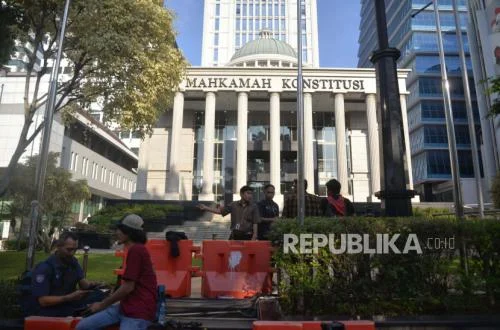
JAKARTA – A dramatic scene unfolded at the Constitutional Court (MK) building on Wednesday, May 29, 2024, when several individuals claiming to be family members of Sulaiman, a key witness for the Democratic Party in an ongoing legislative election dispute, caused a significant commotion. The family vehemently demanded to see Sulaiman, alleging that he had been forcibly taken from his home days earlier and had been incommunicado since. This incident cast a shadow over the already high-stakes judicial process, raising serious questions about witness protection and the integrity of the electoral dispute resolution mechanism in Indonesia.
The Tumultuous Scene at the Constitutional Court
The commotion erupted around the Constitutional Court’s Building I in Jakarta. According to eyewitness accounts and observations, Sulaiman was seen being escorted into the building alongside a legal representative from the Democratic Party. He was notably dressed entirely in black, with his face obscured by a mask, an appearance that only intensified the family’s apprehension. The witness was scheduled to testify in the 2024 Legislative Election Dispute (PHPU Pileg) case Number 196-01-14-22/PHPU/DPR-DPRD-XXII/2024, where the General Election Commission (KPU) serves as the respondent and the National Mandate Party (PAN) is listed as a related party.
Shortly after Sulaiman’s entry, a man and a woman, who identified themselves as his siblings, began shouting from outside the secured perimeter of the court building. The woman, visibly distressed and dressed in a yellow top with a black headscarf, cried out, "I am his older sister! Do you know that? Everything is unfair! There is coercion!" Her desperate pleas highlighted the family’s profound concern over Sulaiman’s status and the circumstances surrounding his appearance at the court. Their attempts to force their way into the building were promptly thwarted by security personnel, who maintained a firm but professional stance. Following their failed attempt to enter, the woman and two other accompanying individuals were approached by an official from the Constitutional Court, who sought to understand the reasons behind their forceful insistence on entry.
The family’s narrative painted a grim picture. Sulaiman’s sister tearfully explained that her brother had been "picked up" from their home on Friday, May 24, 2024, five days prior to the incident at the court. She emphasized that there had been no prior agreement or formal summons that they were aware of, describing it as an unscheduled departure. "There was no agreement. The plan was for (Sulaiman) to be taken out of the house, he said goodbye, and until now there has been no news of him," she recounted, her voice laced with desperation. This alleged disappearance and subsequent reappearance under masked conditions at the court deeply troubled his family, fueling their fears of potential undue influence or coercion.
Background of the 2024 Indonesian General Election and Constitutional Court’s Role
To fully grasp the gravity of this incident, it is essential to understand the broader context of the 2024 Indonesian General Election and the pivotal role of the Constitutional Court. Indonesia held its massive simultaneous general elections on February 14, 2024, electing a president and vice president, as well as members of national, provincial, and regional legislative bodies. This complex democratic exercise, involving over 200 million eligible voters, is the largest single-day election in the world.
The Constitutional Court (Mahkamah Konstitusi or MK) stands as the ultimate arbiter of electoral disputes in Indonesia. Its mandate includes reviewing laws against the constitution, resolving inter-agency disputes, and, crucially, adjudicating disputes related to the results of general elections. Given the high stakes of both the presidential (Pilpres) and legislative (Pileg) elections, the MK’s role is critical in upholding the principles of fairness, transparency, and the rule of law. Any challenge to election results, whether concerning presidential or legislative outcomes, must pass through the rigorous legal process at the MK.
The period leading up to the May 29th commotion had already been marked by intense scrutiny of the Constitutional Court. Just over a month prior, on Monday, April 22, 2024, the MK delivered its highly anticipated verdict on the presidential election dispute. That ruling affirmed the victory of President-elect Prabowo Subianto and Vice President-elect Gibran Rakabuming Raka, dismissing petitions filed by the losing presidential candidates. This presidential election verdict, delivered amidst tight security and nationwide attention, underscored the immense pressure and political sensitivity surrounding the court’s decisions. The atmosphere at the MK during election dispute periods is consistently charged, with supporters, legal teams, and the public keenly observing every development.
The Legislative Election Dispute: Case Number 196-01-14-22/PHPU/DPR-DPRD-XXII/2024
The specific case involving Sulaiman, Number 196-01-14-22/PHPU/DPR-DPRD-XXII/2024, pertains to a dispute over the results of the 2024 legislative elections. These disputes typically involve allegations of vote count manipulation, administrative irregularities, or various forms of electoral fraud that could significantly alter the allocation of seats in legislative bodies. In this particular case, the Democratic Party is challenging results, with the KPU as the primary defendant responsible for organizing and tabulating the elections, and the National Mandate Party (PAN) as a related party, often implicated due to benefiting from the contested results or having a direct interest in the outcome.
Witnesses play an indispensable role in PHPU cases. Their testimonies are crucial for substantiating claims of irregularities or fraud. A credible witness can provide firsthand accounts, documentary evidence, or expert opinions that can sway the court’s decision. Therefore, the integrity and voluntary participation of witnesses are paramount to ensuring a just and fair legal process. Any suggestion of coercion or intimidation of a witness directly undermines the court’s ability to uncover the truth and deliver an impartial judgment.
Chronology of Events Leading to the Commotion
The timeline of events highlights the rapid escalation of the situation from the family’s perspective:
- February 14, 2024: Indonesia conducts its simultaneous general elections for president, vice president, and legislative bodies.
- April 22, 2024: The Constitutional Court delivers its verdict on the Presidential Election Dispute (PHPU Pilpres), affirming the official results.
- Late April – May 2024: The Constitutional Court begins hearing petitions for Legislative Election Disputes (PHPU Pileg), including case Number 196-01-14-22/PHPU/DPR-DPRD-XXII/2024, involving the Democratic Party, KPU, and PAN.
- Friday, May 24, 2024: According to Sulaiman’s family, he was "picked up" from his home under unclear circumstances and subsequently became unreachable by his family. This date marks the beginning of their distress and concerns about his well-being and voluntariness.
- Wednesday, May 29, 2024: Sulaiman appears at the Constitutional Court as a witness for the Democratic Party in the aforementioned PHPU Pileg case. Simultaneously, his family arrives at the court, attempts to gain access, and creates a commotion, alleging coercion and demanding to see him. Security forces intervene, and an MK official questions the family.
Statements and Reactions from Related Parties (Inferred and Logical)
While direct official statements specifically addressing this incident were limited in the initial reports, it is possible to infer how various parties would likely respond, given their roles and the nature of the allegations:
- Sulaiman’s Family: Their reaction was clearly one of extreme distress and fear. They would likely reiterate their allegations of coercion and unauthorized removal, demanding transparency regarding Sulaiman’s whereabouts and condition since May 24th. Their primary concern would be Sulaiman’s safety and his ability to testify freely, without duress. They might also seek legal assistance to investigate the circumstances of his alleged disappearance.
- The Democratic Party: As the party presenting Sulaiman as a witness, they would likely state their commitment to upholding the rule of law and ensuring all witnesses are treated fairly. They might express surprise or concern over the family’s allegations, perhaps clarifying their own procedures for engaging witnesses. They would likely emphasize that their intent is solely to present evidence pertinent to their case and that any allegations of coercion are serious and should be investigated. They might also distance themselves from the methods used to bring the witness to court if it was indeed without proper consent or procedure.
- The Constitutional Court (MK): The Court’s officials would likely emphasize their commitment to judicial integrity and impartiality. They would assert that all proceedings are conducted in accordance with established legal procedures and that witnesses appearing before the court are expected to do so voluntarily. They would likely state that security measures are in place to ensure order and the smooth running of hearings, and that any concerns regarding witness integrity or safety within their premises are taken seriously. The MK might also initiate an internal inquiry into the incident or refer the family’s allegations to relevant law enforcement agencies if warranted.
- General Election Commission (KPU): As the respondent, KPU would likely reiterate its stance that the 2024 elections were conducted fairly and transparently. They would maintain that witness testimonies are part of the legal process in electoral disputes and that they have no involvement in the recruitment or coercion of witnesses for any party. KPU’s focus would be on defending its election results through evidence and legal arguments presented in court.
- National Mandate Party (PAN): As a related party, PAN would likely express confidence in the electoral process and the Constitutional Court’s ability to resolve disputes justly. They would likely await the court’s final decision on the legislative election results and would not typically comment on procedural issues related to other parties’ witnesses unless directly impacted.
- Legal Experts and Human Rights Organizations: Legal analysts would likely point to the critical importance of witness protection and the potential for such incidents to undermine public trust in the judicial system. Human rights organizations would likely call for a thorough and independent investigation into the family’s claims, emphasizing the right to due process and the prevention of any form of intimidation or abduction of witnesses, particularly in politically sensitive cases. They might highlight the role of institutions like the Witness and Victim Protection Agency (LPSK) in safeguarding individuals providing testimony in high-profile legal matters.
Broader Impact and Implications
This incident, though seemingly isolated, carries significant implications for the integrity of Indonesia’s electoral process and the functioning of its judicial institutions:
- Undermining Public Trust: Allegations of witness coercion or disappearance, particularly in the context of high-stakes election disputes, can severely erode public confidence in the fairness of the electoral process and the ability of the Constitutional Court to deliver impartial justice. If the public perceives that witnesses can be manipulated or intimidated, the legitimacy of the court’s final rulings could be questioned.
- Challenges to Witness Protection: The incident highlights potential vulnerabilities in Indonesia’s witness protection mechanisms. While the LPSK exists to protect witnesses and victims, such an event underscores the challenges of ensuring the safety and voluntariness of individuals who come forward in politically charged cases. It may prompt calls for a review and strengthening of witness protection protocols, especially for those involved in election disputes.
- Judicial Integrity: The Constitutional Court’s reputation for impartiality and independence is paramount. Any incident that suggests external pressures or irregular procedures concerning witnesses can cast a shadow on the court’s integrity. The MK will likely need to address these allegations transparently to maintain its standing as a credible arbiter.
- Rule of Law: The principles of due process, voluntary participation in legal proceedings, and protection from coercion are fundamental to the rule of law. If Sulaiman’s family’s claims are substantiated, it would represent a serious breach of these principles and demand a robust response from legal and law enforcement authorities.
- Precedent for Future Disputes: How this specific incident is handled could set a precedent for future election disputes. A thorough investigation and appropriate action are necessary to deter similar occurrences and ensure that all parties operate within the bounds of the law.
The commotion at the Constitutional Court serves as a stark reminder of the intense pressures and sensitivities surrounding electoral justice in Indonesia. As the Constitutional Court continues its deliberations on the legislative election disputes, the allegations made by Sulaiman’s family introduce a layer of complexity and urgency, demanding not only judicial resolution of the election results but also a transparent and thorough investigation into the circumstances surrounding the witness’s appearance. The integrity of the entire democratic process hinges on the unwavering commitment to fairness, transparency, and the protection of all individuals involved, especially those brave enough to step forward as witnesses. The nation watches closely, awaiting not only the court’s decision on the legislative results but also a clear resolution to the unsettling questions raised by this dramatic incident.