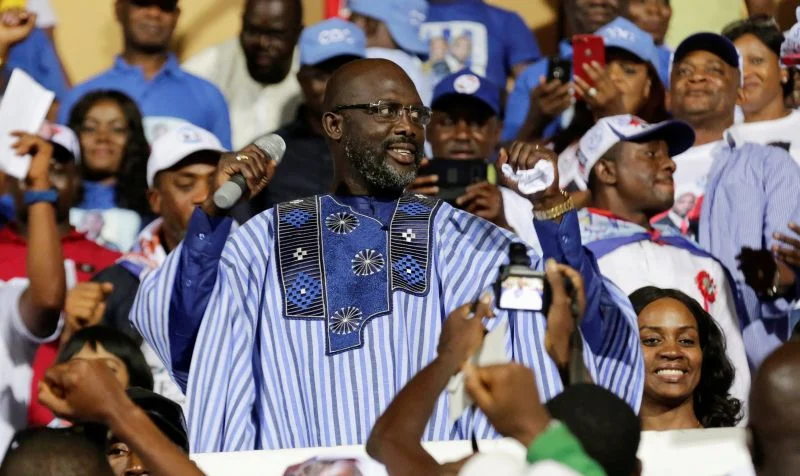
The transition from a professional sports career to the high-stakes arena of national politics is a rare and formidable undertaking, but few have achieved this leap with the historical significance of George Tawlon Manneh Oppong Ousman Weah. Following an illustrious athletic career that saw him crowned as the best player on the planet in 1995, George Weah officially secured his place in history by being elected President of Liberia in December 2017. Long before he stepped into the Executive Mansion in Monrovia, Weah was a global household name, electrifying stadiums across Europe while playing for powerhouse clubs such as AC Milan, Paris Saint-Germain, Chelsea, and Manchester City. Upon hanging up his football boots, Weah pivoted entirely toward public service and statecraft, driven by a profound desire to uplift the nation that shaped his formative years. His journey from the sandy, makeshift pitches of Monrovia to the pinnacle of international football, and ultimately to the highest office of his homeland, remains one of the most compelling narratives of modern political and sporting history.
Early Life and Humble Beginnings in Monrovia
Born on October 1, 1966, in the densely populated Clara Town district of Monrovia, Liberia, George Weah’s early life was marked by the modest circumstances typical of many working-class families in the region. Raised largely by his paternal grandmother, Emma Klonh Brown, Weah displayed an innate passion and remarkable affinity for association football from an early age. Without the luxury of professional coaching, structured training facilities, or standard equipment, young Weah honed his craft on dusty, uneven, and sandy terrain alongside other neighborhood youths. These makeshift matches served as the crucible for his exceptional natural talent, fostering extraordinary close control, agility, and balance that would later baffle elite defenders on the European stage.
As a teenager, Weah’s prodigious abilities soon caught the attention of local clubs. He began his organized domestic career playing for a succession of Liberian sides, including Invincible Eleven, Mighty Barolle, Bongrange Bonguine, and Young Survivors of Claretown. During his stint with Young Survivors—a club notably operating without the guidance of a formal coach—Weah’s leadership and goalscoring prowess propelled the team to a remarkable promotion into the Liberian top-flight division. This early success signaled that the young forward possessed capabilities far exceeding local amateur standards, setting the stage for his eventual exodus to the international scouting radar.
The African Breakthrough and European Scouting
The pivotal turning point in Weah’s early professional journey occurred in 1987, when his undeniable talents attracted the interest of Tonnerre Yaoundé, a prominent club in Cameroon. Securing a three-year contract, Weah made an immediate and profound impact upon his arrival in Central Africa. His explosive speed, physical dominance, and clinical finishing spearheaded the team’s offensive line, culminating in Tonnerre capturing the Cameroonian championship title during his debut season.
It was during this period in Cameroon that Weah’s performances drew the attention of legendary French manager Arsène Wenger, who was then at the helm of AS Monaco. Recognizing the raw, unrefined brilliance of the young African forward, Wenger orchestrated Weah’s transfer to French football, bringing the 22-year-old talent to Europe ahead of the 1988–1989 season. This move marked the official beginning of Weah’s ascent into the upper echelons of global football, bridging the gap between African domestic leagues and the hyper-competitive landscape of European club competitions.
Conquering European Football: AS Monaco and Paris Saint-Germain
Arriving in the French Principality, Weah faced the standard cultural and athletic adjustments required of young foreign imports, yet his adaptation was remarkably swift. Under the astute tutelage of Arsène Wenger at AS Monaco, Weah refined his positioning, tactical awareness, and passing range, transforming from a pure instinctive scorer into a complete modern striker. Over five productive seasons spanning from 1988 to 1992, Weah amassed 57 goals across all competitions, terrorizing defenses in Division 1. One of the defining moments of his tenure at Monaco came in 1991 when he played a crucial role in leading the club to victory in the Coupe de France (French Cup), securing his first major piece of European silverware.
Weah’s blistering pace, combined with a towering aerial presence and an astonishingly accurate strike from distance, quickly made him a fan favorite and a nightmare for opposing center-backs. His relentless work ethic and uncompromising technical capabilities did not go unnoticed by wealthier rivals. In 1992, Weah secured a high-profile transfer to Paris Saint-Germain (PSG), a club rapidly ascending the ranks of French and continental football.
At Parc des Princes, Weah’s status ascended from a promising African prospect to an established global superstar. During his tenure with PSG, he spearheaded the club’s domestic and European ambitions, capturing another French Cup title and the Ligue 1 championship. Furthermore, Weah played a central role in guiding Paris Saint-Germain to the semi-finals of the prestigious UEFA Champions League during the 1994–1995 campaign, a historic milestone for the Parisian club at the time. Across 123 total appearances for PSG, Weah found the back of the net 37 times and contributed numerous assists, solidifying his reputation as one of the most lethal and dynamic forwards in European football.
The Zenith at AC Milan: Individual Glory and Historic Accolades
The pinnacle of Weah’s club career arrived in the summer of 1995 when Italian Serie A powerhouse AC Milan secured his signature. Entering the legendary San Siro stadium, Weah joined a star-studded squad and immediately integrated into the demanding tactical environment of Italian football. In his debut 1995–1996 season, he helped guide the Rossoneri to the Serie A scudetto, showcasing his world-class abilities on the grandest domestic stage in Italy. He would later add a second Serie A title to his resume during the 1998–1999 campaign.
It was during these golden years in Milan that Weah achieved unprecedented individual recognition. In 1995, following his stellar performances for both PSG and AC Milan, Weah was awarded the prestigious FIFA World Player of the Year award, alongside the Ballon d’Or. This historic achievement made him the first—and to this day, the only—African player in history to win either of these supreme global accolades. In addition, he was named the African Footballer of the Year on three separate occasions. Across 114 appearances in the red and black stripes of Milan, Weah netted 51 goals, etching his name permanently into the pantheon of football legends.
Later Career Stints and Transition to Activism
Following his successful spell in Italy, Weah experienced brief stints in the English Premier League with Chelsea and Manchester City, where he continued to demonstrate flashes of his world-class pedigree, including winning another FA Cup with the Blues in 2000. He concluded his professional playing career after spells with Olympique de Marseille in France and Al-Jazira in the United Arab Emirates, officially retiring from active competition in 2003.
Even before hanging up his boots, Weah was deeply invested in the welfare of his homeland, Liberia, which was grappling with the devastating aftermath of brutal civil wars. Utilizing his global platform, wealth, and influence, Weah acted as a UNICEF Goodwill Ambassador, funding health and education initiatives for underprivileged children in Africa and advocating for peace during periods of intense national conflict. His active humanitarian footprint established a foundation of trust and popularity among the Liberian citizenry, laying the essential groundwork for his eventual transition from the sports arena to the political stage.
The Political Awakening and Electoral Path to the Presidency
Weah’s entry into formal politics began in earnest following the conclusion of Liberia’s second civil war in 2003. Recognizing the deep systemic corruption, economic stagnation, and infrastructural ruin plaguing the nation, Weah founded the Congress for Democratic Change (CDC) political party and announced his candidacy for the 2005 presidential election. Despite his lack of formal political experience—a point heavily criticized by his opponents and political elites—Weah won the first round of the 2005 election, though he was ultimately defeated in the run-off vote by veteran economist and former World Bank official Ellen Johnson Sirleaf.
Refusing to be discouraged by his initial electoral defeat, Weah demonstrated a long-term commitment to democratic governance. Understanding the valid criticisms regarding his educational background, Weah returned to academia, eventually earning a high school diploma and subsequently completing both a bachelor’s degree and a master’s degree in public administration from DeVry University and Keller Graduate School of Management, respectively. This dedication to self-improvement significantly bolstered his political credibility and intellectual readiness to govern.
After serving as a Senator representing Montserrado County from 2014 to 2018, Weah mounted his second major presidential campaign for the 2017 general elections. Running on a populist platform centered on youth empowerment, infrastructural development, anti-corruption reforms, and poverty reduction, Weah resonated deeply with the disenfranchised majority of Liberia’s young population. In the historic December 2017 run-off election, running alongside vice-presidential candidate Jewel Howard Taylor, Weah secured a decisive victory, officially succeeding Ellen Johnson Sirleaf in the country’s first democratic transfer of power in over seven decades.
Implications, Governance Challenges, and Historical Legacy
George Weah’s inauguration as the 25th President of Liberia in January 2018 marked a monumental paradigm shift, symbolizing hope and democratic maturity for a nation previously scarred by decades of conflict and instability. International observers, foreign diplomats, and regional bodies lauded the peaceful transition of power, viewing Weah’s presidency as a testament to the resilience of Liberian democratic institutions.
However, the transition from a celebrated sports icon to a head of state brought immediate, complex socio-economic challenges. Inheriting an economy heavily reliant on foreign aid, struggling with high inflation, and plagued by infrastructural deficits, the Weah administration faced intense scrutiny regarding its fiscal management, healthcare provisions, and anti-corruption measures. Critics frequently pointed to the difficulties of translating athletic leadership skills into the nuanced art of legislative compromise and macroeconomic governance. Conversely, supporters highlighted ambitious infrastructural projects, improvements in educational access, and the maintenance of national peace and stability as core achievements of his tenure.
The legacy of George Weah remains a fascinating study in duality. On the global stage, he stands immortally as a pioneer who broke barriers for African athletes, achieving the highest individual honors the sport of football has to offer. Domestically, his journey from the dusty streets of Clara Town to the Executive Mansion represents an unprecedented populist triumph, reflecting the profound yearning of ordinary citizens for leadership untainted by traditional political corruption. Whether viewed through the lens of sports history or modern African political science, the trajectory of George Weah endures as a powerful testament to ambition, resilience, and the capacity for extraordinary transformation.