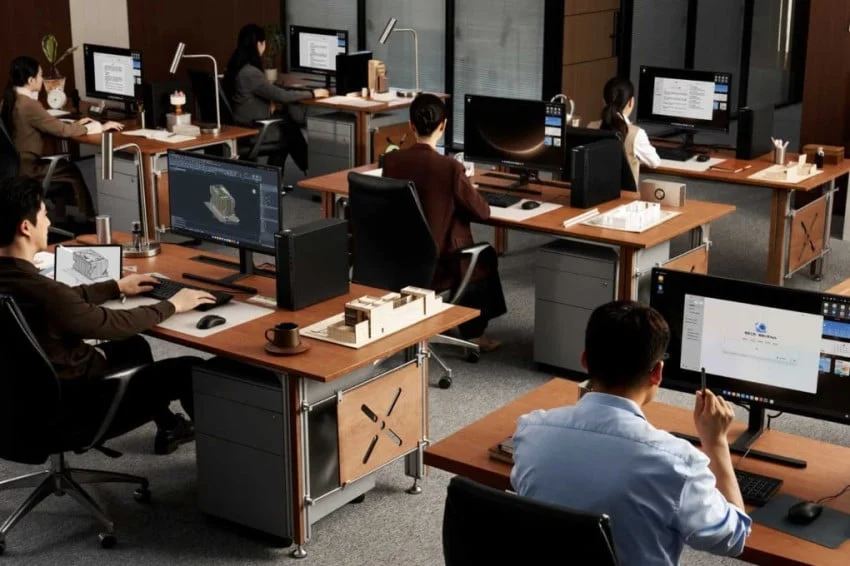
On November 5, 2026, Huawei officially unveiled the Qingyun HM650 and HM650G, a pair of desktop computers specifically engineered for the Chinese government and enterprise sectors. This release represents a significant milestone in the country’s ongoing "Xinchuang" (Information Technology Application Innovation) strategy, which aims to achieve self-reliance in critical technology infrastructure. By replacing traditional Intel and AMD processors, as well as the ubiquitous Microsoft Windows operating system, with the proprietary Kirin X90 chip and HarmonyOS, Huawei is signaling a decisive move toward a fully localized computing ecosystem.
The Technical Foundation of the Qingyun HM650
The core of the HM650 system is the Kirin X90 processor, a chipset that diverges significantly from the x86-64 architecture that has dominated the desktop and server market for decades. Historically, global enterprise computing has relied on Intel Core and AMD Ryzen processors, both of which operate on the x86-64 instruction set architecture (ISA). This shared language allows software developers to create applications that function seamlessly across different hardware brands, provided the hardware meets the required performance benchmarks.
In contrast, Huawei’s new desktop platform utilizes an ARM64-based architecture. To understand this transition, it is helpful to view the instruction set as a language and the processor as a machine capable of interpreting that language. While Intel and AMD provide machines that speak the x86 language, ARM-based processors speak a different dialect. Huawei’s shift to ARM64 on the desktop is not merely a hardware swap; it necessitates a fundamental re-evaluation of how software compatibility is managed within the enterprise environment. While HarmonyOS can run certain applications via virtual machine environments, the lack of granular detail regarding the internal core design of the X90 leaves industry analysts speculating about its raw performance capabilities compared to high-end enterprise-grade x86 chips.
Verification and the Definition of "Domestic"
A central pillar of Huawei’s marketing for the Qingyun HM650 is the claim that 100 percent of the machine’s components are produced in China. To substantiate this assertion, Huawei has cited verification from the Zhejiang Kezheng Electronic Information Product Inspection, an independent agency. However, industry experts are quick to distinguish between "origin of production" and "intellectual property sovereignty."
While the physical manufacturing of the chassis, motherboard, power supply, and other auxiliary components may take place within Chinese borders, the claim does not necessarily extend to the entire supply chain of intellectual property (IP), electronic design automation (EDA) software, or the advanced lithography machines required to manufacture the Kirin X90. Modern semiconductor fabrication is a globalized, highly interconnected process. Even when a chip is fabricated in a domestic foundry, the underlying design tools and specific patents often have international origins. Consequently, while the HM650 is a triumph for domestic manufacturing logistics, it remains a subject of debate whether it represents a total decoupling from international technology dependencies.
Chronology of Huawei’s Pivot
The introduction of the HM650 is the culmination of a multi-year effort by Huawei to circumvent international trade restrictions. The timeline of this transition highlights a calculated shift:
- 2019–2020: The United States implements severe export controls, restricting Huawei’s access to advanced semiconductor technology and Google’s mobile services. This forces the company to pivot from a global consumer-centric strategy to a focus on domestic resilience.
- 2021–2022: Huawei accelerates the development of HarmonyOS, positioning it not just as a mobile OS, but as a cross-platform foundation for IoT and enterprise computing.
- 2023–2024: Huawei begins small-scale deployments of desktop systems using legacy Kirin chips, testing the waters within provincial government offices.
- 2025: The company refines the integration between its hardware and the HarmonyOS ecosystem, focusing on security and compatibility for enterprise applications.
- November 2026: The formal launch of the Qingyun HM650 and HM650G establishes a commercial-ready product line for government and corporate procurement.
Market Implications and the Xinchuang Strategy
The Xinchuang strategy is more than a policy; it is a massive economic investment intended to insulate China’s public sector from geopolitical volatility. By mandating the use of domestically produced IT equipment, the government is effectively creating a captive market that guarantees demand for Huawei’s new hardware.

For multinational corporations operating in China, the rise of the HM650 creates a complex landscape. These companies may soon face pressure to adopt "locally compatible" hardware to maintain interoperability with government systems. This could lead to a fragmented IT environment where firms must maintain two parallel sets of infrastructure: one for international operations using x86/Windows, and another for Chinese operations using Kirin/HarmonyOS.
From a competitive standpoint, the HM650 provides a test case for whether HarmonyOS can sustain a desktop user experience that rivals the productivity of established ecosystems. Critics note that while hardware can be manufactured domestically, the software ecosystem—including professional-grade software for design, engineering, and data analysis—relies heavily on developers who have historically prioritized the Windows/x86 environment. Huawei’s success will ultimately depend on its ability to incentivize software developers to port their applications to the ARM64-based HarmonyOS.
Economic and Strategic Outlook
The release of the Qingyun HM650 signals that Huawei has moved beyond the "survival mode" of the early 2020s and is now actively shaping a new technological standard. By controlling both the hardware and the software, Huawei is positioning itself as a vertically integrated provider similar to Apple, but with a specific focus on the unique requirements of the Chinese public sector.
Financial analysts are watching the procurement volume of these machines closely. If state-owned enterprises and government bureaus shift en masse to the HM650, it will provide Huawei with the capital necessary to further refine its semiconductor manufacturing processes. This cycle of investment, production, and deployment is the engine of China’s push toward technological autonomy.
However, the global semiconductor community remains skeptical regarding the long-term performance trajectory of the X90 chip. Without access to the most advanced extreme ultraviolet (EUV) lithography tools—which are currently subject to international trade bans—Huawei must rely on innovative architecture and multi-chiplet packaging to close the performance gap with the latest offerings from Intel and AMD. Whether the Kirin X90 can match the multi-threaded performance required for complex enterprise workloads remains an open question that will be answered as these units enter service in the coming months.
Conclusion: A New Era of Computing
The debut of the Huawei Qingyun HM650 is a watershed moment for the global technology industry. It represents the first large-scale attempt by a major power to operate an entire enterprise IT ecosystem independently of Western architectural standards. While the "100 percent Chinese-made" claim provides a marketing narrative, the true significance lies in the underlying shift in infrastructure.
As Huawei continues to iterate on the HM650 series, the global technology sector will be forced to adapt to a bifurcated world. The outcome of this experiment will likely influence national technology policies worldwide, as other nations observe whether a transition to domestic hardware and proprietary operating systems can truly deliver the performance, security, and scalability required by modern digital economies. For now, the Qingyun HM650 stands as a testament to Huawei’s resilience and a clear indication that the company is determined to define the future of computing on its own terms, independent of international supply chain norms.