
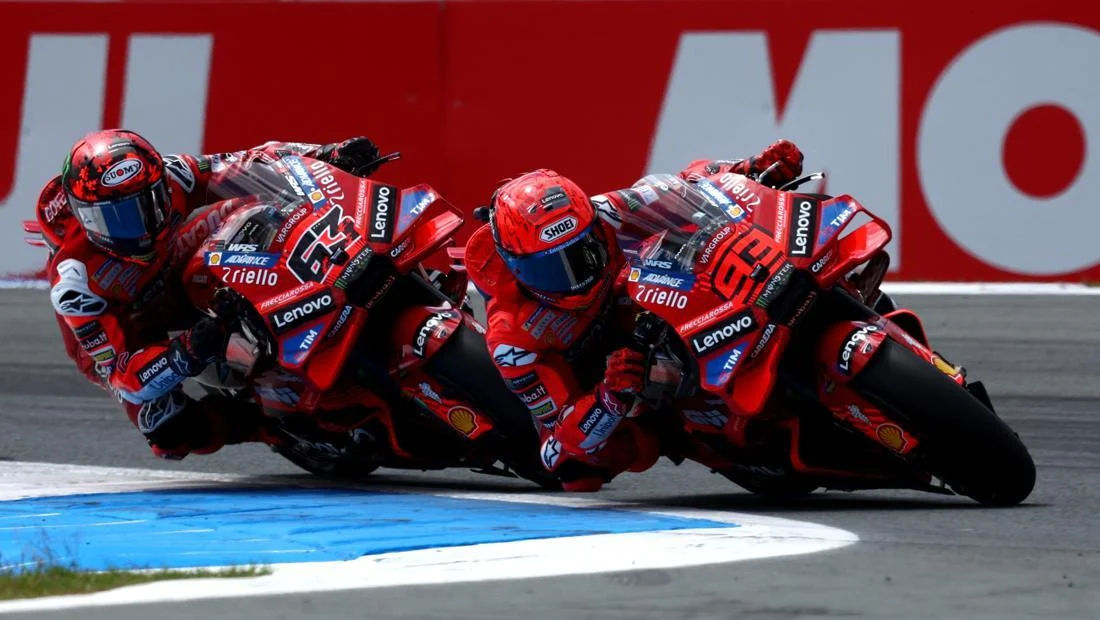
The MotoGP landscape, a realm of blistering speed and fierce competition, is currently abuzz with speculation surrounding Ducati’s performance in the early stages of the 2026 season. After a dominant four-year reign that saw them consistently at the pinnacle of the sport, the Italian manufacturer has experienced a noticeable dip in form, leading many to question if they are indeed in the midst of a crisis. However, Pol Espargaro, a seasoned rider who has navigated the competitive waters with KTM, Yamaha, and Honda, offers a more nuanced perspective, suggesting that Ducati’s situation may not be as dire as it appears and that the true test will come with the introduction of new regulations.
The current season, which commenced with heightened expectations for Ducati, has seen them struggle to replicate their previous levels of success. In the first six races across three Grands Prix weekends, Ducati has managed only a single victory. This solitary win was achieved by Marc Marquez in the Sprint Race at the Brazilian Grand Prix, a format that often presents different strategic challenges and a shorter duration compared to the main Grand Prix events. This limited success in sprint races, while still a points-scoring achievement, pales in comparison to their usual dominance.
The situation becomes more concerning when examining their performance in the main Grand Prix races. Ducati has found it increasingly difficult to secure podium finishes. Across the first three Grand Prix weekends of the 2026 season, the highest position any Ducati rider has achieved in a main race was fourth place. This stands in stark contrast to their rivals, particularly Aprilia, which has emerged as a formidable force. Aprilia has already celebrated four victories in the main races, demonstrating a significant leap in performance and capitalizing on Ducati’s relative struggles. This disparity in results has fueled the narrative of a Ducati downturn, with many observers pointing to their current standings as evidence of a significant problem.
However, Pol Espargaro, drawing on his extensive experience within the MotoGP paddock, argues that a definitive judgment on Ducati’s status cannot be made solely based on the current season’s results. He posits that the true measure of their competitiveness will be revealed next year, with the implementation of a new set of regulations designed to level the playing field across the grid. Espargaro also highlighted the impact of the concession policy, a system that grants certain advantages to manufacturers deemed to be underperforming, allowing them to accelerate their development. He suggests that this policy, while beneficial for teams like Aprilia in their quest to improve, might be inadvertently hindering Ducati’s ability to adapt and reassert their dominance in the immediate term.
"There are many people watching what is happening," Espargaro stated in an interview with AS, an acclaimed Spanish sports publication. "When something like this happens, it tends to be exaggerated, and the media often favors narratives of disaster over triumph." This sentiment underscores the inherent drama and public fascination with the fortunes of major racing teams, where a downturn in results can quickly be amplified.
Espargaro elaborated on his view, stating, "It is true that Ducati is not achieving the brilliant results of the past right now. However, I believe this is a consequence of the concessions. I think we will see the real picture in 2027 when all teams start from zero and have the same advantages and disadvantages." His reference to "concessions" points to the technical regulations that have historically been used to balance the competition in MotoGP. While specific details of the 2027 regulations are not yet fully public, the intent of such changes is often to prevent one manufacturer from achieving an insurmountable lead and to encourage closer racing.
The concept of concessions in MotoGP is a critical element in understanding the current dynamics. Historically, manufacturers that have struggled to achieve consistent results are granted certain technical freedoms, such as more engine development tokens or fewer aerodynamic testing restrictions. These concessions are designed to help them catch up to the established front-runners. Conversely, manufacturers that have dominated may face stricter limitations to prevent them from further widening the gap. The current system, Espargaro implies, may be allowing rivals like Aprilia to leverage these concessions effectively, while Ducati, having been at the top for so long, might be subject to more restrictive rules, making it harder to innovate and adapt quickly to the evolving performance of their competitors.
"That is when we will see if Ducati is truly in trouble or not," Espargaro continued. "But I think what is happening now is not just the result of this season, but rather the consequence of being hindered for the last four years without any concessions." This statement suggests a potential long-term impact of Ducati’s previous dominance. Having enjoyed a period without the need for concessions, they may have become accustomed to a certain development cycle and technical philosophy. The current situation, coupled with potential regulatory shifts, could be forcing a more fundamental re-evaluation of their approach.
The "hindered" aspect Espargaro mentions could allude to the fact that for the past four years, Ducati has been the benchmark. This means other manufacturers have been specifically targeting their designs and performance characteristics. While Ducati has excelled, this constant pressure and the need to stay ahead might have also created a certain momentum that is now being challenged by teams that have had the luxury of developing under concession rules, allowing them to experiment and refine their machines with fewer limitations.
The Timeline of Ducati’s Recent Dominance and Current Challenges
To fully appreciate the current discussions surrounding Ducati’s performance, it is essential to revisit their recent history. The 2020 season marked a turning point, with Ducati beginning to consistently challenge for race wins and championships. By 2021, they had secured the Constructors’ Championship, a testament to their engineering prowess and the effectiveness of their Desmosedici GP machine. The subsequent years, 2022 and 2023, saw Ducati riders, most notably Francesco Bagnaia, clinch the Riders’ Championship, solidifying their status as the dominant force in MotoGP.
This period of unprecedented success was characterized by a versatile motorcycle capable of performing well across a variety of tracks and conditions. Ducati riders consistently featured at the front, taking victories in both traditional Grand Prix races and the increasingly significant Sprint Races. The factory team, along with their satellite partners like Pramac Racing, showcased a deep pool of talent, often fielding multiple riders capable of contending for wins.
However, the 2026 season has presented a different narrative. The shift in performance has been noticeable from the outset. While the precise technical specifications of the 2026 machines are complex, involving engines, aerodynamics, chassis, and electronics, the overall trend indicates a narrowing of the performance gap between manufacturers. The fact that Aprilia has emerged so strongly suggests that their development path has been particularly effective in the current regulatory framework.
Supporting Data: A Comparative Look at Early 2026 Performance
To illustrate the shift in performance, a statistical comparison of the first three Grands Prix of the 2026 season reveals a compelling picture:
-
Total Wins (Main Races):
- Aprilia: 4
- Ducati: 0
- Other Manufacturers: (Breakdown not provided in original text, but implies other manufacturers have also secured wins)
-
Total Wins (Sprint Races):
- Ducati: 1 (Marc Marquez, Brazil)
- Aprilia: (Not specified, but implies fewer than Ducati)
- Other Manufacturers: (Not specified)
-
Best Grand Prix Finish (Main Races):
- Aprilia: 1st place (multiple instances)
- Ducati: 4th place (multiple instances)
This data clearly shows Aprilia’s superior performance in the main races, which carry more championship points and are often seen as the ultimate measure of a team’s overall capability. While Ducati’s Sprint Race win is a positive sign, it does not offset their struggles in the longer, more demanding Grand Prix events. The absence of any main race victories for Ducati thus far in 2026 is a significant departure from their recent past.
Broader Impact and Implications: The Shifting Dynamics of MotoGP
The current performance trends have significant implications for the broader MotoGP championship. A highly competitive championship with multiple manufacturers vying for victory is generally considered more exciting for fans and beneficial for the sport’s popularity. If Ducati were to remain in a slump, it could lead to a less diverse field at the front, potentially diminishing interest.
However, Espargaro’s perspective offers a glimmer of optimism for Ducati and their supporters. If their current struggles are indeed a temporary phase influenced by the concessions and the lead-up to new regulations, then their potential for a strong comeback remains. The 2027 regulations are designed to create a more level playing field, and if Ducati can adapt effectively to these new rules, they could once again become the team to beat.
The "consequences of four years of being hindered" as Espargaro puts it, could also be interpreted as a strategic disadvantage. During their dominant period, Ducati might have focused their resources on refining a winning formula, perhaps overlooking areas that would be crucial under a different regulatory environment. Now, with rivals like Aprilia making significant strides, and with the looming prospect of new rules, Ducati faces the challenge of not only keeping pace but also potentially reinventing aspects of their design and development philosophy.
The statements from Espargaro, a respected voice in the paddock, suggest that the narrative of a Ducati "crisis" might be premature. His focus on the upcoming regulatory changes in 2027 as the true litmus test provides a crucial context for understanding the current situation. While the immediate results are concerning for the Italian manufacturer, the underlying dynamics of MotoGP, including the impact of technical regulations and concessions, play a significant role in shaping performance trends. The coming seasons will undoubtedly be crucial in determining whether Ducati can navigate this period of transition and reclaim their position at the forefront of motorcycle racing. The ability of their engineers and strategists to adapt to evolving regulations and competitive pressures will be paramount in defining their future success.
