
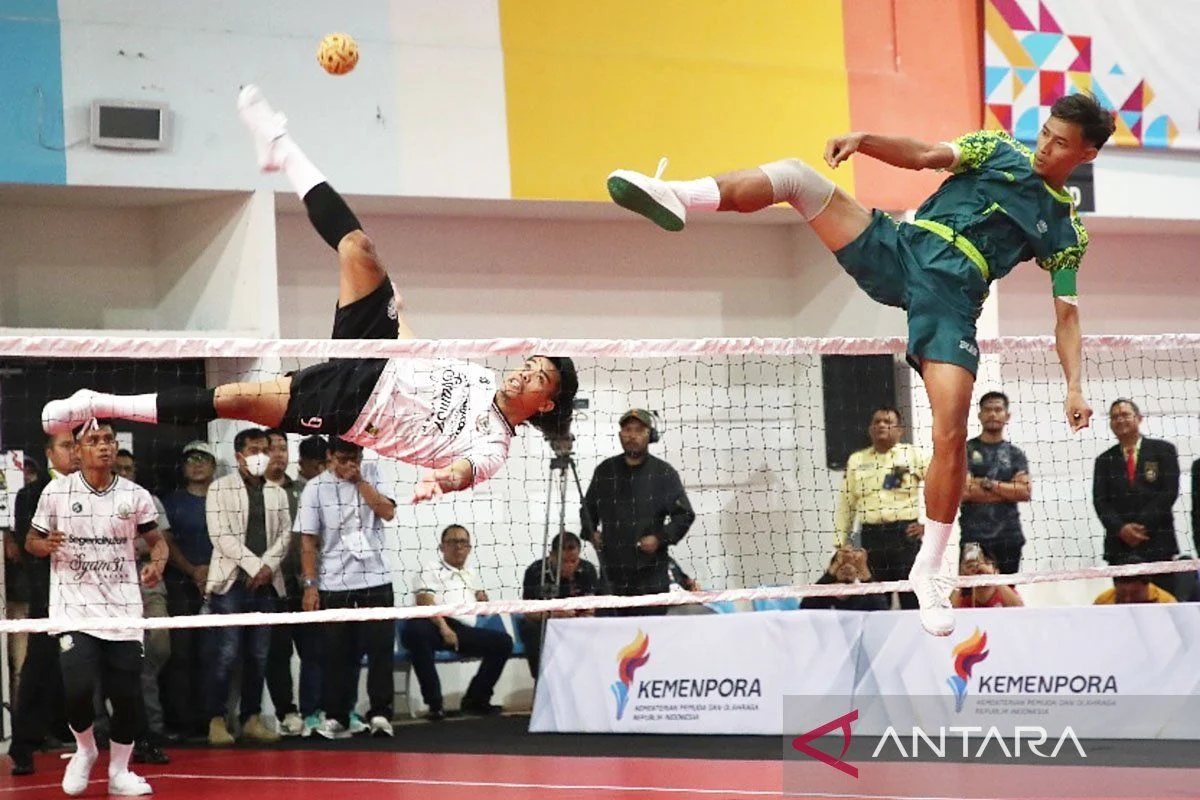
What if one could witness a sport that seamlessly blends the agile grace of volleyball with the acrobatic, foot-driven flair of football, all while strictly forbidding the use of hands? This is the essence of Sepak Takraw, a traditional Southeast Asian sport that continues to captivate audiences and athletes across a wide geographical spectrum, including Indonesia, Thailand, Malaysia, and the Philippines. Its unique blend of athleticism, strategy, and cultural heritage positions it as a compelling spectacle in the global sporting landscape.
The name "Sepak Takraw" itself is a linguistic tapestry, woven from the Malay word "Sepak," meaning "to kick," and the Thai word "Takraw," referring to a "woven rattan ball." Literally translated, the sport signifies "to kick a rattan ball." Its formal establishment as a recognized sport was solidified following a match between Malaysia and Thailand in Kuala Lumpur in 1960, marking a significant milestone in its modern evolution.
Prior to this formalization, the sport was known in Malaysia as Sepak Raga Jaring. The addition of "Jaring" (net) is attributed to Hamid Mydin, widely regarded as a foundational figure in the development of Sepak Takraw. In Penang, around 1945, Mydin introduced the net, distinguishing it from the traditional Sepak Raga game that was played without one. This innovation fundamentally altered the dynamics of the sport, introducing a vertical dimension and demanding a new level of aerial control and precision.
Often referred to as "kick volleyball" due to its striking visual similarities to its more globally recognized counterpart, Sepak Takraw is a team-based sport typically contested by two to four players per side. The playing field closely resembles that of a badminton court, a compact arena that emphasizes agility and quick reflexes. The fundamental rules of Sepak Takraw demand a high degree of bodily coordination, as players are exclusively permitted to use their feet, knees, shoulders, chest, and head to propel the ball over the net. This restriction, mirroring the core prohibition of hand use in football, forces athletes to develop extraordinary control and creative techniques for ball manipulation.
On the international stage, the governance and standardization of Sepak Takraw fall under the purview of the International Sepaktakraw Federation (ISTAF), established in 1988. ISTAF plays a crucial role in promoting the sport globally, organizing major tournaments, and ensuring uniform rules and regulations.
The sport is known by a variety of local names across different nations, reflecting its deep-rooted presence in regional cultures. In Indonesia, Brunei, Malaysia, and Singapore, it is commonly called Sepak Raga. The Philippines knows it as Sipa, while Myanmar’s version is Chinlone, and Thailand’s is Takraw. These regional appellations underscore the sport’s widespread appeal and its adaptation to diverse cultural contexts within Southeast Asia.
The Genesis of Sepak Takraw: A Journey Through Centuries
The origins of Sepak Takraw are believed to trace back to Malaysia approximately 500 years ago, gaining prominence within royal courts during the 15th century. This early adoption by the elite suggests a sport that was not only physically demanding but also possessed an aesthetic appeal, likely showcasing the prowess and discipline of its practitioners.
By the 16th century, the game had made its way to Indonesia, where it became known as Sepak Raga. Its popularity gradually spread throughout Southeast Asia, reaching a significant surge in the 1940s with the formalization of its rules. This period marked a transition from a traditional pastime to a more structured competitive sport.
The inaugural official competition of Sepak Takraw was held in Penang in 1945, under the banner of "Sepak Raga Jaring." This event was pivotal in standardizing the game and laying the groundwork for its future development. The establishment of the Malaysian Sepak Raga Federation in Penang in 1960 further cemented its organizational structure. A significant moment arrived in 1965 when Sepak Takraw was included in the Southeast Asian Peninsular Games (SEAP Games). It was during this major sporting event that the sport was officially christened "Sepak Takraw," a name that has since become globally recognized.
Interestingly, some historical accounts suggest that Sepak Takraw may have been introduced to Southeast Asia by Chinese traders, hinting at an even older and more complex lineage. Furthermore, there are compelling arguments for its shared ancestry with football, with some scholars positing that Sepak Takraw evolved from Cuju, an ancient Chinese game recognized by FIFA as an early precursor to modern football. Cuju, described as an ancient military exercise, involved soldiers kicking a leather ball with the objective of keeping it airborne for as long as possible, a skill that resonates strongly with the aerial demands of Sepak Takraw. This connection to football’s ancient roots adds another layer of historical intrigue to the sport.
Navigating the Court: Core Rules and Gameplay of Sepak Takraw
The modern game of Sepak Takraw is played on a rectangular court, precisely 13.4 meters long and 6.1 meters wide, divided by a net. The height of the net varies for men’s and women’s competitions: 1.52 meters at the center for men, and 1.42 meters for women. The court dimensions are identical to those used in badminton.
Each team consists of three players: a ‘Tekong’ (server) and two ‘Strikers’ (who operate in the front court). The positioning is strategic: the Tekong stands at the back, responsible for initiating play, while the two Strikers are positioned in front of the net, ready to receive and attack. This formation requires intricate teamwork and communication to effectively defend and launch offensive plays.
The Dance of the Rattan Ball: How Sepak Takraw is Played
1. The Initial Serve and Positional Dynamics
The game commences with a serve, initiated by the Tekong. The Tekong stands within a designated serving circle (a quarter-circle with a radius of 3 meters from the net post) and must serve the ball by kicking it over the net into the opponent’s court. Prior to the match, a coin toss determines which team has the initial serving advantage or opts to receive. The Tekong is crucial in setting the tone for the rally, delivering a serve that is both powerful and strategically placed to disrupt the opposing team.
2. The Flow of Play: An Aerial Ballet
Once the serve is in play, the rally unfolds with a rapid exchange of kicks, headers, and body maneuvers. Teams are allowed a maximum of three touches to return the ball to the opponent’s side. The objective is to land the ball within the boundaries of the opponent’s court in a way that they cannot legally return it. Players employ a breathtaking array of techniques, including overhead kicks, bicycle kicks, chest bumps, and knee-to-head passes, all executed with astonishing grace and precision. The ‘Killer’ (a powerful attacker) and the ‘Feeder’ (who sets up attacking opportunities) must work in tandem, orchestrating complex passing sequences and deceptive feints to outmaneuver their opponents. The Tekong, after serving, typically retreats to a defensive position to cover the backcourt.
3. The Scoring System: A Race to Victory
Points are awarded when a team successfully forces the ball to land in the opponent’s court, or if the opposing team commits a fault (e.g., hitting the ball out of bounds, touching the net, or using their hands). A standard set is won by the first team to reach 21 points, with a margin of at least two points required. If the score reaches 20-20, play continues until one team establishes a two-point lead. A match is typically decided by the best of three sets, meaning the first team to win two sets claims victory. This scoring system ensures intense and often dramatic contests, where a few critical plays can shift the momentum of an entire match.
Global Reach and Developmental Trajectory
While deeply rooted in Southeast Asia, Sepak Takraw is steadily gaining international recognition. ISTAF actively works to promote the sport in regions beyond its traditional stronghold. The sport’s inclusion in multi-sport events like the Asian Games and the Southeast Asian Games has been instrumental in raising its profile.
The development of Sepak Takraw is not without its challenges. Ensuring consistent global standards, providing adequate training facilities, and fostering professional leagues in emerging nations are ongoing efforts. However, the inherent excitement and unique appeal of the sport suggest a bright future. Its visual spectacle, demanding athleticism, and rich cultural heritage provide a strong foundation for continued growth and broader appeal. The growing number of national federations affiliated with ISTAF indicates a positive trajectory, with more countries actively engaging in the sport’s development and competition.
The "dualism" in Indonesian Sepak Takraw, as mentioned in the source material, refers to past organizational disputes that have since been resolved, a testament to the commitment of stakeholders to the sport’s progress. Such resolutions are vital for unified development and international competitiveness.
The global sporting community is increasingly recognizing Sepak Takraw not just as a regional curiosity, but as a legitimate and thrilling athletic discipline. Its ability to combine elements of familiar sports while offering a completely novel experience makes it a compelling proposition for both new fans and seasoned sports enthusiasts. As the sport continues to evolve, its blend of martial arts-like precision, acrobatic flair, and strategic team play promises to captivate audiences worldwide. The journey from a traditional game played with rattan balls to a globally recognized sport is a testament to the enduring appeal of athletic human achievement and the universal language of sport.
